A. Service Scope and Client Fit
A1We already had a GRC partner do DPDPA readiness. What does privacy advisory add?
DPDPA readiness gets the basics in place. Privacy advisory goes deeper where risk is highest: international transfers, DPIAs for new products, an ISO/IEC 27701 management system, breach decisions, consent design and AI. Codec Networks reuses any existing data map and records.
A2Which sub-service should we start with?
Usually the one closest to a deadline or a live risk: consent and notices for consumer businesses, transfers for companies with overseas vendors or group entities, DPIAs for a product launch, and breach readiness if you have never rehearsed a breach.
A3Are we a Data Fiduciary or a Data Processor?
It depends on who decides why and how personal data is processed. Many organisations are both, for different activities. Codec Networks maps your role for each activity as the first step.
A4What is a Significant Data Fiduciary?
A Data Fiduciary that the Central Government notifies as significant, based on factors such as the volume and sensitivity of data and risks to individuals. Significant Data Fiduciaries have extra duties, including an India-based DPO, periodic DPIAs and audits.
A5We are a SaaS company processing data for global customers. Is this relevant?
Yes. As a processor you need processor controls, sub-processor oversight, transfer mechanisms and breach notice to your customers. ISO/IEC 27701 certification and SCCs help answer customer due diligence.
A6Can you help our product team without slowing releases?
Yes. Codec Networks builds a short DPIA screening checklist and privacy by design checkpoints into your existing release process, so only high-risk changes need a full DPIA.
A7Do you cover employee data as well as customer data?
Yes. HR, payroll, monitoring and recruitment data are personal data too, and are often shared with several vendors and countries.
A8Can you act as our Data Protection Officer?
Codec Networks provides DPO-as-a-service and supports appointed DPOs. Where the law requires a named officer based in India, such as for Significant Data Fiduciaries, Codec Networks advises on the appointment and supports that officer.
B. Laws, Rules and Regulatory Alignment
B1When do the DPDP obligations apply?
The DPDP Rules 2025 were notified on 13 November 2025 with phased commencement. Consent manager provisions follow after twelve months and most Data Fiduciary obligations after eighteen months, in May 2027.
B2Can we transfer personal data outside India?
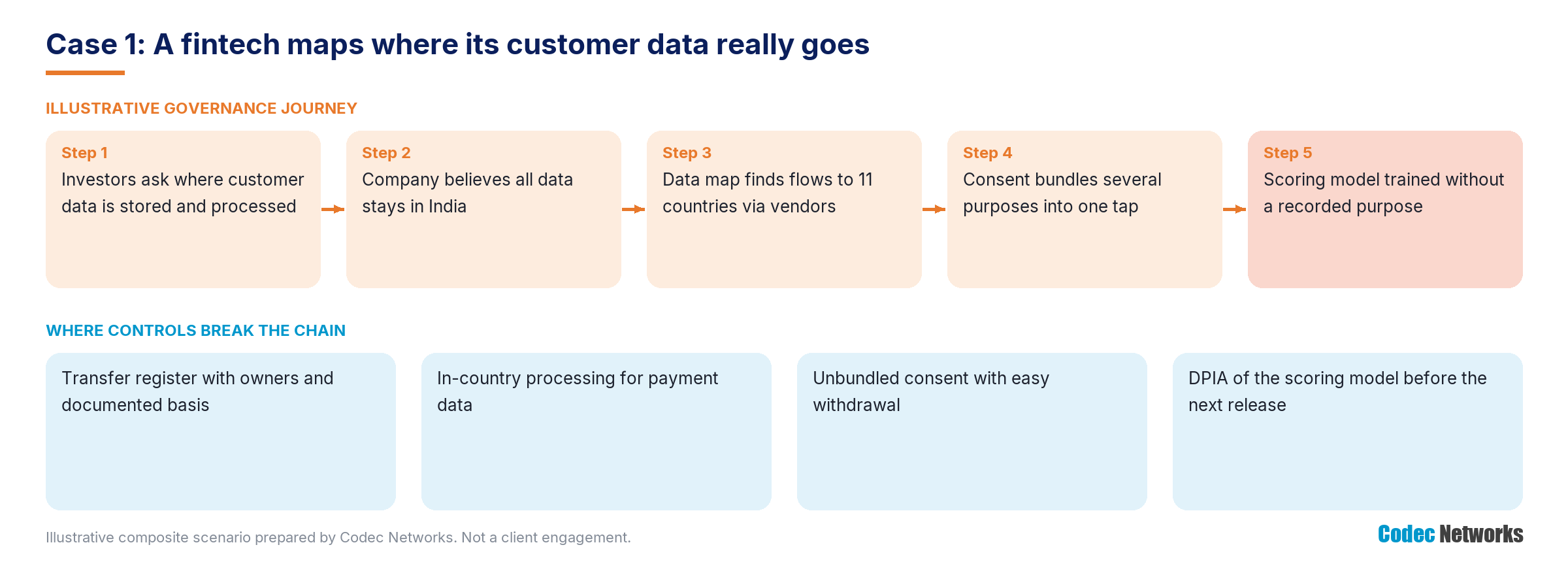
As general information: Section 16 of the DPDP Act allows transfers except to countries the Central Government restricts, and the DPDP Rules 2025 can add conditions. Sector rules, such as RBI's 2018 direction on storage of payment system data, may require some data to stay in India.
B3What must a breach notification under the DPDP regime contain?
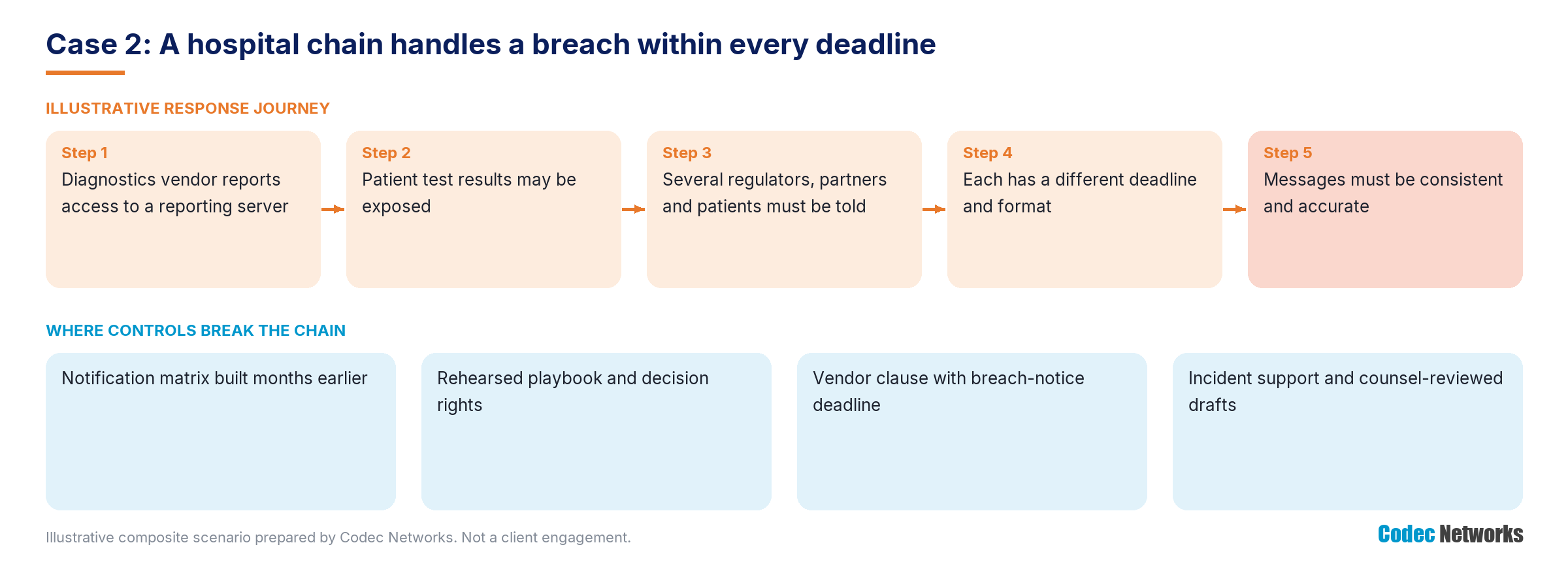
As general information: the DPDP Act requires intimation of a personal data breach to the Data Protection Board and to each affected Data Principal, and the DPDP Rules 2025 set out the form, content and timeline. Codec Networks builds templates from the notified text; counsel should confirm them.
B4How do CERT-In's 2022 Directions interact with DPDP breach duties?
They run in parallel. CERT-In's Directions of 28 April 2022 require specified cyber incidents to be reported within six hours. A personal data breach may trigger both CERT-In reporting and DPDP intimation, as well as sector and contractual notices.
B5Does GDPR apply to an Indian company?
It can, if you offer goods or services to people in the EU or monitor their behaviour (GDPR Article 3(2)), or process personal data for EU-based customers as a processor.
B6What changed in ISO/IEC 27701:2025?
The 2025 edition, published in October 2025, is a standalone standard, so organisations can certify a privacy management system without first certifying to ISO/IEC 27001. It can still be integrated with an existing ISMS.
B7What rules apply to children's data?
The DPDP Act requires verifiable consent of a parent or lawful guardian before processing a child's personal data and prohibits tracking, behavioural monitoring and targeted advertising directed at children, subject to exemptions in the Rules. Penalties for breach of these duties can reach ₹200 crore.
B8Are dark patterns regulated in India?
Yes. The Central Consumer Protection Authority issued guidelines on the prevention and regulation of dark patterns in November 2023. Codec Networks reviews consent and checkout journeys against them, for client information.
C. Engagement Approach and Delivery
C1How does an engagement start?
With a scoping call and a document request covering notices, contracts, system lists and any existing records. Codec Networks then agrees the scope, plan and RACI with your DPO or privacy lead.
C2How do you build a data map without disrupting teams?
Through short workshops with system and process owners, existing documentation and, where agreed, tool-assisted discovery. Each owner typically spends a few hours.
C3Will Codec Networks see our customers' personal data?
Only where an engagement needs it, such as testing a rights request. Access is minimised and handled under Codec Networks' ISO/IEC 27001:2022 certified ISMS, with agreed deletion afterwards.
C4Who writes our privacy notices and consent text?
Codec Networks drafts them in clear language, your legal counsel reviews them and your teams publish them. Codec Networks also tests the journeys on each channel.
C5How do you run a DPIA?
Codec Networks screens the initiative, describes the processing with the owner, assesses necessity and risks, recommends measures and records residual risk and the approval, following ISO/IEC 29134 practice.
C6How is a breach tabletop run?
Codec Networks presents a realistic scenario with timed injects, and the team decides on containment, notification and communication against each deadline. Gaps are recorded and the playbook is updated.
C7How do you review AI use cases for privacy?
By inventorying the use case, its data and decisions, reviewing the lawful basis of training and inference data, testing for leakage and re-identification, and recommending controls and governance.
C8Do you work with our law firm?
Yes. Codec Networks provides the data map, technical facts and drafts; your law firm gives legal opinions. This keeps legal advice where it belongs and avoids duplicated work.
D. Commercials, Timelines and Effort
D1How is pricing decided?
By the level you choose (Basic, Medium or Advanced) and by scope drivers such as entities, systems, channels, countries, processors and AI use cases. Document 7 gives indicative bands; a written proposal confirms them after scoping.
D2How long does a privacy baseline take?
Typically four to eight weeks for a data map of key systems, a gap list against the DPDP Act and other applicable laws, and a plan to May 2027.
D3What does a single DPIA cost?
A DPIA for one initiative is usually part of a Basic or Medium package; DPIAs can also be bought per initiative under a privacy retainer.
D4How long does ISO/IEC 27701 certification take?
Typically four to eight months to certification readiness, followed by the certification body's Stage 1 and Stage 2 audits. It is faster if an ISO/IEC 27001 ISMS already exists.
D5How is DPO-as-a-service priced?
As a monthly retainer based on the volume of rights requests, DPIAs, vendor reviews and Board reporting, typically from ₹2 lakh to ₹8 lakh a month.
D6Are certification body and tool fees included?
No. Certification body fees, consent platform licences and other third-party costs are paid by the client and listed separately in proposals.
D7Do bundles cost less?
Yes. The Privacy Starter, DPDP Ready and Privacy Programme bundles cost less than their parts because the data map, records and workshops are reused.
D8How quickly can you support a live breach?
Clients on an incident retainer get assured response hours. Others are supported as quickly as Codec Networks' incident response team is available.
E. Evidence, Reporting and Ongoing Support
E1What will leadership receive?
A quarterly privacy pack: data map changes, rights requests and response times, DPIAs completed, transfers added, breaches and notifications, and decisions required.
E2What evidence will the Data Protection Board expect?
Typically records showing notices, consent, security safeguards, breach handling and, for Significant Data Fiduciaries, DPIAs and audits. Codec Networks builds and maintains these records in one repository.
E3How do we keep records of processing current?
Through owners for each activity, a change trigger in projects and procurement, and quarterly reviews under a retainer.
E4How are rights requests measured?
By volume, type and time to respond, with exceptions explained. These metrics appear in the quarterly pack.
E5How often should we test the breach playbook?
At least once a year, and after major changes to systems, vendors or laws. Codec Networks plans tabletops in the retainer.
E6Will you track changes in the DPDP Rules and other laws?
Yes. Under a retainer, Codec Networks tracks changes to the DPDP Rules, sector directions and foreign laws and updates notices, clauses and playbooks.
E7Can the outputs help with customer audits?
Yes. The data map, records, DPIAs, ISO/IEC 27701 certificate and transfer documents answer most customer privacy questionnaires.
E8Will Codec Networks help after a breach is notified?
Yes. Codec Networks' incident response and forensics teams can support investigation, follow-up questions from regulators and customers, and the lessons-learned review.