

Resources Categories

INDUSTRY FACT FILE · AI, ANALYTICS & AUTOMATION
Main Products and Services in AI, Analytics and Automation
What AI, analytics and automation providers offer, the systems behind each product and where they create cybersecurity and compliance exposure.
|
In this document 1. How AI firms earn their money 2. Products by player type 3. Building AI: data, models and pipelines 4. Running AI: assistants, retrieval and agents 5. The systems behind the products and services 6. Trends that change the attack surface 7. Mapping AI products to Codec Networks engagements |
1. How AI firms earn their money
|
Revenue stream |
How it works |
Security relevance |
|
AI product subscriptions |
Per-seat or per-usage fees for AI products |
Abuse and cost attacks affect revenue |
|
API and token usage |
Fees per call or token |
Denial-of-wallet and key theft |
|
Custom AI projects |
Build and integration for enterprises |
Access to client data and systems |
|
Analytics services |
Platforms and managed analytics |
Large sensitive datasets |
|
Automation outcomes |
Fees tied to processes automated |
Automated actions carry business risk |
2. Products by player type
|
Player type |
Main products |
Data and access involved |
|
AI product firms |
Domain models, assistants, document AI, voice AI |
Training data, user prompts, model weights |
|
Chatbot and agent developers |
Customer service bots, copilots, autonomous agents |
Customer data, tools and system credentials |
|
Analytics providers |
BI, predictive models, decision engines |
Enterprise data warehouses |
|
Automation providers |
RPA bots, intelligent document processing |
Credentials to business applications |
|
Enterprise adopters |
Internal copilots, customer bots, AI-assisted decisions |
Employee and customer data |
3. Building AI: data, models and pipelines
AI systems are built from data, base models and pipelines. Training and fine-tuning data may contain personal or confidential information; base models are often downloaded from public hubs; and MLOps pipelines move data and models between environments. Each step can introduce privacy violations, poisoned data or malicious models.
4. Running AI: assistants, retrieval and agents
In production, assistants answer users through chat and APIs, retrieval-augmented generation (RAG) pulls in documents from enterprise sources, and agents call tools that can send emails, change records or run code. Every input the system reads—including documents and web pages—can carry hidden instructions.
|
Highest-risk moments Untrusted content entering prompts, retrieval across users or tenants, agent tool calls and model downloads are where AI systems are most often compromised. |
5. The systems behind the products and services
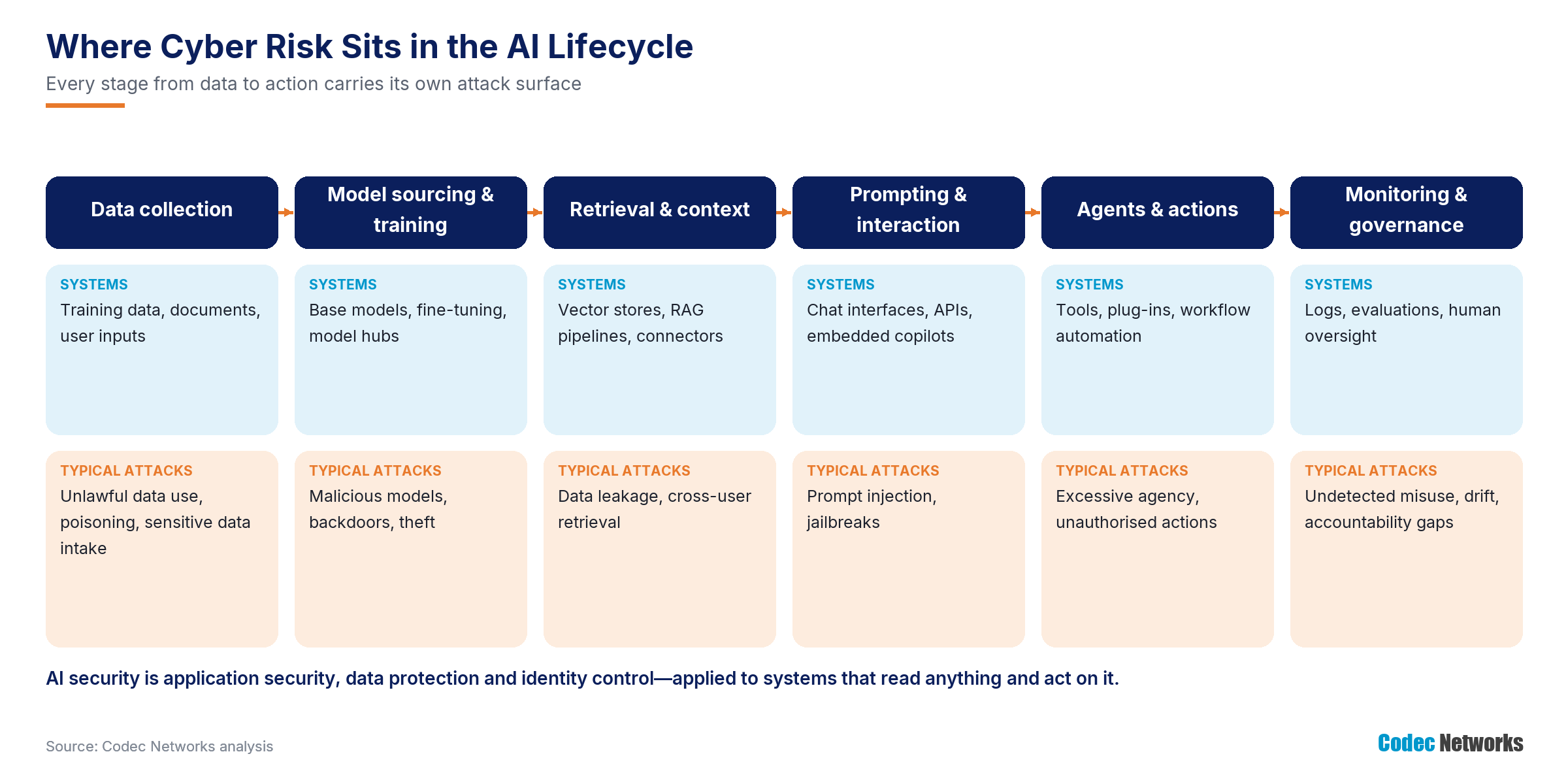
Figure 2: Where cyber risk sits in the AI lifecycle.
|
Product / service |
Systems that deliver it |
Key cyber and compliance touchpoints |
|
Data pipelines |
Data lakes, labelling tools, ETL |
Lawful basis, PII redaction, poisoning checks |
|
Model sourcing and training |
Model hubs, training clusters |
Provenance, scanning, access control |
|
Retrieval |
Vector stores, connectors, search indexes |
Per-user authorisation, leakage testing |
|
Interaction layer |
Chat UIs, APIs, embedded copilots |
Prompt injection and jailbreak testing |
|
Agents and tools |
Plug-ins, function calling, workflow engines |
Least privilege, approvals, sandboxing |
|
Monitoring |
Logs, evaluations, feedback loops |
Abuse detection, audit trails |
6. Trends that change the attack surface
|
Trend |
What is changing |
Security implication |
|
Agentic AI |
Agents act across systems with tools |
Excessive agency becomes a top risk |
|
RAG everywhere |
AI grounded in enterprise documents |
Cross-user retrieval leakage |
|
Open-weight models |
Self-hosted open models |
Model supply-chain and hosting risks |
|
Synthetic media |
Cheap, convincing deepfakes |
Impersonation fraud; labelling rules |
|
AI regulation and standards |
Guidelines, IT Rules, EU AI Act, ISO/IEC 42001 |
Governance evidence required |
7. Mapping AI products to Codec Networks engagements
|
If the organisation builds or uses… |
Recommended starting engagement |
|
A customer chatbot or copilot |
Prompt injection, jailbreak and output leakage testing |
|
RAG over enterprise documents |
Retrieval authorisation and leakage testing |
|
AI agents with tool access |
Agent permission and approval review, sandbox testing |
|
Fine-tuned or self-hosted models |
Training-data privacy review, model supply-chain review |
|
AI in regulated decisions |
Model risk and governance assessment |
Talk to Codec Networks
|
Contact Codec Networks Pvt. Ltd. New Delhi: 507, 5th Floor, New Delhi House, Barakhamba Road, Connaught Place, New Delhi – 110001 Gurugram: 707, 7th Floor, Silverton Tower, Golf Course Extension Road, Sector 50, Gurugram – 122018, Haryana Landline: 011 430 496 96 | 011 437 522 99 Mobile: +91 99716 76124 | +91 88007 88220 | +91 88003 31124 Email: mktg@codecnetworks.com Web: www.codecnetworks.com |
Note: Descriptions are general and based on public information available as of October 2026.