

Resources Categories
INDUSTRY FACT FILE · AI, ANALYTICS & AUTOMATION
Threat Landscape: Top Cyber Threats Facing AI Builders and Adopters
The 18 most relevant AI threats, attacks and challenges for AI product firms, chatbot and agent developers, analytics providers and enterprise AI adopters.
|
In this document 1. The threat picture in numbers 2. Top 18 threats, attacks and challenges 3. Threat relevance by AI segment 4. Five priority threats in depth 5. Impact on AI builders, adopters and users 6. How regulation turns incidents into business events 7. Questions every leadership team should ask |
1. The threat picture in numbers
|
~US$25m Reported 2024 loss from a deepfaked executive video call |
2024 Tribunal held an airline liable for its chatbot's advice |
6 hours To report cyber incidents to CERT-In |
May 2027 Most DPDP obligations take effect |
AI systems widen the attack surface in three ways: they read untrusted content, they hold or retrieve sensitive data, and they increasingly take actions. Prompt injection, data leakage and excessive agency now sit alongside classic application and cloud threats.
Widely reported cases illustrate the impact: in 2024 a multinational firm reportedly lost about US$25 million after a video call with deepfaked executives, a Canadian tribunal held an airline liable for its chatbot's incorrect advice, and in 2023 engineers at a large electronics firm pasted confidential code into a public chatbot.
2. Top 18 threats, attacks and challenges
The list below is a practical assessment framework, not a statistical ranking. Priority varies by business model, technology exposure and existing controls.
|
# |
Threat / attack / challenge |
Typical scenario |
Most exposed |
Potential impact |
|
1 |
Direct prompt injection and jailbreaks |
Users craft prompts to bypass guardrails |
Chatbots and copilots |
Harmful output and policy bypass |
|
2 |
Indirect prompt injection |
Hidden instructions in emails, documents or web pages |
Assistants, RAG apps, agents |
Data theft and unauthorised actions |
|
3 |
Sensitive data leakage |
AI reveals personal, confidential or system data |
All AI applications |
Privacy and confidentiality breaches |
|
4 |
Excessive agency |
Agents act beyond intended scope |
Agent and automation platforms |
Unsafe or destructive actions |
|
5 |
Cross-user retrieval leakage |
RAG returns documents users should not see |
Enterprise copilots |
Internal data exposure |
|
6 |
Training-data privacy violations |
Personal data used without lawful basis |
AI product firms |
DPDP exposure and model withdrawal |
|
7 |
Data and model poisoning |
Manipulated data or fine-tuning |
Model builders |
Backdoored behaviour |
|
8 |
Malicious models and AI supply chain |
Tampered model files or libraries |
Teams using open models |
Code execution and theft |
|
9 |
Model theft and extraction |
Weights stolen or behaviour cloned via APIs |
AI product firms |
IP loss |
|
10 |
Deepfake and impersonation fraud |
Synthetic voices and video of executives |
Enterprises and BFSI |
Fraudulent payments |
|
11 |
Insecure plug-ins and connectors |
Weak authorisation in tools agents call |
Agent ecosystems |
Lateral access |
|
12 |
Shadow AI |
Staff use unapproved AI tools |
Enterprise adopters |
Data leakage |
|
13 |
Hallucination and harmful output |
Confident but wrong or unsafe answers |
Customer-facing bots |
Liability and harm |
|
14 |
Bias and unfair outcomes |
Discriminatory decisions |
Analytics and BFSI adopters |
Regulatory and reputational harm |
|
15 |
Denial of wallet and resource abuse |
Abuse drives up compute costs |
AI APIs and products |
Financial loss |
|
16 |
System prompt and secret exposure |
Prompts reveal configuration or keys |
AI applications |
Further compromise |
|
17 |
Weak AI logging and oversight |
No audit trail of AI decisions and actions |
Most adopters |
Undetected misuse |
|
18 |
Insecure AI infrastructure |
Exposed notebooks, model servers and vector stores |
AI platforms |
Data and model theft |
3. Threat relevance by AI segment
The matrix is a qualitative guide for prioritising the first round of security reviews.
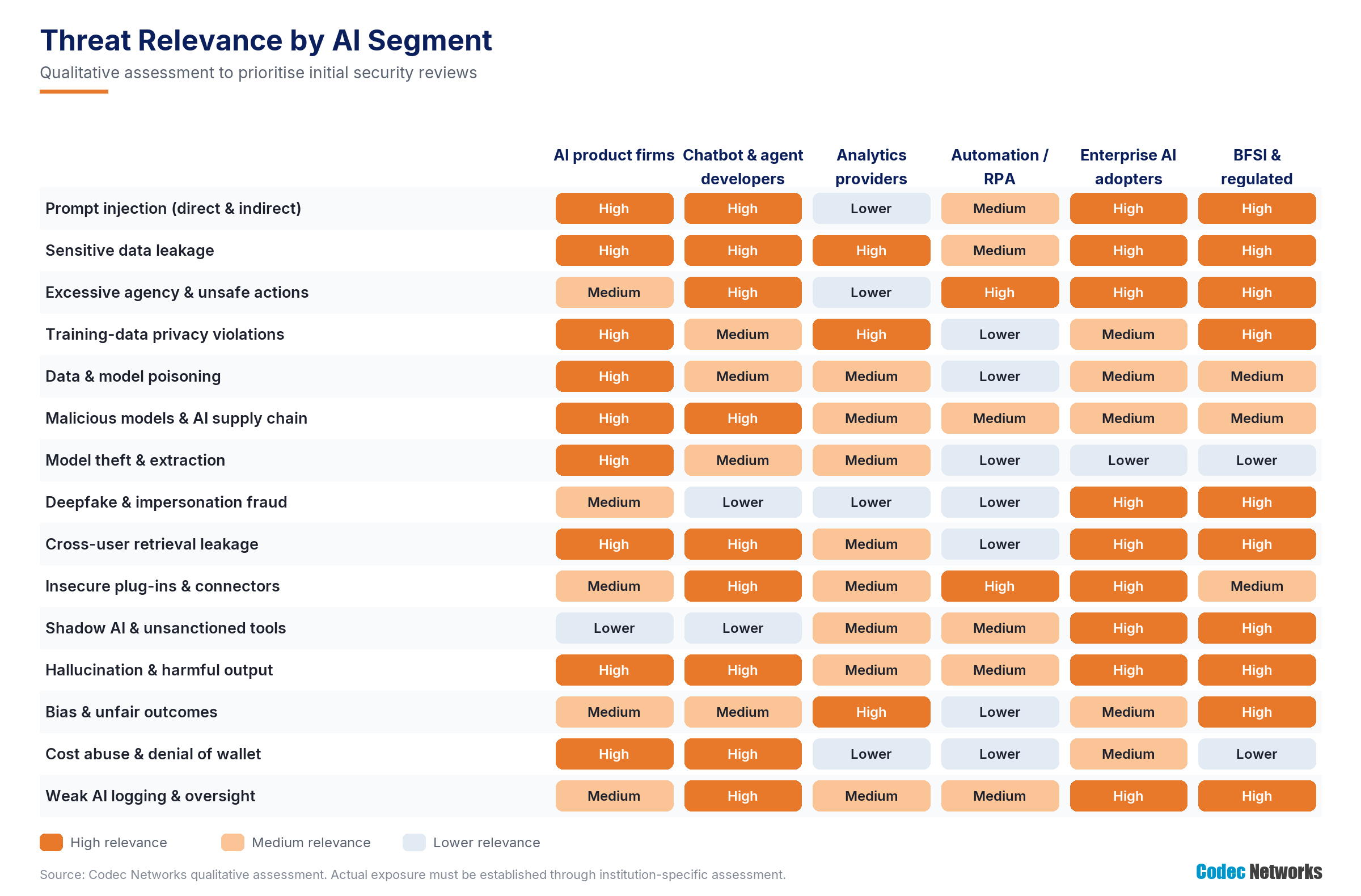
Figure 5: Qualitative threat relevance by AI segment (Codec Networks assessment).
4. Five priority threats in depth
4.1 Indirect prompt injection
When AI reads emails, tickets, documents or web pages, attackers can hide instructions that the model follows—leaking data or triggering tools.
- Questions to test: Is untrusted content separated from instructions? Are tool calls constrained and approved? Is output filtered for sensitive data?
- Relevant services: indirect prompt injection testing, RAG and agent reviews, output filtering, monitoring.
4.2 Excessive agency
Agents given broad credentials 'to save time' can be steered into destructive or fraudulent actions.
- Questions to test: Are agent permissions scoped to the task? Do high-impact actions require human approval? Is there a kill switch and full action logging?
- Relevant services: agent security review, sandbox testing, approval controls.
4.3 Data leakage and retrieval
RAG systems often index documents without preserving per-user permissions, so a copilot may answer with content the user should never see.
- Questions to test: Does retrieval enforce the requesting user's permissions? Are outputs tested for leakage? Are system prompts and secrets protected?
- Relevant services: retrieval authorisation testing, leakage testing, secrets review.
4.4 Training data and DPDP
Fine-tuning on customer conversations or scraped data can violate data protection law and cause models to repeat personal details.
- Questions to test: Is there a lawful basis and notice for training data? Is PII redacted? Has memorisation been tested?
- Relevant services: DPDPA review for AI data, PII redaction, memorisation testing.
4.5 Model supply chain and deepfakes
Open model files can carry malicious code, and synthetic media enables convincing impersonation for fraud.
- Questions to test: Are models scanned and sourced from approved registries? Are payment instructions verified out of band?
- Relevant services: model supply-chain review, deepfake simulations, payment control testing.
5. Impact on AI builders, adopters and users
|
Player type |
Threats to prioritise |
Main impact |
|
AI product firms |
Training-data privacy, model theft, supply chain |
Regulatory exposure and IP loss |
|
Chatbot and agent developers |
Prompt injection, excessive agency |
Customer harm and liability |
|
Analytics providers |
Data leakage, bias |
Client loss and regulatory scrutiny |
|
Enterprise adopters |
Shadow AI, retrieval leakage, deepfakes |
Data loss and fraud |
|
End users |
Harmful or wrong answers, scams |
Financial and personal harm |
6. How regulation turns incidents into business events
- CERT-In: cyber incidents affecting AI systems reported within six hours.
- IT Rules: intermediaries must label synthetic content and act quickly on flagged unlawful content under the 2026 amendment.
- Privacy: personal data breaches involving AI must be intimated to the Data Protection Board once DPDP breach provisions commence in May 2027.
- Sector regulators: BFSI and other regulated adopters may face supervisory scrutiny of AI failures.
- Customers: contracts may require notification and remediation of AI incidents.
|
Insight Treat every input to an AI system as untrusted and every action it can take as privileged. Most serious AI incidents come from what the system was allowed to read or do, not from the model itself. |
7. Questions every leadership team should ask
- What happens if our AI reads a malicious instruction in an email or document?
- Which actions can our agents take without human approval?
- Does our retrieval layer respect each user's permissions?
- Do we have a lawful basis and redaction for data used to train our models?
- Where do our models come from, and are they scanned before use?
- Would a deepfaked executive on a video call be able to order a payment?
Talk to Codec Networks
|
Contact Codec Networks Pvt. Ltd. New Delhi: 507, 5th Floor, New Delhi House, Barakhamba Road, Connaught Place, New Delhi – 110001 Gurugram: 707, 7th Floor, Silverton Tower, Golf Course Extension Road, Sector 50, Gurugram – 122018, Haryana Landline: 011 430 496 96 | 011 437 522 99 Mobile: +91 99716 76124 | +91 88007 88220 | +91 88003 31124 Email: mktg@codecnetworks.com Web: www.codecnetworks.com |
Note: Threat descriptions and relevance ratings are general guidance, not findings about any specific organisation. Public incident references are summarised from widely reported events.