

Resources Categories
INDUSTRY FACT FILE · AUTOMOTIVE & MOBILITY
Threat Landscape: Top Cyber Threats Facing Automotive and Mobility
The 18 most relevant cyber threats, attacks and industry challenges for OEMs, component suppliers, EV and battery makers, charging networks, dealers, mobility platforms and fleet providers, and the impact each one has.
|
In this document 1. The threat picture in numbers 2. Top 18 threats, attacks and challenges 3. Threat relevance by automotive and mobility segment 4. Five priority threats in depth 5. Impact on OEMs, suppliers, dealers, platforms and vehicle owners 6. How regulation turns incidents into business events 7. Questions every leadership team should ask |
1. The threat picture in numbers
|
Sep 2025 Cyberattack halted JLR's global production for ~5 weeks |
£1.9 bn Estimated UK economic cost of the JLR attack (CMC) |
Jun 2024 CDK Global attack put ~15,000 dealerships on paper |
6 hours To report incidents to CERT-In |
Automotive attracts ransomware groups because plants, suppliers and dealers cannot stop without immediate, visible loss; it attracts data thieves because dealers, apps and fleets hold customer, financial and location data at scale; and it attracts researchers and criminals alike because flaws in apps, APIs and telematics reach the vehicle itself. The attack surface spans PLM and software pipelines, just-in-time suppliers, plant OT, shared dealer platforms, OTA systems, charging back-ends and fleet telematics.
Recent incidents show the pattern. Toyota (2022) lost a day of output at 14 plants when one supplier was hit; CDK Global (2024) put about 15,000 dealerships on paper for two weeks and reportedly paid a US$25 million ransom; Jaguar Land Rover (2025) halted global production for about five weeks at an estimated economic cost of £1.9 billion; and researchers have shown in several OEM cases that dealer-portal and app API flaws allow vehicles to be located, unlocked and started remotely. In India, an automotive engineering-services company disclosed a ransomware incident in early 2025.
2. Top 18 threats, attacks and challenges
The list below is a practical assessment framework, not a statistical ranking. Priority varies by business model, technology exposure and existing controls.
|
# |
Threat / attack / challenge |
Typical scenario |
Most exposed |
Potential impact |
|
1 |
Ransomware halting plants |
ERP, MES, plant and corporate systems encrypted; production stops |
OEMs, suppliers, EV makers |
Weeks of lost output, lender and Board scrutiny |
|
2 |
Supplier outage stopping lines |
A tier-n supplier's incident breaks just-in-time supply |
OEMs, tier-1s |
Line stoppage without being attacked directly |
|
3 |
Dealer platform outage |
A shared DMS or finance platform is encrypted or breached |
Dealers, OEMs, finance partners |
Sales and registrations on paper; data exposure |
|
4 |
Remote vehicle access via apps and APIs |
Authorisation flaws let attackers bind to and control vehicles |
OEMs, EV makers, mobility platforms |
Safety, theft and brand damage |
|
5 |
OTA and software supply chain compromise |
Tampered updates, compromised build pipelines or signing keys |
OEMs, tier-1s, EV makers |
Fleet-wide vehicle compromise |
|
6 |
Charging backend and OCPP attacks |
Weak admin interfaces and protocols controlling chargers and tariffs |
Charging networks |
Chargers offline, fraud, payment data loss |
|
7 |
Design and platform IP theft |
CAD, ECU software, battery and platform designs stolen |
OEMs, suppliers, EV start-ups |
Lost competitive advantage |
|
8 |
OEM and vendor remote access abuse |
Robot, PLC, MES and telematics vendors' standing access hijacked |
Plants, charging networks |
Logic changes, downtime |
|
9 |
Flat IT/OT plant networks |
No separation between corporate IT and plant systems |
OEM and supplier plants |
Office malware reaching robots and PLCs |
|
10 |
Phishing and credential theft |
Staff, dealer and vendor accounts targeted |
All companies |
Initial access |
|
11 |
Business email compromise |
Fraudulent supplier and dealer payment changes |
All companies |
Direct financial loss |
|
12 |
Customer and driver data theft |
Dealer, app, finance and fleet data exfiltrated |
Dealers, platforms, fleets |
DPDP breach, fraud, reputational damage |
|
13 |
Telematics and GPS manipulation |
Spoofed locations, abused immobiliser or geofence commands |
Fleets, logistics, ride-hailing |
Unsafe commands, theft, disputes |
|
14 |
Keyless and relay vehicle theft |
Relay and key-fob attacks, diagnostic-port exploits |
OEMs, owners, insurers |
Vehicle theft, warranty and insurance costs |
|
15 |
Counterfeit parts and firmware |
Untrusted components and software entering the supply chain |
OEMs, suppliers, workshops |
Safety and recall exposure |
|
16 |
Cloud and SaaS misconfiguration |
Exposed vehicle data stores, excessive permissions, leaked keys |
OEMs, platforms, fleets |
Mass data exposure |
|
17 |
Weak OT detection and response |
No visibility into plants, vehicle commands or remote sessions |
Most companies |
Long dwell time; missed 6-hour reporting |
|
18 |
Backup and recovery failure |
Backups encrypted, untested, missing PLC and robot programs |
Plants |
Weeks of downtime |
3. Threat relevance by automotive and mobility segment
The matrix is a qualitative guide for prioritising the first round of security reviews.
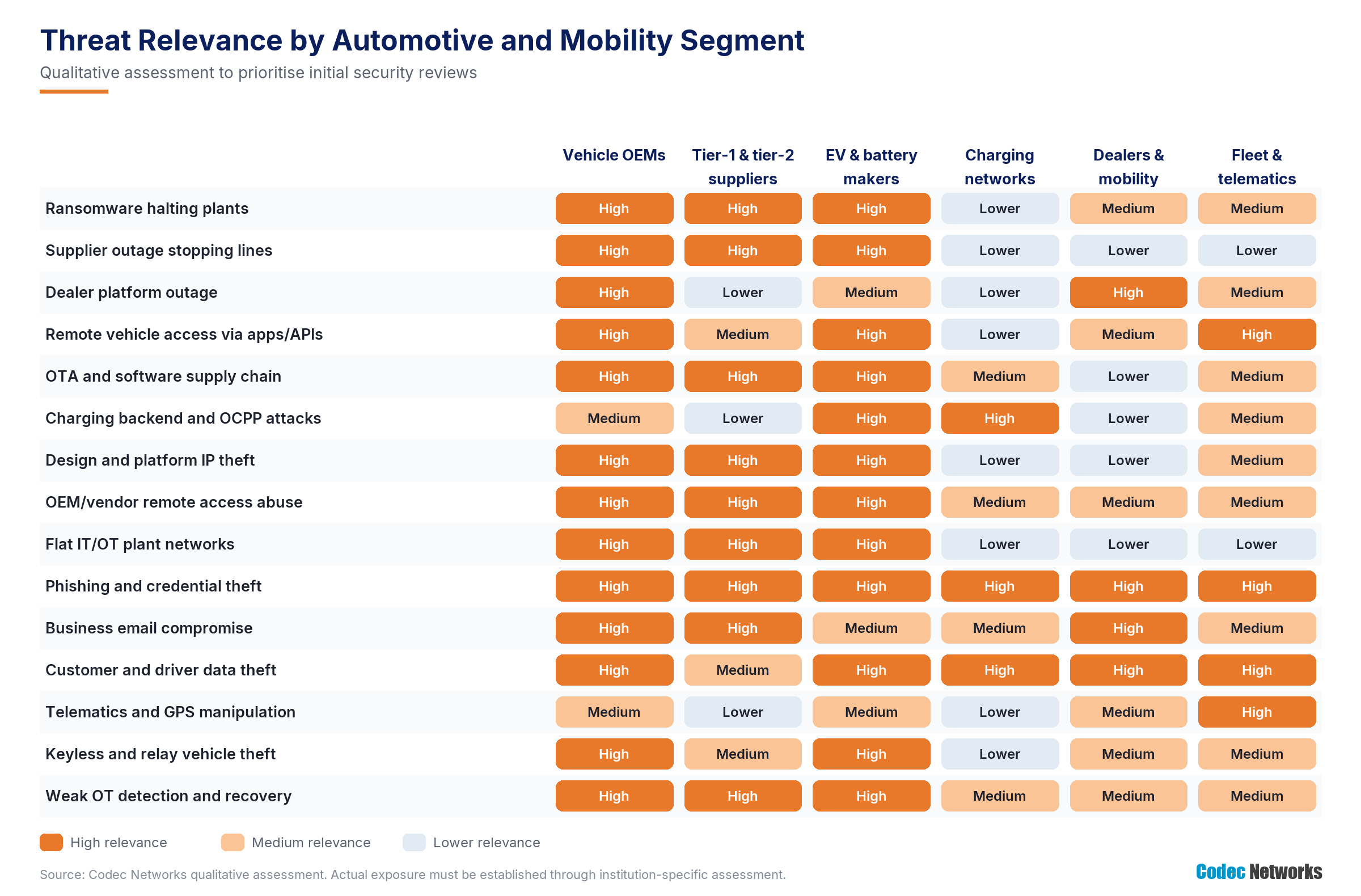
Figure 5: Qualitative threat relevance by automotive and mobility segment (Codec Networks assessment).
4. Five priority threats in depth
4.1 Ransomware across the OEM ecosystem
JLR's 2025 shutdown showed how one intrusion can stop every plant, freeze dealers and idle thousands of suppliers for weeks. Entry is often through a supplier's or vendor's credentials rather than the OEM's own perimeter.
- Questions to test: Can plants run if corporate IT is down? Are backups immutable and restores tested for ERP, MES and dealer systems? Do we monitor supplier and vendor identities? Have we rehearsed a multi-week outage with suppliers and dealers?
- Relevant services: segmentation, backup and recovery testing, identity monitoring, SOC, ecosystem crisis exercises.
4.2 Apps, APIs and the vehicle
Companion apps and dealer portals usually share back-end APIs. Authorisation flaws in vehicle binding, ownership transfer or dealer functions have repeatedly let researchers control cars by VIN or number plate.
- Questions to test: Have app and dealer APIs been tested for authorisation flaws? Are vehicle commands rate-limited and monitored? Is there a vulnerability disclosure process and a vehicle-affecting incident playbook?
- Relevant services: API and app testing, TARA, command monitoring, disclosure and incident processes.
4.3 OTA and the software supply chain
OTA turns a compromised build pipeline or signing key into a fleet-wide compromise. AIS 190 and UN R156 require a managed software update process.
- Questions to test: Who can sign and release updates? Are pipelines and keys protected? Is there an SBOM for each ECU? Can updates be rolled back safely?
- Relevant services: OTA pipeline review, signing and key management, SBOM and dependency review, SUMS readiness.
4.4 Charging and payments
Charge point operators run back-ends that command thousands of chargers and take card payments; weak admin interfaces and OCPP implementations expose both.
- Questions to test: Is the backend admin interface hardened with MFA and segmented? Are charger credentials unique and firmware managed? Are payment flows PCI DSS aligned?
- Relevant services: backend and OCPP assessment, charger firmware review, payment security.
4.5 Detection, reporting and the 6-hour clock
CERT-In requires reporting within six hours; listed companies disclose quarterly; AIS 189 expects monitoring of vehicle cyber threats in the field. Plants and vehicle clouds are often unmonitored.
- Questions to test: Do we monitor plants, vehicle commands and remote sessions 24x7? Is there a playbook covering containment, safe plant operation, vehicle-affecting incidents, CERT-In reporting and disclosure?
- Relevant services: IT/OT SOC with vehicle-cloud monitoring, playbooks, joint drills.
5. Impact on OEMs, suppliers, dealers, platforms and vehicle owners
|
Player type |
Threats to prioritise |
Main impact |
|
Vehicle OEMs |
Ecosystem ransomware, vehicle-reaching flaws, OTA compromise |
Multi-week stoppage, safety events, disclosure |
|
Component suppliers |
Ransomware, OEM audit failure, IP theft |
Lost contracts, line stoppages at customers |
|
EV and charging companies |
Firmware and backend weaknesses, payment data |
Stranded drivers, fraud, regulatory engagement |
|
Dealers and platforms |
DMS outages, data theft, fraud |
Sales on paper, DPDP breaches, lost trust |
|
Fleets and vehicle owners |
Data exposure, unsafe commands, theft |
Operational disruption, personal harm, insurance costs |
6. How regulation turns incidents into business events
- CERT-In: incidents reported within six hours of noticing them.
- AIS 189/190 (once notified): vehicle cyber incidents and software update failures become type-approval and field-monitoring matters with MoRTH and test agencies.
- SEBI LODR: listed OEMs and suppliers disclose cyber incidents quarterly.
- DPDP: incidents involving customer, vehicle, location or driver data trigger breach intimation once provisions commence in May 2027.
- OEM and export customers: contracts require incident notification; UN R155 markets and the EU CRA require vulnerability and incident reporting for connected products.
- Payment networks and insurers: charging and dealer payment incidents trigger PCI DSS obligations; insurers require prompt notification.
|
Insight Automotive incidents cross boundaries fast—from a supplier into the OEM, from the OEM into every dealer, and from an app into the car. Strong boundaries, tested recovery and monitoring of plants and vehicle clouds are the best defence. |
7. Questions every leadership team should ask
- If corporate IT went dark tonight, would our plants and dealers keep working?
- Which supplier or platform provider could stop us, and have we assessed them?
- Could an attacker reach a vehicle through our app, dealer portal or telematics API?
- Who can sign and release an OTA update, and is the pipeline protected?
- Are our chargers, back-ends and payment flows tested and monitored?
- Are we ready for AIS 189/190, and could we report an incident to CERT-In within six hours?
Talk to Codec Networks
|
Contact Codec Networks Pvt. Ltd. New Delhi: 507, 5th Floor, New Delhi House, Barakhamba Road, Connaught Place, New Delhi – 110001 Gurugram: 707, 7th Floor, Silverton Tower, Golf Course Extension Road, Sector 50, Gurugram – 122018, Haryana Landline: 011 430 496 96 | 011 437 522 99 Mobile: +91 99716 76124 | +91 88007 88220 | +91 88003 31124 Email: mktg@codecnetworks.com Web: www.codecnetworks.com |
Note: Threat descriptions and relevance ratings are general guidance, not findings about any specific organisation. Public incident references are summarised from widely reported events and company disclosures.