

Resources Categories
INDUSTRY FACT FILE · CREDIT INFORMATION & FINANCIAL DATA
Threat Landscape: Top Cyber Threats Facing Credit Information and Financial Data Firms
The 18 most relevant cyber threats, attacks and industry challenges for credit bureaus, analytics firms, KYC utilities and financial data processors in India.
|
In this document 1. The threat picture in numbers 2. Top 18 threats, attacks and challenges 3. Threat relevance by credit data segment 4. Five priority threats in depth 5. Impact on credit data firms and consumers 6. How regulation turns incidents into business events 7. Questions every leadership team should ask |
1. The threat picture in numbers
|
₹19,813 cr Reported cyber-fraud losses in 2025, all channels (I4C data) |
6 hours To report incidents to CERT-In |
Fortnightly Bulk credit data transfers from every lender |
May 2027 Most DPDP obligations take effect |
Credit and identity data is the raw material of loan fraud, synthetic identities and targeted scams. Attackers target bureau APIs with stolen member credentials, insiders export analytics datasets, and misconfigured cloud and test environments leak records at scale. Reports based on I4C data put cyber-fraud losses across all channels at about ₹19,813 crore in 2025.
Integrity is as important as confidentiality: a tampered submission file can rewrite credit histories and corrupt lending decisions across the system.
2. Top 18 threats, attacks and challenges
The list below is a practical assessment framework, not a statistical ranking. Priority varies by business model, technology exposure and existing controls.
|
# |
Threat / attack / challenge |
Typical scenario |
Most exposed |
Potential impact |
|
1 |
Bulk data exfiltration |
Large-scale theft of credit, identity and enquiry data |
Bureaus, analytics firms, processors |
Mass exposure, fraud and regulatory action |
|
2 |
API abuse and unauthorised pulls |
Reports pulled without consent or valid purpose |
Bureaus and report consumers |
Data misuse and scams |
|
3 |
Member credential theft |
Lender API keys or portal logins stolen |
Bureaus and their members |
Unauthorised access at scale |
|
4 |
Submission-file tampering |
Credit data altered before or during upload |
Lenders and bureaus |
Corrupted credit histories |
|
5 |
Insider misuse |
Staff or analysts export data for resale |
Analytics firms and bureaus |
Data theft and legal exposure |
|
6 |
Identity fraud and synthetic IDs |
Stolen data used to build fake identities |
All players |
Fraudulent loans and disputes |
|
7 |
Ransomware and extortion |
Encryption and theft of data platforms |
Bureaus, KYC utilities, processors |
Outages and extortion |
|
8 |
Cloud and data-lake misconfiguration |
Public storage or over-broad permissions |
Cloud-based platforms |
Data exposure |
|
9 |
Test and analytics data leakage |
Production data copied to non-production environments |
Processors and analytics firms |
Uncontrolled exposure |
|
10 |
Third-party and vendor compromise |
Breach at processors, cloud or analytics vendors |
All players |
Downstream exposure |
|
11 |
Consumer account takeover |
Phished credentials on consumer portals |
Bureaus with consumer services |
Report access and fraudulent disputes |
|
12 |
Fraudulent disputes and corrections |
Social engineering to alter records |
Bureaus and lenders |
Integrity loss |
|
13 |
Model tampering and AI misuse |
Manipulated models or training data |
Analytics firms |
Wrong credit decisions |
|
14 |
Phishing and brand impersonation |
Fake 'credit score' sites and messages |
Bureaus and fintechs |
Consumer harm |
|
15 |
Weak logging and detection |
Gaps in monitoring of pulls and exports |
Smaller processors |
Missed 6-hour reporting |
|
16 |
Insecure file transfer |
Weak SFTP, shared accounts or email transfers |
Lenders and processors |
Interception and tampering |
|
17 |
Excessive data retention |
Data kept beyond purpose and contract |
All players |
Larger breach impact and DPDP exposure |
|
18 |
Backup and recovery failure |
Untested or reachable backups |
Bureaus and KYC utilities |
Extended outages |
3. Threat relevance by credit data segment
The matrix is a qualitative guide for prioritising the first round of security reviews.
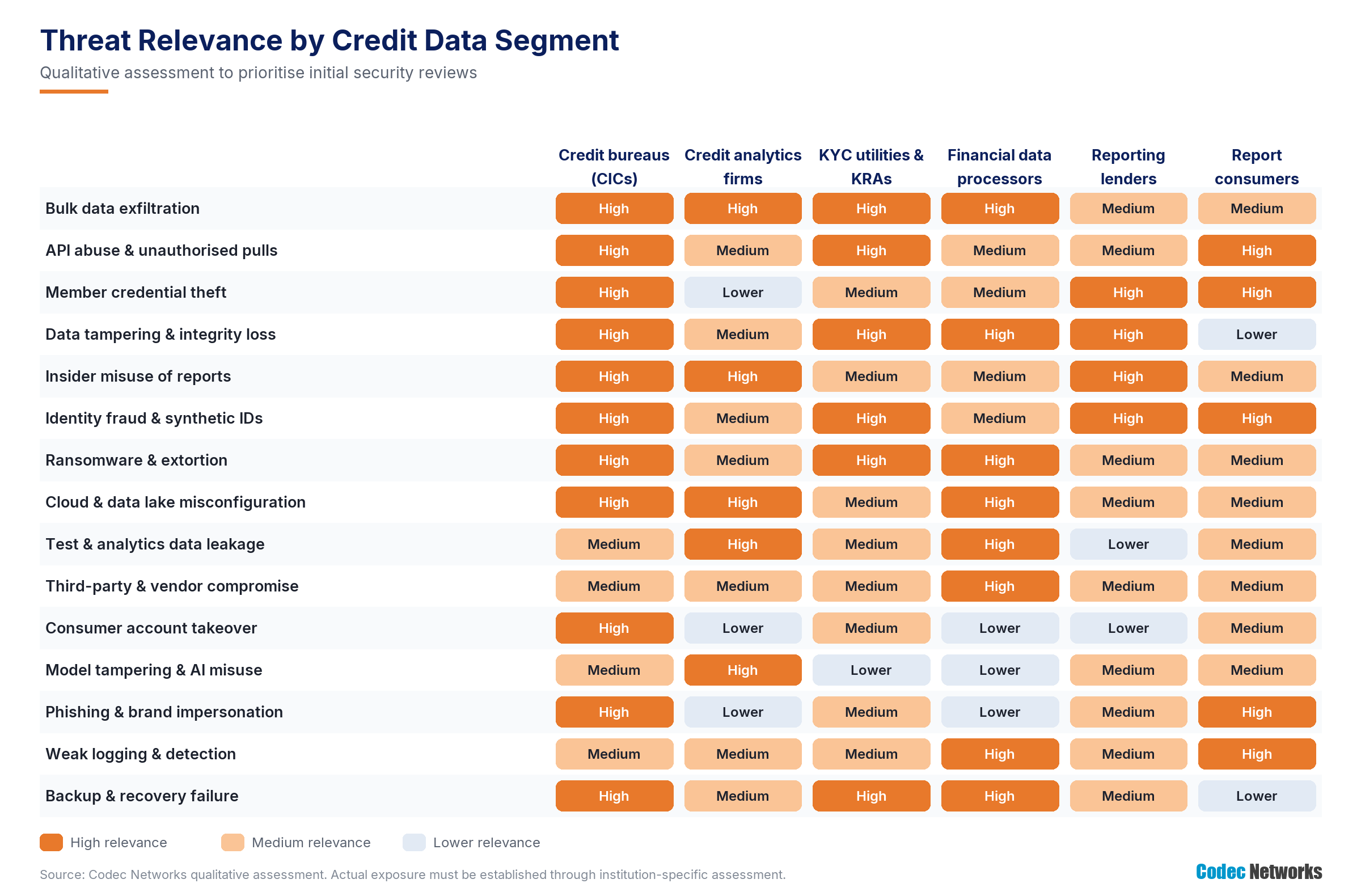
Figure 5: Qualitative threat relevance by credit data segment (Codec Networks assessment).
4. Five priority threats in depth
4.1 Member credential and API abuse
Bureaus serve thousands of member institutions. A single leaked API key or shared portal login can be used to pull reports quietly for weeks, often staying below simple rate limits.
- Questions to test: Are member credentials vaulted and rotated? Are pulls baselined per member and checked against consent and purpose? Can a member be revoked instantly?
- Relevant services: API security testing, secrets management review, SOC use cases, member assurance.
4.2 Insider exports from analytics environments
Analysts and data scientists need large datasets, and broad warehouse access makes bulk export easy. Leaked segments end up with lead sellers and fraud rings.
- Questions to test: Is access purpose-bound and least-privilege? Are exports, uploads and email monitored? Is data masked in sandboxes?
- Relevant services: data access reviews, DLP and UEBA, insider simulation, forensic readiness.
4.3 Integrity of submission files
Credit histories are only as reliable as the files lenders submit. Collusive insiders or attackers can change repayment status, clearing defaults for selected borrowers.
- Questions to test: Are files hashed and signed? Are uploads reconciled to lenders' core systems? Are unusual status changes flagged?
- Relevant services: data integrity assessment, pipeline review, anomaly detection.
4.4 Cloud, test and analytics leakage
Production KYC and credit data copied into test or analytics environments often lacks production controls, and public storage remains a common cause of exposure.
- Questions to test: Is non-production data masked or synthetic? Is cloud storage monitored for public exposure? Is there an inventory of all data copies?
- Relevant services: cloud and data-lake review, leakage assessment, posture monitoring.
4.5 Detection and the 6-hour clock
CERT-In requires reporting within six hours of noticing an incident, and RBI and members expect prompt notice. Without monitoring of pulls, exports and privileged activity, leaks are found late—often by outsiders.
- Questions to test: Are API, warehouse and privileged logs centralised? Are there playbooks for leaks and member compromise?
- Relevant services: managed SOC, playbooks, tabletop exercises, IR retainer.
5. Impact on credit data firms and consumers
|
Player type |
Threats to prioritise |
Main impact |
|
Credit bureaus |
Bulk exfiltration, member abuse, tampering |
Systemic trust and regulatory action |
|
Analytics firms |
Insider exports, sandbox leakage |
Client loss and contract disputes |
|
KYC utilities and KRAs |
Identity data leakage, ransomware |
National-scale identity exposure |
|
Data processors |
Cloud misconfiguration, vendor compromise |
Client exposure and liability |
|
Consumers |
Scams and identity fraud using leaked data |
Financial loss and damaged credit |
6. How regulation turns incidents into business events
- CERT-In: incidents reported within six hours of noticing them.
- RBI and SEBI: incidents and control failures may trigger supervisory scrutiny and reporting under the applicable Directions and frameworks.
- Members and clients: contracts typically require prompt notification and may trigger audits or suspension.
- Privacy: once DPDP breach provisions commence in May 2027, personal data breaches must be intimated to the Data Protection Board, with a detailed report within 72 hours.
- Consumers: affected individuals may raise disputes and complaints.
|
Insight In credit data, integrity failures can be as damaging as leaks. A tampered record changes lending decisions long after the incident—so integrity controls deserve the same attention as access controls. |
7. Questions every leadership team should ask
- Who can pull, query or export our data today, and when was access last recertified?
- Would we detect a member key pulling reports at an unusual pace?
- Could a tampered submission file change a credit history without detection?
- Do any production copies of credit or KYC data sit in test or analytics environments?
- Could we report a leak to CERT-In within six hours?
- Which vendors hold our data, and do our contracts allow us to audit them?
Talk to Codec Networks
|
Contact Codec Networks Pvt. Ltd. New Delhi: 507, 5th Floor, New Delhi House, Barakhamba Road, Connaught Place, New Delhi – 110001 Gurugram: 707, 7th Floor, Silverton Tower, Golf Course Extension Road, Sector 50, Gurugram – 122018, Haryana Landline: 011 430 496 96 | 011 437 522 99 Mobile: +91 99716 76124 | +91 88007 88220 | +91 88003 31124 Email: mktg@codecnetworks.com Web: www.codecnetworks.com |
Note: Threat descriptions and relevance ratings are general guidance, not findings about any specific organisation. I4C figures cover all channels. Regulatory references are summaries; confirm against the official instruments.