

Resources Categories
INDUSTRY FACT FILE · DRONES, ROBOTICS & AUTONOMOUS SYSTEMS
Threat Landscape: Top Cyber Threats Facing Drone and Robotics Businesses
The 18 most relevant cyber threats, attacks and industry challenges for drone and component makers, drone operators, robotics and warehouse automation firms, autonomous delivery businesses and fleet software providers, and the impact each has.
|
In this document 1. The threat picture in numbers 2. Top 18 threats, attacks and challenges 3. Threat relevance by drone, robotics and autonomy segment 4. Five priority threats in depth 5. Impact on drone makers, operators, robotics firms and their customers 6. How regulation turns incidents into business events 7. Questions every leadership team should ask |
1. The threat picture in numbers
|
6 Airports beyond Delhi reporting GNSS interference (Dec 2025) |
4 Robot models exposed by one 2025 wireless setup flaw |
Dec 2025 US adds foreign-made drones to the FCC Covered List |
6 hours To report incidents to CERT-In |
Drone and robotics businesses face attackers with very different aims. Criminal groups use ransomware against manufacturers, integrators and software platforms because downtime in production, delivery or a customer's warehouse creates pressure to pay. Espionage actors seek designs, flight code, AI models and imagery of sensitive sites, and are interested in where drones fly and what they see. Opportunistic attackers scan the internet for exposed fleet consoles, robot controllers, remote desktop services and storage buckets. Researchers and hobbyists find flaws in pairing, links and firmware, which become public quickly. Insiders and contractors with shared pilot or administrator accounts can misuse fleets and data. Satellite navigation can be degraded or falsified by interference that operators do not control, and hostile use of drones themselves, as in the June 2021 attack on the Air Force Station in Jammu that the NIA investigated, has made security agencies and critical sites more cautious about who flies near them.
Public reporting shows how these risks are moving. DGCA issued an advisory circular on GNSS interference in November 2023 after reports over West Asian airspace, and in December 2025 the government confirmed GPS spoofing near Delhi's airport and interference reports from six other major Indian airports, directed the Wireless Monitoring Organisation to trace sources and issued a reporting procedure. In September 2025 researchers disclosed a Bluetooth setup flaw in four commercial quadruped and humanoid robot models that allowed nearby attackers to run code with full privileges. Governments are acting on supply chain concerns: India restricted Chinese-made components in military drones according to Reuters, US agencies issued guidance in 2024, and the US FCC added foreign-produced drones and critical components to its Covered List in December 2025. Each of these turns into questions from customers, regulators and investors about firmware, links, navigation, fleet platforms and data.
2. Top 18 threats, attacks and challenges
The list below is a practical assessment framework, not a statistical ranking. Priority varies by business model, technology exposure and existing controls.
|
# |
Threat / attack / challenge |
Typical scenario |
Most exposed |
Potential impact |
|
1 |
Firmware tampering and unsigned updates |
Modified firmware or update packages loaded onto flight or robot controllers |
Drone makers, robotics firms, component makers |
Unsafe behaviour, backdoors, fleet-wide compromise |
|
2 |
Insecure command, control and telemetry links |
Unencrypted or weakly authenticated radio links intercepted or taken over |
Operators, delivery fleets, inspection services |
Loss of control, intercepted video and data |
|
3 |
GNSS jamming and spoofing exposure |
Interference that degrades or falsifies satellite positioning during missions |
Delivery, survey and BVLOS operators |
Fly-aways, mission failure, safety incidents |
|
4 |
Ground control station and pilot device compromise |
Malware or remote access tools on laptops, tablets and phones that plan and fly missions |
Survey, inspection and agricultural services |
Hijacked missions, stolen imagery and credentials |
|
5 |
Fleet management and cloud console takeover |
Stolen admin credentials or misconfigured consoles that control many drones or robots |
Fleet software, delivery fleets, warehouse robotics |
Fleet-wide outage or misuse |
|
6 |
API and mobile app flaws in drone and robot platforms |
Broken authorisation in pilot apps, customer portals and mission or partner APIs |
Fleet software providers, drone-as-a-service firms |
Cross-tenant data exposure, unauthorised missions |
|
7 |
Aerial imagery and survey data exposure |
Imagery, maps and video of critical sites and people left in open or shared storage |
Survey, mapping and inspection operators |
DPDP exposure, client and security concerns |
|
8 |
Component, SDK and supply chain provenance risk |
Components, radios, cameras or SDKs with hidden data flows or unknown origins |
Drone makers, suppliers to government and defence |
Disqualification, data leakage, recalls |
|
9 |
Robot controller and ROS middleware attacks |
Unauthenticated middleware or exposed controllers that accept injected commands |
Robotics firms, factories, research labs |
Unsafe motion, damaged equipment, downtime |
|
10 |
Warehouse automation and AMR fleet disruption |
Ransomware or misconfiguration halting fleet managers, WMS links and sorters |
Warehouse robotics firms and their 3PL customers |
Fulfilment stoppage, SLA penalties |
|
11 |
Wireless pairing, Bluetooth and Wi-Fi setup flaws |
Hard-coded keys or weak pairing that let nearby attackers take over devices |
Service robots, consumer and prosumer drones |
Device takeover, spread between devices |
|
12 |
Vendor remote access and support tunnels |
Always-on vendor tunnels and shared support accounts into robot cells and fleets |
Robotics integrators, plants, warehouses |
Unmonitored access, OT compromise |
|
13 |
Ransomware on engineering and production IT |
Encryption of design files, ERP and production systems at makers and integrators |
Drone makers, component makers, robotics firms |
Delivery delays, lost IP, missed tenders |
|
14 |
Theft of designs, flight code and AI models |
Theft of source code, designs, test data and trained models by outsiders or leavers |
OEMs, start-ups, autonomy developers |
Lost advantage, cloned products |
|
15 |
Manipulation of AI perception and autonomy |
Poisoned training data, adversarial inputs or tampered models affecting navigation or detection |
Autonomous inspection, delivery and robotics |
Wrong decisions, safety risk |
|
16 |
Insider misuse and shared pilot or admin accounts |
Shared logins on ground apps and consoles, unrevoked access, misuse of flight data |
Operators, training organisations, agri services |
Untraceable actions, data misuse |
|
17 |
Integrity of registration, permission and flight records |
Tampered or poorly protected UIN, permission, maintenance and flight log records |
Operators, manufacturers, training organisations |
Regulatory action, disputed incidents |
|
18 |
Weak logs, monitoring and 6-hour reporting |
No telemetry, cloud, device and OT logging or 24x7 monitoring |
Smaller operators, start-ups, integrators |
Missed reporting, unprovable timelines |
3. Threat relevance by drone, robotics and autonomy segment
The matrix is a qualitative guide for prioritising the first round of security reviews.
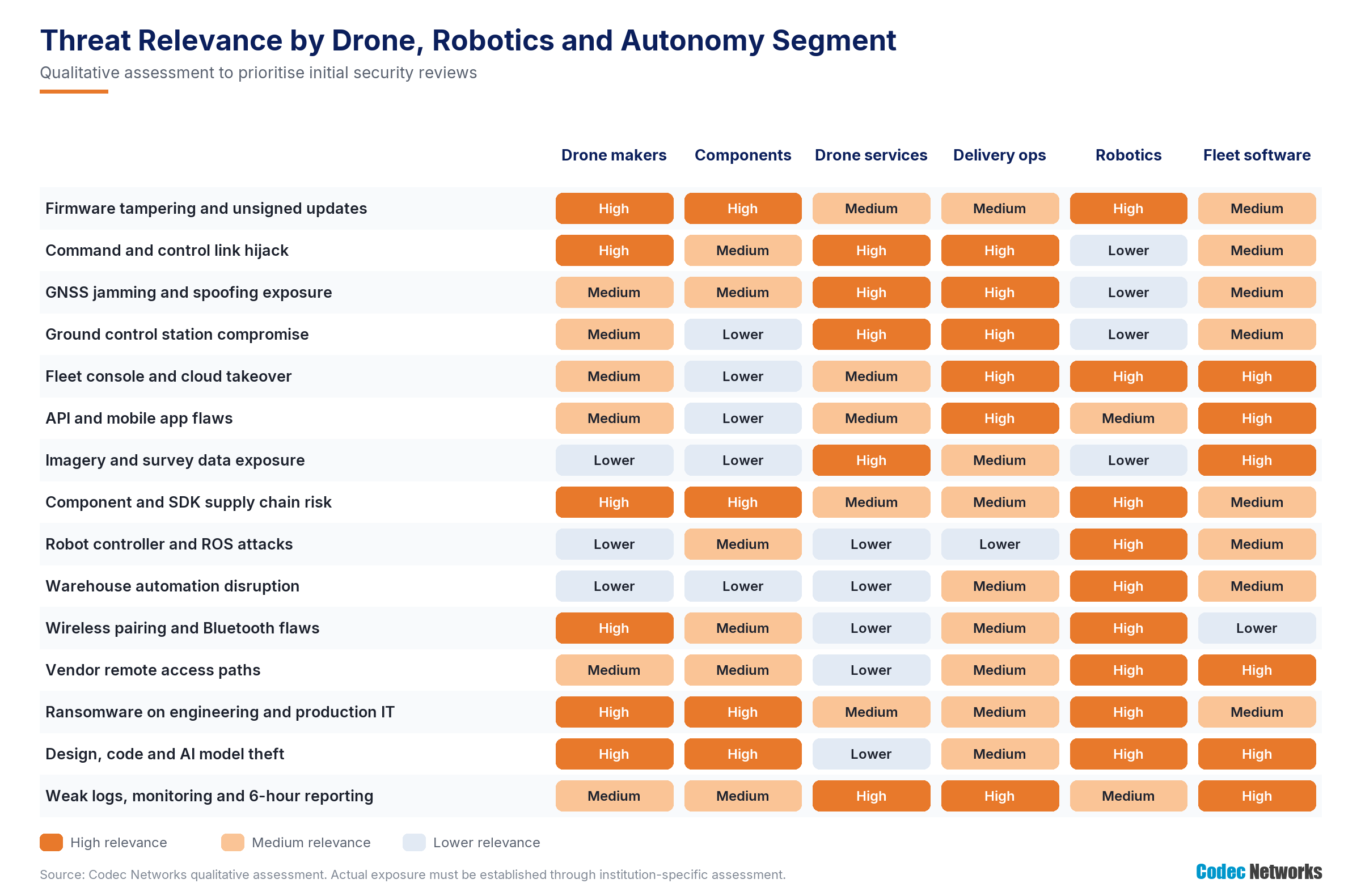
Figure 5: Qualitative threat relevance by drone, robotics and autonomy segment (Codec Networks assessment).
4. Five priority threats in depth
4.1 Firmware, updates and the build pipeline
The most efficient way to compromise a fleet is through its updates. A manufacturer that signs firmware with a key stored on a build server, or whose drones and robots accept unsigned or downgraded images, gives anyone who breaches that server a route to every unit in the field. Hardware debug ports left open on production boards and component firmware from suppliers without update or vulnerability processes add to the risk. Because these devices move, a tampered update can cause safety incidents as well as data theft.
- Questions to test: Where are signing keys held, and who can use them? Do devices reject unsigned and rolled-back firmware at boot? Are updates staged and watched in telemetry before full release? Are debug interfaces locked on production units? Do suppliers patch their components?
- Relevant services: firmware and secure boot review, update signing and pipeline review, hardware interface testing, supplier and SBOM assessments, and incident response for update compromise.
4.2 Links, ground stations and fleet consoles
Command, telemetry and video links, the apps that plan and fly missions and the cloud consoles that manage fleets are the control path of every drone and robot. Weak pairing, unencrypted links, unmanaged pilot phones, shared accounts and exposed consoles let attackers watch, interfere with or redirect operations. Fleet platforms concentrate this risk: one stolen administrator credential or broken API check can affect every customer and every vehicle on the platform.
- Questions to test: Are links encrypted and mutually authenticated? Are ground station devices managed and hardened? Is every console account named and protected with MFA? Is tenant isolation tested in every release? Would we notice an unusual mission change or geofence edit within minutes?
- Relevant services: link and RF security testing, ground control app and device testing, fleet cloud and API VAPT, cloud configuration and identity review, and managed SOC monitoring of consoles and telemetry.
4.3 Navigation resilience under interference
Satellite navigation is a shared, external dependency. DGCA's circular describes how jamming can deny position information and spoofing can supply false positions, and Indian airports reported both kinds of interference in 2025. Delivery, inspection and BVLOS drones need to detect when position is unreliable, cross-check with inertial, visual or other sensors and fall back to safe behaviour. These defences can only be verified through authorised testing in controlled environments, coordinated with the customer and any required regulatory permissions.
- Questions to test: How heavily do our drones depend on a single navigation source? Do they detect position jumps and integrity loss? Are fail-safes, geofences and return behaviours tested and documented? Do pilots know how to report interference? Do our logs preserve evidence of what happened?
- Relevant services: authorised navigation resilience testing in controlled environments, sensor cross-check and fail-safe design review, flight log and evidence review, and operator awareness and reporting playbooks.
4.4 Robot cells, AMR fleets and vendor access
Robotics deployments connect robot controllers, safety systems, fleet managers and warehouse systems on networks that were often designed for convenience. Middleware such as ROS can accept commands from any node on the network if it is not secured, robots may expose services over Wi-Fi or Bluetooth, and vendors keep remote support tunnels to tune fleets. Ransomware on a fleet management server or a phished support account can halt a warehouse or a production line, and unsafe commands can damage equipment.
- Questions to test: Are robot networks segmented from office and warehouse IT? Are ROS and controller interfaces authenticated and restricted? Is vendor access named, time-bound, recorded and protected with MFA? Can we rebuild a fleet manager from tested backups? Have we mapped zones and conduits under IEC 62443?
- Relevant services: OT and robot cell assessments aligned with IEC 62443, AMR fleet and ROS exposure reviews, vendor remote access review, backup and recovery testing, and SOC monitoring of remote sessions.
4.5 Data, imagery and supply chain trust
Survey and inspection imagery shows critical sites, operating details and people, and flight data reveals where and when operators fly. Shared folders, laptops and client portals often hold it with weak controls, which creates DPDP exposure and worries for utility and government clients. Supply chain trust is the other side of the same question: buyers and foreign regulators increasingly ask where components, SDKs and cloud services come from and where data flows, and makers must be able to answer with evidence.
- Questions to test: Do we know where all imagery and flight data is stored and who can reach it? Are people blurred or minimised where possible? Do client contracts define retention and handling? Do we hold SBOMs and provenance records for components and SDKs? Are hidden data flows tested?
- Relevant services: cloud storage and data handling review, DPDP programme for imagery and pilot data, supply chain and component provenance assessment, firmware data flow analysis and supplier assurance.
5. Impact on drone makers, operators, robotics firms and their customers
|
Player type |
Threats to prioritise |
Main impact |
|
Drone and component makers |
Firmware and update compromise, supply chain, ransomware, IP theft |
Recalls, lost tenders and certification delays, export barriers |
|
Survey, inspection and agri operators |
Ground station compromise, imagery exposure, shared accounts |
Lost contracts, DPDP exposure, client distrust |
|
Delivery and autonomous fleets |
Link and console compromise, GNSS interference, API flaws |
Safety incidents, grounded fleets, client and regulator scrutiny |
|
Robotics and warehouse automation |
Fleet server ransomware, vendor access abuse, controller attacks |
Halted operations, SLA penalties, equipment damage |
|
Fleet and traffic software providers |
Tenant isolation failures, console takeover, data leaks |
Multi-customer incidents, contract claims, loss of trust |
|
Customers and the public |
Unsafe behaviour, exposed imagery, privacy intrusion |
Physical harm risk, privacy harm, loss of confidence |
6. How regulation turns incidents into business events
- CERT-In: incidents reported within six hours of noticing them; logs kept for 180 days in India and available for investigation; CERT-In may issue directions and advisories.
- DGCA and the Drone Rules: safety occurrences, unauthorised operations and compromised records can lead to scrutiny of permissions, certificates and type certification; GNSS interference is reported under DGCA procedures.
- Customers and tenders: utilities, government buyers and enterprises can suspend contracts or disqualify suppliers after incidents or provenance concerns.
- Law enforcement: misuse of drones, intrusions and data theft lead to police complaints and requests for flight logs and evidence.
- DPDP Act: breach intimation and safeguards for personal data in imagery and records once provisions commence; SEBI LODR disclosure for listed makers.
- Export markets: products sold in the EU face CRA vulnerability and incident reporting from September 2026; US authorisation rules affect drones and critical components.
|
Insight The most damaging drone and robotics incidents rarely need exotic attacks. They begin with an update key on a build server, a shared console password, a vendor tunnel left open, a public storage folder or a navigation fail-safe nobody tested, and end as unsafe behaviour, a halted fleet or a leak that costs the next tender. Testing firmware, links, platforms, fail-safes and access together is the best defence. |
7. Questions every leadership team should ask
- If our build or update server were breached, could it push malicious firmware to the fleet?
- Who can reach our fleet consoles, robot controllers and vendor support tunnels today, and with what authentication?
- Have our navigation fail-safes been verified through authorised testing in controlled environments?
- Do we know where every set of imagery and flight data is stored, and who can access it?
- Can we prove where our components, SDKs and cloud services come from when a buyer asks?
- Could we detect, contain and report a fleet or robot incident within six hours, including at night?
Talk to Codec Networks
|
Contact Codec Networks Pvt. Ltd. New Delhi: 507, 5th Floor, New Delhi House, Barakhamba Road, Connaught Place, New Delhi – 110001 Gurugram: 707, 7th Floor, Silverton Tower, Golf Course Extension Road, Sector 50, Gurugram – 122018, Haryana Landline: 011 430 496 96 | 011 437 522 99 Mobile: +91 99716 76124 | +91 88007 88220 | +91 88003 31124 Email: mktg@codecnetworks.com Web: www.codecnetworks.com |
Note: Threat descriptions and relevance ratings are general guidance, not findings about any specific organisation or product. Public incident references are summarised from official statements and widely reported events. Navigation threats are described only at the level needed to explain defences, and testing is described only as authorised testing in controlled environments, coordinated with the customer and any required regulatory permissions.