

Resources Categories
INDUSTRY FACT FILE · FMCG, FOOD & BEVERAGES
Main Products and Services in FMCG, Food and Beverages
What India's consumer goods groups, food processors, beverage companies, dairies, cold-chain operators and distributors make and deliver, the plant, enterprise, channel and consumer systems behind each activity, and where those systems create cybersecurity and compliance exposure.
|
In this document 1. How FMCG, food and beverage companies earn their money 2. Products and services by company type 3. The plant layer: lines, batching, quality and cold chain 4. The enterprise and channel layer: ERP, distributors, retailers and consumers 5. The systems behind the products and services 6. Trends that change the attack surface 7. Mapping operations to Codec Networks engagements |
1. How FMCG, food and beverage companies earn their money
|
Revenue stream |
How it works |
Security relevance |
|
General trade through distributors |
Distributors buy from the company and sell to millions of outlets, supported by schemes and sales-force apps |
DMS and app security; scheme and claims integrity; distributor data |
|
Modern trade and e-commerce |
Supermarket chains, marketplaces and quick-commerce platforms integrated by EDI and APIs |
Integration security; retailer requirements; promotion data |
|
Direct-to-consumer and loyalty |
Brand apps, D2C stores and loyalty programmes |
Consumer and payment data; account security |
|
Institutional, export and private label |
Food service, exports and manufacturing for retailers' brands |
Customer data; co-packing contracts; export documentation |
|
Cold-chain, warehousing and services |
Storage, transport and distribution services sold to brands |
Availability of WMS and telematics; customer stock at risk |
2. Products and services by company type
|
Company type |
Main products and services |
Key systems |
|
Consumer goods groups |
Home care, personal care, packaged foods, beverages |
Group ERP, MES, DMS, trade-promotion engines, loyalty platforms |
|
Food processors |
Snacks, staples, bakery, ready meals, meat, seafood |
Process control, batching, LIMS, traceability, co-packer portals |
|
Beverage companies |
Soft drinks, juices, water, brewing, spirits |
Filling and packaging lines, bottler systems, DMS, route-to-market apps |
|
Dairies and cooperatives |
Liquid milk, chilled and long-life dairy |
Milk collection and payment systems, pasteuriser control, cold-chain IoT |
|
Cold-chain and warehouse operators |
Cold storage, refrigerated transport, distribution |
WMS, refrigeration control, telematics, customer EDI |
|
Distributors and channel platforms |
Secondary sales, credit, delivery, merchandising |
DMS, billing, sales-force apps, retailer ordering apps |
3. The plant layer: lines, batching, quality and cold chain
Food and beverage plants are continuous or batch processes run by programmable logic controllers, SCADA and batching systems, with filling, labelling and packaging lines that must run at speed to meet daily demand. Manufacturing execution systems release orders and record output; laboratory information and traceability systems hold recipes, test results and batch genealogy that food safety and recalls depend on; utilities such as refrigeration, boilers and water treatment have their own controls. Dairies add milk collection, pasteurisation and chilled storage; beverage systems add bottling franchisees running the same recipes and brands.
The cold chain extends the plant outwards: cold rooms, refrigerated trucks and distribution centres report temperatures through IoT gateways and telematics, often to cloud dashboards run by vendors. Much of this estate is vendor-maintained, runs on legacy operating systems and sits on the same network as office IT—so an office infection or an exposed gateway can reach lines and chillers, and a tampered temperature or batch record becomes a food safety question.
4. The enterprise and channel layer: ERP, distributors, retailers and consumers
Above the plant sits the enterprise and channel layer that actually sells. ERP and order management take orders from distributors, modern trade and e-commerce, release dispatch, raise GST e-invoices and pay suppliers, farmers and aggregators. Distributor management systems, sales-force apps and trade-promotion engines run secondary sales, schemes and claims across thousands of partners; retailer EDI and marketplace APIs connect integrated channels; and HR and contractor systems hold data on large workforces.
Consumer-facing systems add a third layer: loyalty apps, D2C stores, quick-commerce integrations and CRM platforms, often built by agencies and run by marketing. They hold consumer personal data covered by DPDP, may process card payments covered by PCI DSS and are exposed to scraping, account takeover and API abuse. When ERP stops, lines can run but nothing can be ordered, labelled or invoiced; when a DMS is abused, schemes pay the wrong people; when an app leaks, the brand faces consumers and regulators.
|
Highest-risk moments ERP and order-management outages that stop dispatch while lines keep running, distributor portals and scheme engines with weak authorisation, co-packer and 3PL links nobody has assessed, IoT gateways and OEM remote sessions into plant networks, supplier and farmer payment changes accepted by email, and consumer apps launched by agencies without testing are where FMCG, food and beverage incidents typically begin or escalate. |
5. The systems behind the products and services
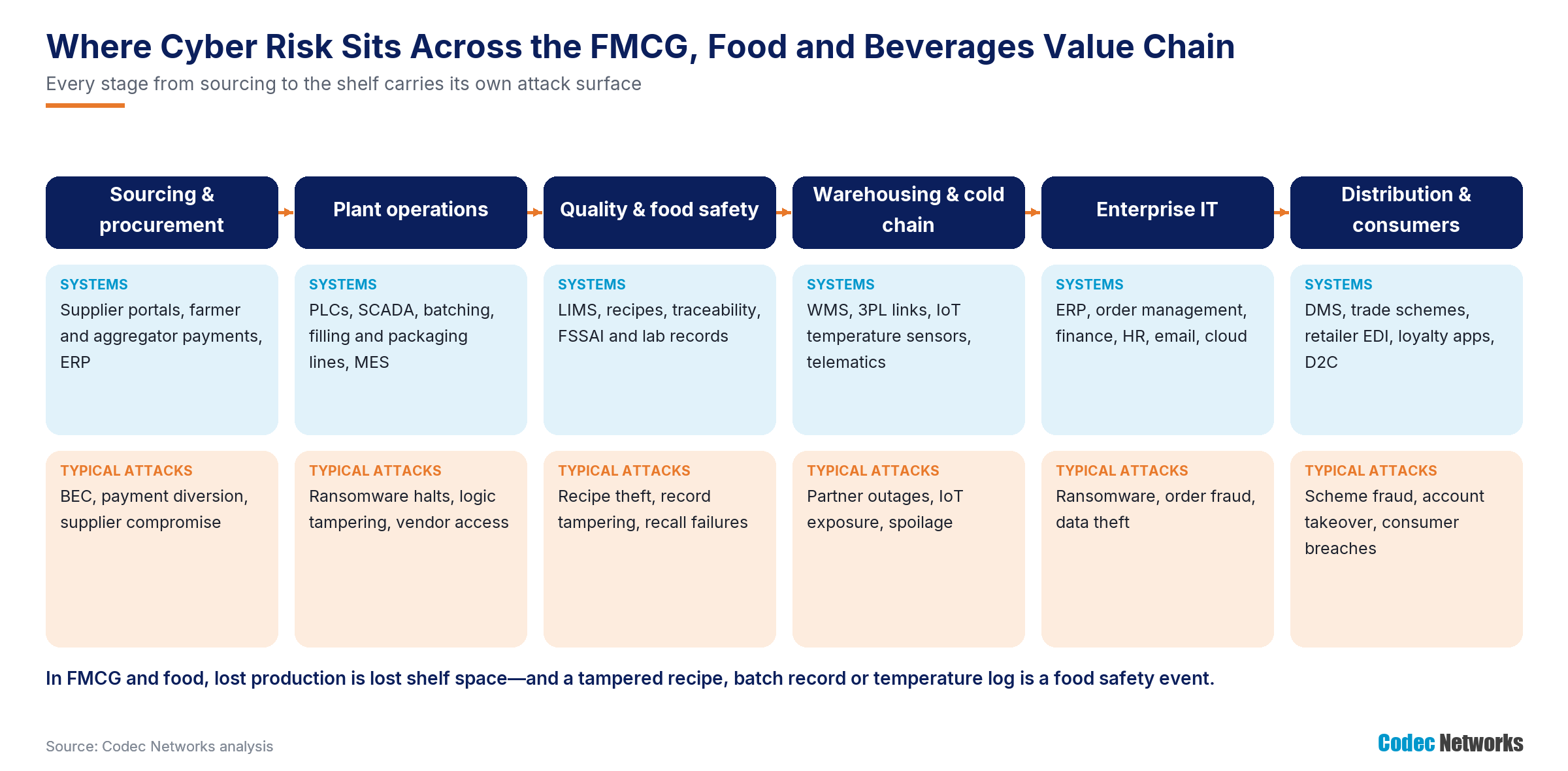
Figure 2: Where cyber risk sits across the FMCG, food and beverages value chain.
|
Product / service |
Systems that deliver it |
Key cyber and compliance touchpoints |
|
Sourcing and procurement |
Supplier portals, farmer and aggregator payment systems, ERP procurement |
Payment and master-data controls, BEC simulation, supplier assessments |
|
Plant operations |
PLCs, SCADA, batching, filling and packaging lines, MES, utilities |
IEC 62443 assessment, segmentation, OEM access brokering, OT monitoring |
|
Quality and food safety |
LIMS, recipes, traceability, batch and recall records |
Record integrity, access reviews, data classification |
|
Warehousing and cold chain |
WMS, 3PL integrations, IoT temperature sensors, telematics |
IoT assessment, partner integration reviews, tamper-evident logs |
|
Enterprise IT |
ERP, order management, finance, HR, email, cloud |
EDR, backups, identity, SOC, DPDP for personal data |
|
Distribution and consumers |
DMS, sales apps, trade schemes, retailer EDI, loyalty apps, D2C |
Portal, API and app testing, claims analytics, bot controls, DPDP |
6. Trends that change the attack surface
|
Trend |
What is changing |
Security implication |
|
Quick commerce and omnichannel |
Rapid growth of app-based delivery and integrated retail |
More APIs, more partner data and higher availability demands |
|
Digital route-to-market |
Distributor apps, retailer ordering apps and AI-driven schemes |
Scheme and claims logic becomes a fraud target |
|
Connected plants and cold chains |
IIoT sensors, predictive maintenance, IoT temperature monitoring |
New bridges between the internet and plant and cold-room systems |
|
Loyalty and first-party data |
Brands building consumer data assets through apps and D2C |
DPDP obligations and breach exposure grow with the data |
|
Co-packing and outsourced logistics |
More production and distribution run by partners |
Third-party risk becomes operational and food safety risk |
|
Regulatory formalisation |
CERT-In audit guidelines, SEBI disclosure, DPDP, FSSAI digitalisation |
Evidence-based assurance replaces informal practice |
7. Mapping operations to Codec Networks engagements
|
If the company operates… |
Recommended starting engagement |
|
Plants with PLCs, batching, filling or packaging lines |
IEC 62443-aligned plant OT assessment, segmentation design, OT monitoring |
|
Distributor management systems, sales apps and trade schemes |
DMS, app and API testing, claims analytics, access and onboarding reviews |
|
Co-packers, 3PLs, cold-storage or agency partners |
Supply chain assessment programme with contract clauses and integration testing |
|
Cold rooms and trucks with IoT monitoring |
IoT and cold-chain security assessment, segmentation, tamper-evident records |
|
Loyalty apps, D2C stores or quick-commerce integrations |
Mobile and API testing, DPDP programme, vendor reviews |
|
Many plants, depots and distributors across states |
24x7 IT/OT SOC with fraud analytics and 6-hour reporting support |
Talk to Codec Networks
|
Contact Codec Networks Pvt. Ltd. New Delhi: 507, 5th Floor, New Delhi House, Barakhamba Road, Connaught Place, New Delhi – 110001 Gurugram: 707, 7th Floor, Silverton Tower, Golf Course Extension Road, Sector 50, Gurugram – 122018, Haryana Landline: 011 430 496 96 | 011 437 522 99 Mobile: +91 99716 76124 | +91 88007 88220 | +91 88003 31124 Email: mktg@codecnetworks.com Web: www.codecnetworks.com |
Note: Descriptions are general and based on public information available as of October 2026. Systems and exposures differ by plant and company.