

Resources Categories
INDUSTRY FACT FILE · GOVERNMENT, PSUS & PUBLIC DIGITAL SERVICES
Threat Landscape: Top Cyber Threats Facing Government, PSUs and Public Services
The 18 most relevant cyber threats, attacks and industry challenges for ministries, state governments, PSUs, data centres and government technology providers, and the impact each has on services, citizens and trust.
|
In this document 1. The threat picture in numbers 2. Top 18 threats, attacks and challenges 3. Threat relevance by public-sector segment 4. Five priority threats in depth 5. Impact on departments, PSUs, citizens and vendors 6. How regulation turns incidents into business events 7. Questions every leadership team should ask |
1. The threat picture in numbers
|
29.44 lakh Cyber incidents handled by CERT-In in 2025 |
5 servers Encrypted at AIIMS New Delhi in November 2022 |
413 Towns served by the MP portal hit in December 2023 |
6 hours To report incidents to CERT-In |
Government and public-sector undertakings attract every class of attacker because they hold what each one wants. Ransomware groups target hospitals, municipal portals and PSU IT systems because the pressure to restore public services is intense. State-linked actors pursue policy papers, defence and infrastructure information and the credentials of officials, usually through spear-phishing that imitates ministries and circulars. Hacktivists deface websites and flood portals with traffic during periods of tension. Fraudsters scrape citizen data and impersonate departments to run scams. Insiders hold privileged access to records that affect millions, and vendors and integrators often hold the keys to many departments at once.
The public record shows how these play out. Ransomware at AIIMS New Delhi in November 2022 encrypted five servers hosting the e-Hospital application; the government attributed the breach to improper network segmentation and restored data from an unaffected backup. The Nuclear Power Corporation of India confirmed in October 2019 that malware had been found on an internet-connected administrative computer at Kudankulam, which it said was isolated from the plant's critical network. Oil India reported ransomware at its Duliajan headquarters in April 2022 with a reported demand of about US$7.5 million; Madhya Pradesh's power management company reported ransomware on an internal IT system in May 2023; and a cyberattack in December 2023 corrupted data on the Madhya Pradesh e-Nagarpalika portal serving 413 towns, which officials restored from tape backups taken every three days. Across all sectors, CERT-In handled more than 29.44 lakh incidents in 2025.
2. Top 18 threats, attacks and challenges
The list below is a practical assessment framework, not a statistical ranking. Priority varies by business model, technology exposure and existing controls.
|
# |
Threat / attack / challenge |
Typical scenario |
Most exposed |
Potential impact |
|
1 |
Ransomware on hospital, ERP and e-governance servers |
Servers encrypted after entry through exposed remote access or phishing |
State departments, hospitals, PSUs |
Services stopped, manual operations, data loss |
|
2 |
Spear-phishing and email compromise of officials |
Lures imitating ministries, circulars and meeting notices |
Ministries, PSUs, state secretariats |
Credential theft, espionage, onward phishing |
|
3 |
State-linked espionage and APT intrusion |
Long-term access to steal policy, project and infrastructure data |
Ministries, strategic and central PSUs |
Loss of sensitive information, national security impact |
|
4 |
Website defacement and hacktivist campaigns |
Old CMS and unpatched sites altered during sensitive events |
State departments, data centres, municipal bodies |
Public embarrassment, misinformation |
|
5 |
DDoS against citizen portals |
Traffic floods during results, payments or national events |
Citizen platforms, state portals |
Services unavailable at peak demand |
|
6 |
Citizen data exposure through portals and APIs |
Broken authorisation lets one user read others' records; scraping |
State portals, scheme and municipal systems |
Mass data exposure, fraud against citizens |
|
7 |
Vendor and system integrator compromise |
Stolen developer or AMC credentials used to reach many systems |
Data centres, GovTech providers, departments |
Multi-department compromise |
|
8 |
Unpatched legacy systems and orphan websites |
Old applications and sites without owners or updates |
State data centres, departments, State PSUs |
Easy initial access and defacement |
|
9 |
Cloud and data-centre misconfiguration |
Open storage, exposed consoles, weak tenant isolation |
Data centres, cloud-hosted platforms |
Data exposure without intrusion |
|
10 |
Flat networks and weak segmentation |
One compromised machine reaches every server |
Hospitals, departments, PSU offices |
Ransomware spreads across the estate |
|
11 |
Insider misuse of privileged access |
Officials or contractors misuse access to records |
Departments, data centres, platforms |
Leaks, fraud, manipulation of records |
|
12 |
OT and plant network intrusion at PSUs |
IT compromise or remote access reaching SCADA and plant systems |
Central and State PSUs, utilities |
Safety, production and supply risk |
|
13 |
Procurement, tender and payment fraud |
Bid leaks, fake vendors and diverted payments |
PSUs, departments with large procurement |
Financial loss, vigilance cases |
|
14 |
Fake apps, websites and official impersonation |
Lookalike portals, apps and messages using government branding |
Citizen platforms, scheme departments |
Citizen fraud, loss of trust |
|
15 |
Remote access and VPN compromise |
Unpatched gateways and passwords without MFA |
PSUs, departments, vendors |
Initial access for ransomware and espionage |
|
16 |
Insecure development and skipped audits |
Changes and new modules go live without security testing |
GovTech providers, platform teams |
New vulnerabilities after a clean audit |
|
17 |
Backup and recovery failure |
Backups online, untested or encrypted with servers |
Hospitals, departments, State PSUs |
Extended outages, lost records |
|
18 |
Weak detection and 6-hour reporting |
No 24x7 monitoring of servers, email, portals or vendor access |
Most departments and smaller PSUs |
Late discovery; missed CERT-In reporting |
3. Threat relevance by public-sector segment
The matrix is a qualitative guide for prioritising the first round of security reviews.
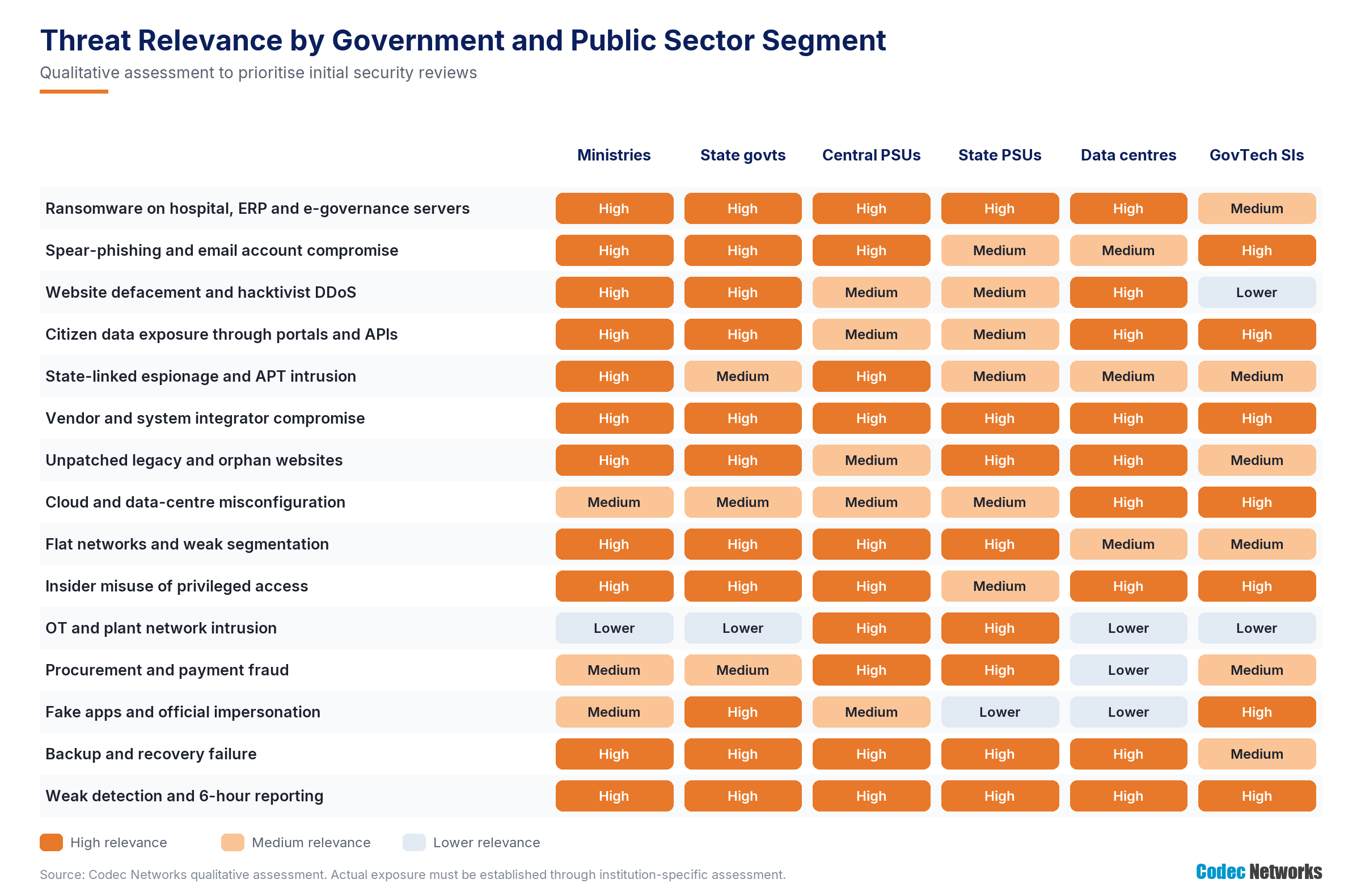
Figure 5: Qualitative threat relevance by public-sector segment (Codec Networks assessment).
4. Five priority threats in depth
4.1 Ransomware on public-service systems
Ransomware is the threat most likely to stop a public service. Attackers enter through exposed remote desktop, unpatched VPN gateways or a phished account, move across flat networks, disable backups and encrypt servers in hours. The AIIMS New Delhi incident of 2022, where five servers were encrypted and the breach was attributed to improper network segmentation, and the corruption of Madhya Pradesh's e-Nagarpalika portal in 2023 show that recovery depends on segmentation and on backups that attackers cannot reach.
- Questions to test: Is every remote-access path protected by MFA and patched quickly? Are hospital, citizen-service and administrative zones segmented? Are backups offline and tested, and how long would restore take? Would the SOC see lateral movement and mass encryption early?
- Relevant services: infrastructure VAPT, segmentation review, backup and restore testing, EDR and managed SOC, ransomware response retainer and tabletop exercises.
4.2 Espionage through spear-phishing of officials
State-linked actors target ministries and strategic PSUs with emails that imitate circulars, meeting notices and official letters, often from lookalike domains, to plant backdoors or harvest email credentials. The Kudankulam malware discovery in 2019 began with an alert from CERT-In, a reminder that many intrusions are found by others first. Access is often held quietly for months while documents leave in small amounts.
- Questions to test: Are email authentication and lookalike-domain controls in place? Are attachments sandboxed and endpoints covered by EDR? Does anyone hunt for beaconing and slow exfiltration? Are officials trained and tested against realistic lures?
- Relevant services: email security review, phishing simulation for officials, EDR and SOC threat hunting, compromise assessment and forensics.
4.3 Citizen data exposure through portals and APIs
Citizen portals and APIs often check that a user is logged in but not whether the record requested belongs to that user. Changing an application or certificate number then returns someone else's data, and automated scraping can download entire databases. Under DPDP, State processing for services and benefits must follow the standards in the Rules, and exposed data fuels fraud calls in the government's name.
- Questions to test: Has every endpoint been tested for object-level authorisation? Are rate limits and bot detection in place? Was the latest release audited before hosting? Do we know what personal data each portal returns and why?
- Relevant services: application, mobile and API VAPT, pre-hosting audits and retests, DPDP data minimisation review and SOC monitoring of scraping.
4.4 Vendor and system integrator compromise
System integrators, developers and AMC providers often hold administrative access to many department systems, shared code libraries and deployment servers. One reused password or unprotected remote tool can open dozens of portals. CERT-In's 2023 guidelines for government entities address third-party access and outsourcing, and tenders increasingly require vendors to show security controls.
- Questions to test: Which vendors have privileged access, and is it time-bound and logged? Are vendor accounts protected by MFA? Are build and deployment systems secured and code integrity checked? Do contracts set audit, reporting and security duties?
- Relevant services: third-party risk assessments, privileged access review, secure SDLC and code review, vendor audits and SOC monitoring of administrative activity.
4.5 Detection, reporting and the 6-hour clock
CERT-In's Directions require government organisations to report incidents within six hours and keep 180 days of logs, and its 2023 guidelines expect a CISO with a dedicated security team. Many departments and smaller PSUs still have no round-the-clock monitoring, so defacements are found by citizens on social media and intrusions by CERT-In alerts.
- Questions to test: Are servers, portals, email, cloud and vendor sessions monitored 24x7? Are logs kept for 180 days in India? Is there a playbook covering containment, CERT-In reporting, public communication and DPDP intimation? Has it been rehearsed with senior officials?
- Relevant services: managed SOC, log architecture review, playbooks, cyber crisis management plans and tabletop exercises with officials.
5. Impact on departments, PSUs, citizens and vendors
|
Player type |
Threats to prioritise |
Main impact |
|
Ministries and departments |
Espionage, phishing, defacement, insider misuse |
Loss of sensitive information, public embarrassment, audit observations |
|
State governments and hospitals |
Ransomware, data exposure, DDoS |
Stopped services, manual operations, harm to citizens |
|
Central PSUs |
Espionage, OT intrusion, procurement fraud |
Production risk, contract loss, disclosure duties if listed |
|
State PSUs and utilities |
Ransomware on billing and ERP, legacy OT |
Revenue disruption, supply risk, regulator scrutiny |
|
Data centres and GovTech providers |
Vendor compromise, misconfiguration, orphan sites |
Multi-department impact, contract termination |
|
Citizens and businesses |
Exposed records, fake portals, fraud calls |
Financial loss, privacy harm, loss of trust in services |
6. How regulation turns incidents into business events
- CERT-In: incidents reported within six hours of noticing them; logs available for investigation; CERT-In may issue directions and advisories.
- CERT-In guidelines for government entities: audit findings and incidents reviewed by the CISO and senior management; overdue audits become findings in themselves.
- NCIIPC: incidents on notified protected systems handled with NCIIPC guidance and reporting.
- DPDP: breaches of citizen or employee personal data trigger intimation to the Data Protection Board and affected persons once provisions commence in May 2027, subject to State-specific provisions.
- Legislatures and auditors: Parliament and assembly questions, CAG audit observations and vigilance enquiries follow major incidents.
- SEBI LODR (listed PSUs): cyber incidents disclosed in the quarterly corporate governance report.
|
Insight The most damaging public-sector incidents start with ordinary weaknesses—an open remote-access port, a flat network, an unowned website, a vendor's reused password—and end as national news. Segmented networks, tested citizen platforms, accountable vendors and 24x7 monitoring are the best defence. |
7. Questions every leadership team should ask
- Could ransomware on one server stop our hospital, portal or treasury, and how long would recovery take?
- Has every citizen portal, app and API been audited since its last major change?
- Which vendors hold privileged access to our systems, and would we see them misused?
- Are our six-monthly internal and annual third-party audits up to date, with findings closed?
- Are backups offline, tested and separate from everyday administrator accounts?
- Could we detect, contain and report an incident within six hours, including at night and on holidays?
Talk to Codec Networks
|
Contact Codec Networks Pvt. Ltd. New Delhi: 507, 5th Floor, New Delhi House, Barakhamba Road, Connaught Place, New Delhi – 110001 Gurugram: 707, 7th Floor, Silverton Tower, Golf Course Extension Road, Sector 50, Gurugram – 122018, Haryana Landline: 011 430 496 96 | 011 437 522 99 Mobile: +91 99716 76124 | +91 88007 88220 | +91 88003 31124 Email: mktg@codecnetworks.com Web: www.codecnetworks.com |
Note: Threat descriptions and relevance ratings are general guidance, not findings about any specific organisation. Public incident references are summarised from official statements, replies in Parliament and widely reported events.