

Resources Categories
INDUSTRY FACT FILE · HEALTHCARE & HEALTHTECH
Threat Landscape: Top Cyber Threats Facing Hospitals and Healthtech
The 18 most relevant cyber threats, attacks and industry challenges for hospitals, diagnostic networks, telemedicine providers and digital health platforms.
|
In this document 1. The threat picture in numbers 2. Top 18 threats, attacks and challenges 3. Threat relevance by healthcare segment 4. Five priority threats in depth 5. Impact on healthcare organisations and patients 6. How regulation turns incidents into business events 7. Questions every leadership team should ask |
1. The threat picture in numbers
|
Nov 2022 Ransomware disrupted AIIMS New Delhi systems |
Feb 2024 Ransomware at a US health-payment processor disrupted claims nationwide |
6 hours To report incidents to CERT-In |
May 2027 Most DPDP obligations take effect |
Healthcare attackers want two things: data and leverage. Medical records sell well and support fraud, and hospitals under pressure to restore care are more likely to pay ransoms. Legacy systems, flat networks and vendor-managed devices make hospitals especially exposed.
The 2022 ransomware attack on AIIMS New Delhi forced manual operations, and the 2024 attack on a major US health-payment processor disrupted claims and pharmacy payments across the country—showing both the clinical and financial impact.
2. Top 18 threats, attacks and challenges
The list below is a practical assessment framework, not a statistical ranking. Priority varies by business model, technology exposure and existing controls.
|
# |
Threat / attack / challenge |
Typical scenario |
Most exposed |
Potential impact |
|
1 |
Ransomware and downtime |
Encryption of HIS, LIS, PACS and backups |
Hospitals and diagnostics |
Care disruption and patient diversion |
|
2 |
Patient data leakage |
Records, reports and images exposed |
All organisations |
Privacy harm and regulatory action |
|
3 |
Medical IoT and device attacks |
Compromise or disruption of connected devices |
Hospitals |
Clinical safety risk |
|
4 |
Report portal and API exposure |
Reports retrievable by changing IDs |
Diagnostics and platforms |
Mass leakage |
|
5 |
Phishing and credential theft |
Staff credentials stolen |
All organisations |
Initial access |
|
6 |
Third-party and vendor compromise |
Breach at HIS, PACS or cloud vendors |
Hospitals and platforms |
Downstream exposure |
|
7 |
Legacy and unpatched systems |
Unsupported operating systems in clinical use |
Hospitals |
Easy exploitation |
|
8 |
Insider misuse of records |
Staff viewing or selling records |
Hospitals |
Privacy breaches |
|
9 |
Consent and data-sharing misuse |
Records shared or fetched without valid consent |
Platforms and integrators |
Regulatory exposure |
|
10 |
Cloud misconfiguration |
Public storage of images or reports |
Healthtech and diagnostics |
Data exposure |
|
11 |
Billing and claims fraud |
Manipulated bills and claims |
Hospitals |
Financial loss and partner disputes |
|
12 |
App and SDK data leakage |
Health data sent to analytics or ad SDKs |
Telemedicine and apps |
Privacy breaches |
|
13 |
Remote vendor access abuse |
Always-on vendor connections to clinical systems |
Hospitals |
Unauthorised access |
|
14 |
DDoS and availability attacks |
Floods on portals and public systems |
Public programmes and platforms |
Service disruption |
|
15 |
Medical identity fraud |
Stolen identities used for care or claims |
Hospitals and insurers |
Fraud and record contamination |
|
16 |
AI misuse in diagnostics |
Unvalidated or manipulated AI tools |
Hospitals and diagnostics |
Clinical and data risk |
|
17 |
Weak detection and response |
Limited monitoring and staff |
Standalone hospitals |
Missed 6-hour reporting |
|
18 |
Backup and recovery failure |
Untested restoration of clinical systems |
All organisations |
Extended outages |
3. Threat relevance by healthcare segment
The matrix is a qualitative guide for prioritising the first round of security reviews.
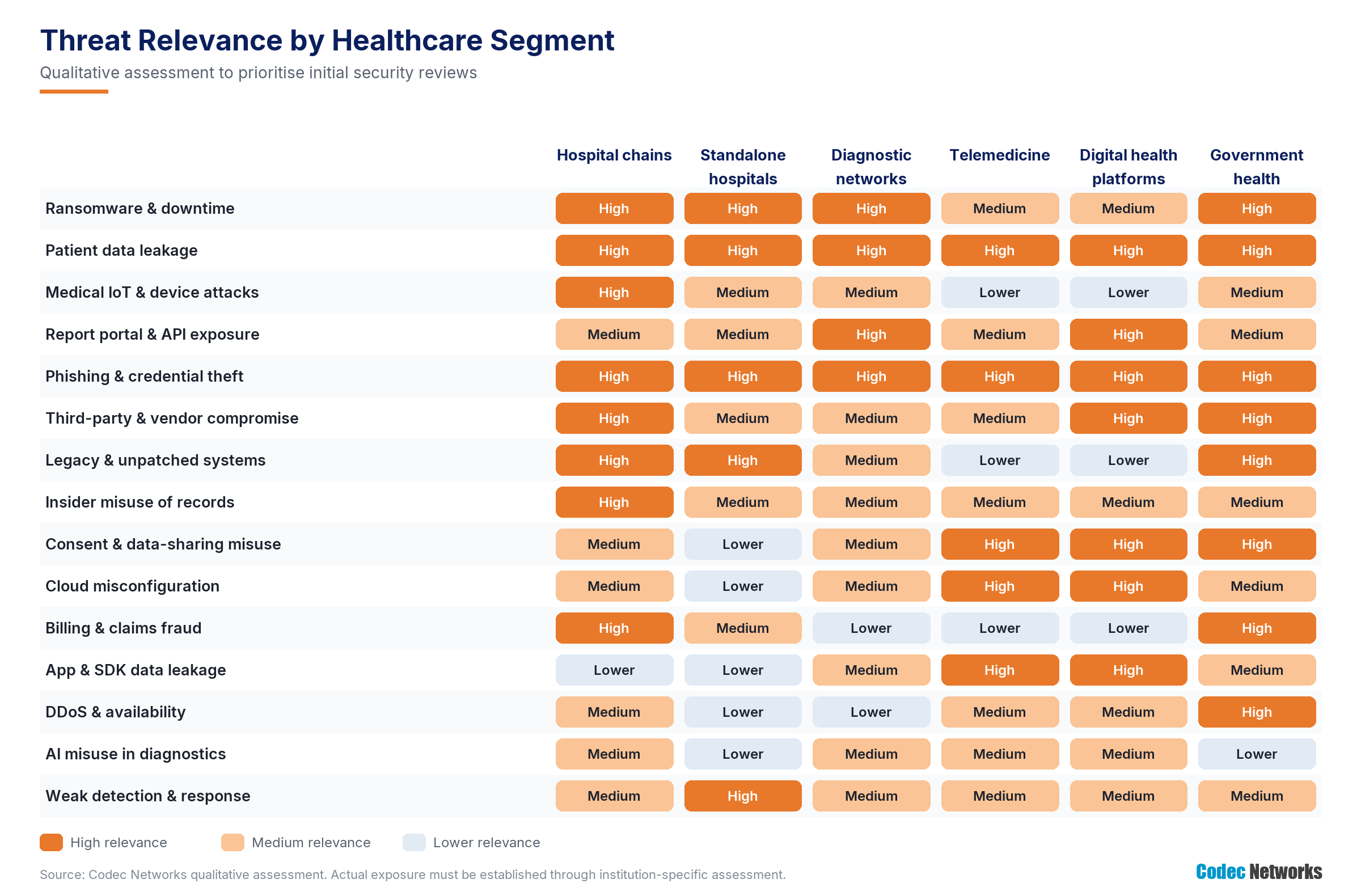
Figure 5: Qualitative threat relevance by healthcare segment (Codec Networks assessment).
4. Five priority threats in depth
4.1 Ransomware and downtime
Flat hospital networks let attackers move from an admin PC to clinical servers. Encryption of HIS, LIS and PACS stops registration, labs and imaging, forcing paper processes and diverting patients.
- Questions to test: Are clinical, admin and device networks segmented? Are backups immutable and restore times known? Are downtime procedures practised?
- Relevant services: segmentation review, ransomware simulation, backup and restore testing, managed SOC, incident response.
4.2 Patient data leakage and portals
Report portals and APIs often use predictable identifiers or weak authorisation, letting attackers download reports in bulk.
- Questions to test: Are report links unguessable and expiring? Is object-level authorisation enforced? Are bulk downloads monitored?
- Relevant services: portal and API testing, data protection programme, download monitoring.
4.3 Medical IoT
Connected devices often run outdated software, cannot be patched easily and sit on shared networks with guest or admin traffic.
- Questions to test: Is there a complete device inventory? Are devices segmented and access-controlled? Are device management servers tested?
- Relevant services: medical IoT inventory and testing, segmentation, IoMT monitoring.
4.4 Vendors, apps and consent
HIS, PACS and cloud vendors often hold remote access, apps embed third-party SDKs, and integrations may skip consent checks.
- Questions to test: Is vendor access brokered and monitored? Do apps send health data to SDKs? Is consent verified and logged for every record fetch?
- Relevant services: vendor risk assessments, app and SDK privacy testing, consent-flow testing.
4.5 Detection and the 6-hour clock
CERT-In requires reporting within six hours of noticing an incident. Many hospitals lack 24x7 security monitoring and discover incidents only when systems fail.
- Questions to test: Are clinical and IT systems monitored around the clock? Is there a playbook covering clinical continuity and reporting?
- Relevant services: managed SOC, playbooks, tabletop exercises, IR retainer.
5. Impact on healthcare organisations and patients
|
Player type |
Threats to prioritise |
Main impact |
|
Hospital chains |
Ransomware, medical IoT, vendor access |
Care disruption across sites |
|
Standalone hospitals |
Legacy systems, phishing |
Prolonged outages |
|
Diagnostic networks |
Report leakage, LIS outages |
Privacy harm and delayed results |
|
Telemedicine and platforms |
App leakage, consent misuse, cloud exposure |
Regulatory and trust impact |
|
Patients |
Leaked data, delayed care, fraud |
Safety and privacy harm |
6. How regulation turns incidents into business events
- CERT-In: incidents reported within six hours of noticing them.
- Privacy: personal data breaches must be intimated to the Data Protection Board and affected individuals once DPDP breach provisions commence in May 2027.
- ABDM participants: incidents affecting integrated health data may trigger obligations under ABDM policies.
- Insurers, TPAs and schemes: partners may require notification and review.
- Accreditation: incidents may be examined during accreditation assessments.
|
Insight In healthcare, recovery time is a clinical metric. Segmentation, immutable backups and practised downtime procedures determine how long patients are affected. |
7. Questions every leadership team should ask
- Could ransomware on one PC reach our HIS, LIS and PACS?
- How long would it take to restore clinical systems from backup?
- Do we know every connected medical device and where it sits on the network?
- Could someone download other patients' reports from our portal?
- Which vendors can reach our clinical systems remotely?
- Could we report an incident to CERT-In within six hours while keeping care running?
Talk to Codec Networks
|
Contact Codec Networks Pvt. Ltd. New Delhi: 507, 5th Floor, New Delhi House, Barakhamba Road, Connaught Place, New Delhi – 110001 Gurugram: 707, 7th Floor, Silverton Tower, Golf Course Extension Road, Sector 50, Gurugram – 122018, Haryana Landline: 011 430 496 96 | 011 437 522 99 Mobile: +91 99716 76124 | +91 88007 88220 | +91 88003 31124 Email: mktg@codecnetworks.com Web: www.codecnetworks.com |
Note: Threat descriptions and relevance ratings are general guidance, not findings about any specific organisation. Public incident references are summarised from widely reported events.