

Resources Categories
INDUSTRY FACT FILE · IT SERVICES & SYSTEMS INTEGRATION
Threat Landscape: Top Cyber Threats Facing IT Service Providers and System Integrators
The 18 most relevant cyber threats, attacks and industry challenges for software developers, IT consultancies, system integrators and managed service providers.
|
In this document 1. The threat picture in numbers 2. Top 18 threats, attacks and challenges 3. Threat relevance by IT services segment 4. Five priority threats in depth 5. Impact on IT service firms and their clients 6. How regulation turns incidents into business events 7. Questions every leadership team should ask |
1. The threat picture in numbers
|
6 hours To report incidents to CERT-In |
2020–23 SolarWinds, Kaseya and MOVEit showed provider-led supply-chain risk |
180 days ICT logs to be retained in India |
May 2027 Most DPDP obligations take effect |
IT service providers are attractive because of what they can reach. Attackers target build pipelines to insert code into trusted software, remote-management tools to push ransomware to many clients at once, and developers and engineers for credentials that open client environments.
The SolarWinds (2020), Kaseya VSA (2021) and MOVEit (2023) incidents demonstrated how a single provider-side compromise can affect thousands of downstream organisations.
2. Top 18 threats, attacks and challenges
The list below is a practical assessment framework, not a statistical ranking. Priority varies by business model, technology exposure and existing controls.
|
# |
Threat / attack / challenge |
Typical scenario |
Most exposed |
Potential impact |
|
1 |
Build and release compromise |
Malicious code inserted into signed software |
Software and product firms |
Mass client compromise and recalls |
|
2 |
RMM and remote-access tool abuse |
Stolen MSP credentials used to push ransomware |
MSPs |
Many clients encrypted at once |
|
3 |
Privileged access misuse |
Admin access to client systems abused |
SIs and MSPs |
Client data theft and outages |
|
4 |
Source code and secret leakage |
Keys and code exposed in repositories |
Developers |
Client cloud compromise |
|
5 |
Malicious or vulnerable dependencies |
Typosquatted packages and unpatched libraries |
Developers and product firms |
Vulnerable delivered software |
|
6 |
Ransomware |
Encryption of own and managed estates |
All providers |
Outages and client claims |
|
7 |
Phishing and credential theft |
Engineers targeted for client access |
All providers |
Initial access to client environments |
|
8 |
Business email compromise |
Invoice and payment diversion |
Consultancies and SIs |
Financial loss |
|
9 |
Insider threat |
Staff or contractors misuse access |
SIs, MSPs, staffing firms |
Data theft and sabotage |
|
10 |
Client data in test environments |
Production data used in testing |
Developers and SIs |
Uncontrolled exposure |
|
11 |
Cloud misconfiguration |
Public storage or excess permissions |
Cloud-focused providers |
Client data exposure |
|
12 |
Vulnerable delivered applications |
Insecure code reaches production |
Developers |
Client breaches and liability |
|
13 |
Weak joiner-mover-leaver control |
Former staff retain client access |
SIs, MSPs, staffing firms |
Unauthorised access |
|
14 |
AI coding assistant leakage |
Client code and secrets pasted into public tools |
Developers |
Confidentiality breaches |
|
15 |
Subcontractor compromise |
Breach at a niche vendor in the delivery chain |
Prime contractors |
Downstream exposure |
|
16 |
Weak detection and response |
Limited monitoring of own and managed estates |
Mid-sized providers |
Missed 6-hour reporting |
|
17 |
Insecure file transfer tools |
Vulnerabilities in transfer platforms |
Providers handling client files |
Mass data theft |
|
18 |
Backup and recovery failure |
Shared or reachable backups |
MSPs |
Extended client outages |
3. Threat relevance by IT services segment
The matrix is a qualitative guide for prioritising the first round of security reviews.
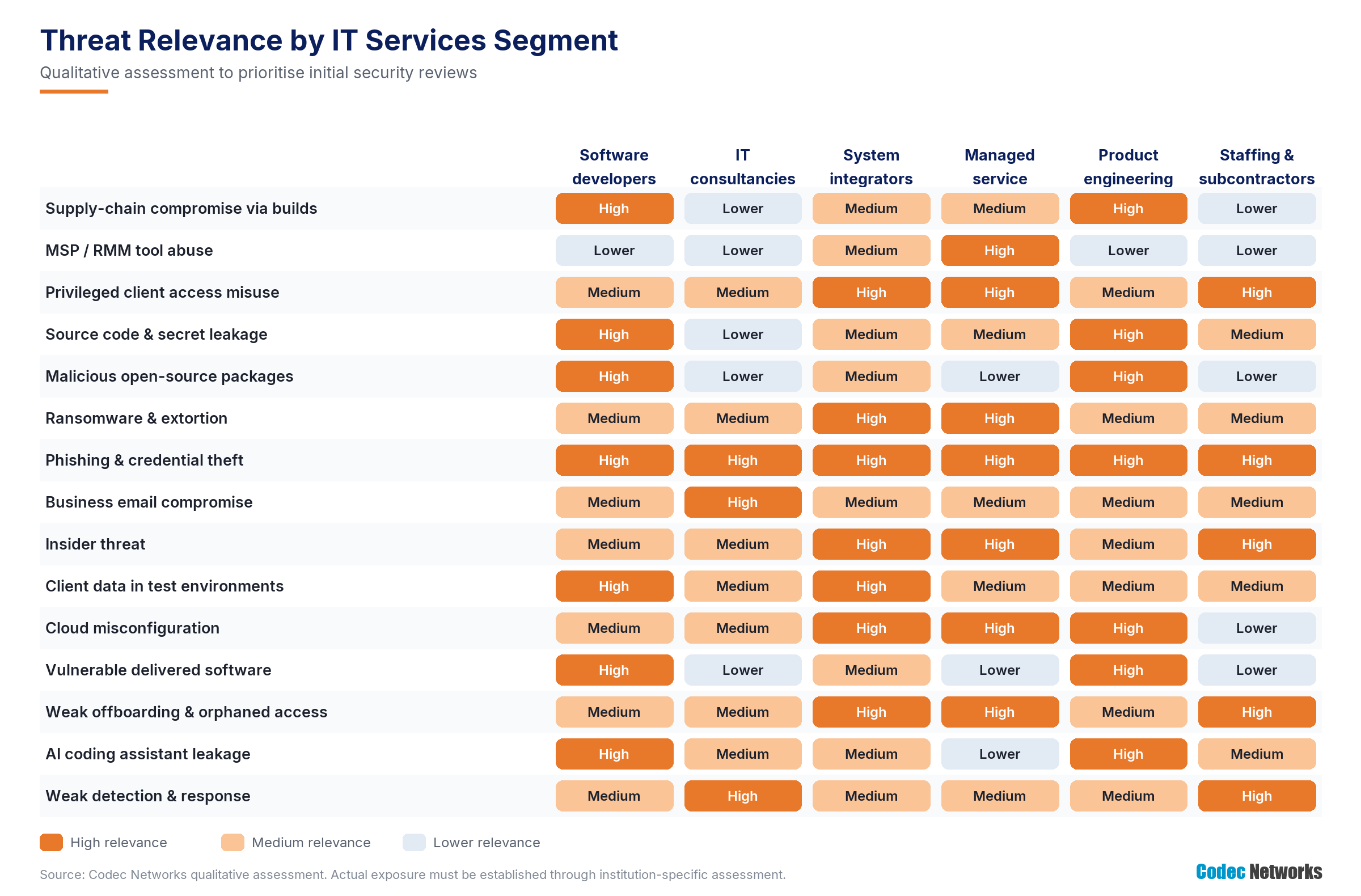
Figure 5: Qualitative threat relevance by IT services segment (Codec Networks assessment).
4. Five priority threats in depth
4.1 Build and release compromise
Attackers who reach a build server or signing key can ship malicious code inside trusted updates. Clients install it because it comes from their provider.
- Questions to test: Are build systems isolated and hardened? Are signing keys protected in HSMs or vaults? Are releases reviewed and accompanied by SBOMs?
- Relevant services: DevSecOps and pipeline review, secure code review, SBOM governance, incident playbooks.
4.2 RMM and privileged tool abuse
Remote-management consoles can run scripts on every managed endpoint. A phished MSP login without strong MFA can encrypt many clients in one night.
- Questions to test: Is phishing-resistant MFA enforced on RMM and PAM? Are mass actions approved and monitored? Are clients segmented from one another?
- Relevant services: RMM and PAM testing, infrastructure VAPT, 24x7 SOC, segmentation review.
4.3 Code, secrets and AI tools
Developers commit secrets to repositories and paste code into AI assistants. Bots harvest exposed keys within minutes.
- Questions to test: Are secrets scanned in IDEs and pipelines? Are credentials short-lived and vaulted? Are approved AI tools and policies in place?
- Relevant services: secrets scanning, code review, DLP, AI governance.
4.4 Access lifecycle across people and subcontractors
Large delivery teams rotate often. Former staff and subcontractors frequently keep VPN, admin or client accounts.
- Questions to test: Is access recertified regularly? Are client accounts tied to identity lifecycle? Are dormant accounts flagged?
- Relevant services: access lifecycle review, UEBA, third-party assurance.
4.5 Detection and the 6-hour clock
CERT-In requires reporting within six hours of noticing an incident, and clients expect prompt notice when their environments are affected.
- Questions to test: Are own and managed estates monitored 24x7? Is there a client-impact playbook with notification steps?
- Relevant services: managed SOC, playbooks, tabletop exercises, IR retainer.
5. Impact on IT service firms and their clients
|
Player type |
Threats to prioritise |
Main impact |
|
Software developers |
Build compromise, secret leakage |
Client breaches and liability |
|
System integrators |
Privileged access misuse, insiders |
Client data loss and disputes |
|
Managed service providers |
RMM abuse, ransomware |
Mass client outages |
|
Consultancies |
BEC, data leakage |
Financial loss and confidentiality breaches |
|
Clients |
Inherited provider weaknesses |
Breaches, outages and regulatory exposure |
6. How regulation turns incidents into business events
- CERT-In: incidents reported within six hours of noticing them.
- Clients: contracts typically require prompt notification, cooperation and evidence, and may trigger audits, penalties or termination.
- Client regulators: bank, market and insurance clients may need to report incidents caused by providers to RBI, SEBI or IRDAI.
- Privacy: clients as data fiduciaries must intimate personal data breaches to the Data Protection Board once DPDP breach provisions commence in May 2027.
- International: EU clients may have notification duties under GDPR, NIS2 or DORA.
|
Insight A provider incident is rarely contained to the provider. Every privileged tool and pipeline should be designed on the assumption that compromising it would compromise every client it touches. |
7. Questions every leadership team should ask
- Could a compromised build or update reach our clients?
- Is phishing-resistant MFA enforced on every RMM, PAM and admin console?
- Do former staff or subcontractors still have client access?
- Are secrets and client code leaking through repositories or AI tools?
- Could we report an incident to CERT-In within six hours and notify every affected client?
- Can we show clients current audit, VAPT and certification evidence?
Talk to Codec Networks
|
Contact Codec Networks Pvt. Ltd. New Delhi: 507, 5th Floor, New Delhi House, Barakhamba Road, Connaught Place, New Delhi – 110001 Gurugram: 707, 7th Floor, Silverton Tower, Golf Course Extension Road, Sector 50, Gurugram – 122018, Haryana Landline: 011 430 496 96 | 011 437 522 99 Mobile: +91 99716 76124 | +91 88007 88220 | +91 88003 31124 Email: mktg@codecnetworks.com Web: www.codecnetworks.com |
Note: Threat descriptions and relevance ratings are general guidance, not findings about any specific organisation. Public incident references are summarised from widely reported events.