

Resources Categories
INDUSTRY FACT FILE · ITES, BPO, KPO & GCCS
Threat Landscape: Top Cyber Threats Facing ITeS, BPO, KPO and GCCs
The 18 most relevant cyber threats, attacks and industry challenges for contact centres, back-office operations, shared service centres and GCCs.
|
In this document 1. The threat picture in numbers 2. Top 18 threats, attacks and challenges 3. Threat relevance by service-centre segment 4. Five priority threats in depth 5. Impact on service centres and their clients 6. How regulation turns incidents into business events 7. Questions every leadership team should ask |
1. The threat picture in numbers
|
6 hours To report incidents to CERT-In |
2023 Help-desk social engineering reportedly enabled a major US casino breach |
2025 Bribed overseas support contractors leaked a US crypto exchange's customer data |
May 2027 Most DPDP obligations take effect |
Attackers target service centres through their people and processes. Criminal groups recruit agents to leak data, impersonate staff to obtain password and MFA resets, and send fake bank-change letters to finance teams.
Widely reported incidents—help-desk social engineering behind a major US casino breach in 2023 and bribed overseas support contractors leaking a US crypto exchange's customer data in 2025—show how human-centred attacks bypass technical controls.
2. Top 18 threats, attacks and challenges
The list below is a practical assessment framework, not a statistical ranking. Priority varies by business model, technology exposure and existing controls.
|
# |
Threat / attack / challenge |
Typical scenario |
Most exposed |
Potential impact |
|
1 |
Insider data theft and bribery |
Agents recruited to photograph or export records |
Contact centres, BPO |
Mass customer exposure |
|
2 |
Help-desk social engineering |
Impersonation to obtain password and MFA resets |
All centres, especially GCCs |
Account takeover and ransomware |
|
3 |
Payment and vendor-master fraud |
Fake bank-change requests processed |
Shared service centres, BPO |
Financial loss |
|
4 |
Customer data leakage |
Data copied via email, USB, print or cloud |
All centres |
Privacy breaches and penalties |
|
5 |
Phishing and credential theft |
Agents and admins phished |
All centres |
Initial access |
|
6 |
Ransomware |
Encryption of delivery and client-connected systems |
BPO, SSCs, GCCs |
Outages and client claims |
|
7 |
Unmanaged and home devices |
Data on personal or weakly managed devices |
WFH teams |
Leakage and theft |
|
8 |
Screen capture and photography |
Phones used to photograph screens |
Contact centres |
Hard-to-detect leakage |
|
9 |
Shared and orphaned accounts |
Generic logins and leavers' access |
BPO and contact centres |
Untraceable misuse |
|
10 |
Privileged access into parent systems |
GCC admins with global rights |
GCCs |
Global compromise |
|
11 |
Fraudulent account changes |
Agents or impostors change customer details |
Contact centres, BPO |
Account takeover and fraud |
|
12 |
Cloud contact-centre misconfiguration |
Exposed recordings or transcripts |
Contact centres |
Data exposure |
|
13 |
AI assistant data leakage |
Customer data in AI tools or prompts |
KPO, GCCs, contact centres |
Confidentiality breaches |
|
14 |
Fake candidates and identity fraud |
Impostors hired to gain access |
GCCs, WFH teams |
Insider access for attackers |
|
15 |
Call recording exposure |
Recordings with card or health data |
Contact centres |
PCI DSS and privacy breaches |
|
16 |
Third-party and telecom compromise |
Breach at CCaaS or connectivity providers |
All centres |
Downstream exposure |
|
17 |
Weak detection and response |
Limited UEBA and identity monitoring |
Mid-sized centres |
Missed 6-hour reporting |
|
18 |
Backup and recovery failure |
Untested recovery of delivery systems |
BPO and SSCs |
Extended outages |
3. Threat relevance by service-centre segment
The matrix is a qualitative guide for prioritising the first round of security reviews.
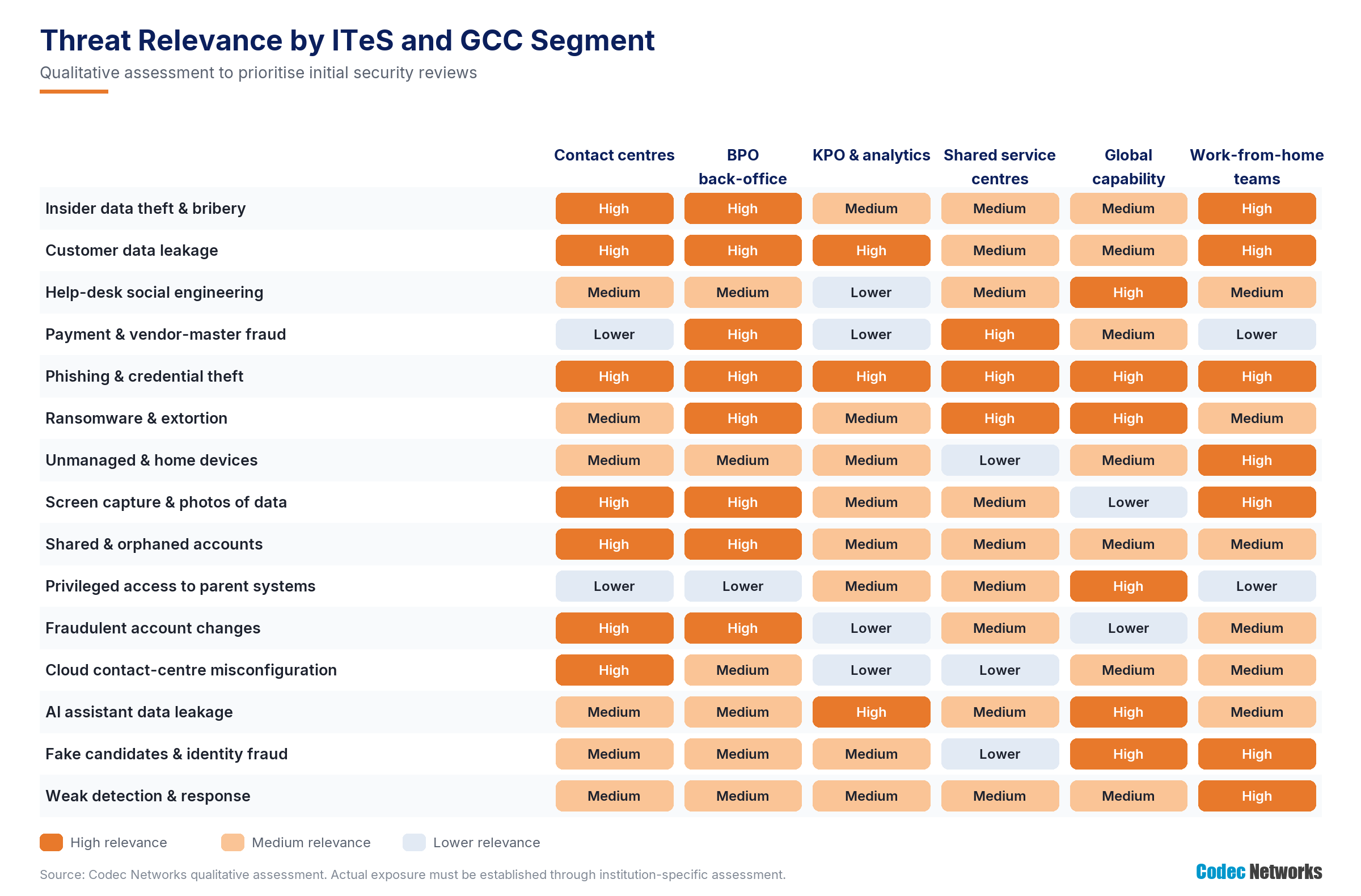
Figure 5: Qualitative threat relevance by service-centre segment (Codec Networks assessment).
4. Five priority threats in depth
4.1 Insider data theft and bribery
Criminal groups recruit agents through social media and messaging apps, paying for screenshots or exports of customer records that are then used for impersonation scams.
- Questions to test: Is customer data masked on screens? Are phones barred from sensitive floors? Are unusual look-up patterns monitored?
- Relevant services: masking and access reviews, clean-desk controls, UEBA, insider investigations.
4.2 Help-desk social engineering
Attackers call internal help desks posing as employees or managers and talk agents into resetting passwords and MFA. The resulting access is used for data theft and ransomware.
- Questions to test: How are callers verified? Are resets for privileged users approved out of band? Are resets followed by unusual access flagged?
- Relevant services: help-desk control testing, social-engineering simulations, identity monitoring.
4.3 Payment and vendor-master fraud
Shared service centres process large payment runs. Fake bank-change letters from compromised vendor mailboxes are a leading cause of losses.
- Questions to test: Are bank changes verified by call-back on known numbers? Is there maker-checker approval? Are payment anomalies monitored?
- Relevant services: payment-control testing, BEC simulation, SOC use cases.
4.4 Work-from-home leakage
Remote agents may save files locally, use personal devices or print at home. Lost or stolen laptops expose customer data.
- Questions to test: Is delivery through VDI or locked-down devices? Is disk encryption enforced? Does DLP block local saves and USB?
- Relevant services: WFH assessments, VDI review, DLP assessment.
4.5 GCC privileged access and the 6-hour clock
GCC engineers often hold administrative rights in global systems. A compromised GCC account can lead to a global incident, and CERT-In requires reporting within six hours.
- Questions to test: Is a tiered admin model in place? Is phishing-resistant MFA enforced for privileged users? Is there a joint India–global playbook?
- Relevant services: PAM review, red teaming, joint SOC, cross-border IR playbook.
5. Impact on service centres and their clients
|
Player type |
Threats to prioritise |
Main impact |
|
Contact centres |
Insider theft, screen capture, account changes |
Client penalties and fraud |
|
BPO back-office |
Fraudulent changes, ransomware |
Processing disruption and losses |
|
Shared service centres |
BEC and vendor-master fraud |
Direct financial loss |
|
GCCs |
Help-desk attacks, privileged misuse |
Global incidents |
|
Clients and customers |
Leaked data and fraud |
Harm, complaints and regulatory exposure |
6. How regulation turns incidents into business events
- CERT-In: incidents reported within six hours of noticing them.
- Clients: contracts require prompt notification and cooperation, and may trigger audits, penalties or termination.
- Client regulators: regulated clients may need to report provider-caused incidents to RBI, SEBI or IRDAI.
- Privacy: clients as data fiduciaries must intimate personal data breaches to the Data Protection Board once DPDP breach provisions commence in May 2027; overseas clients may have GDPR or HIPAA notification duties.
- Card brands: card-data compromises can trigger PCI forensic investigations.
|
Insight In service centres, the costliest breaches often start with a conversation, not an exploit. Verification, least privilege and behaviour monitoring stop what firewalls cannot. |
7. Questions every leadership team should ask
- What customer data can a typical agent see, and could they photograph or copy it?
- How does our help desk verify a caller before resetting MFA?
- Are bank and vendor-master changes verified out of band?
- Are work-from-home devices encrypted and covered by DLP?
- Do GCC accounts hold administrative rights in global systems?
- Could we report an incident to CERT-In within six hours and notify every affected client?
Talk to Codec Networks
|
Contact Codec Networks Pvt. Ltd. New Delhi: 507, 5th Floor, New Delhi House, Barakhamba Road, Connaught Place, New Delhi – 110001 Gurugram: 707, 7th Floor, Silverton Tower, Golf Course Extension Road, Sector 50, Gurugram – 122018, Haryana Landline: 011 430 496 96 | 011 437 522 99 Mobile: +91 99716 76124 | +91 88007 88220 | +91 88003 31124 Email: mktg@codecnetworks.com Web: www.codecnetworks.com |
Note: Threat descriptions and relevance ratings are general guidance, not findings about any specific organisation. Public incident references are summarised from widely reported events.