

Resources Categories
INDUSTRY FACT FILE · LOGISTICS, WAREHOUSING & SUPPLY CHAINS
Threat Landscape: Top Cyber Threats Facing Logistics, Warehousing and Supply Chains
The 18 most relevant cyber threats, attacks and industry challenges for 3PLs, couriers, forwarders, fleets, warehouses and supply-chain platforms, and the impact each one has on operations, customers and partners.
|
In this document 1. The threat picture in numbers 2. Top 18 threats, attacks and challenges 3. Threat relevance by logistics segment 4. Five priority threats in depth 5. Impact on logistics companies, their shippers and their partners 6. How regulation turns incidents into business events 7. Questions every leadership team should ask |
1. The threat picture in numbers
|
Jun 2017 Maersk rebuilt 45,000 PCs in ten days after NotPetya |
Feb 2022 Expeditors shut down global systems after a cyberattack |
Nov 2024 Blue Yonder ransomware disrupted retailers' warehouses |
6 hours To report incidents to CERT-In |
Logistics companies attract ransomware groups because stopped cargo creates immediate, measurable pressure—demurrage, spoilage, missed cut-offs and angry shippers—which makes victims more likely to pay. They attract fraudsters because freight is paid by invoice between parties who rarely meet, which makes business email compromise easy. And they attract data brokers and criminals because shipment data is both personal (consignees' names, phones and addresses) and operational (what is in the truck and where it will stop). The attack surface is unusually open: partner APIs, EDI, customer portals, telematics platforms and SaaS providers connect hundreds of organisations to the same systems.
Landmark incidents show the pattern. Maersk (2017) lost its network to NotPetya and US$250–300 million; Hellmann (2021) had data leaked and warned customers of payment-change fraud; Expeditors (2022) shut down global systems and absorbed tens of millions in demurrage and recovery costs; Blue Yonder (2024) showed how one SaaS provider's incident reaches many customers' warehouses; KNP Logistics (2025) collapsed after a single guessed password. Verizon's 2025 DBIR found third-party involvement in 30% of breaches and ransomware in 44%—both ratios that describe logistics well.
2. Top 18 threats, attacks and challenges
The list below is a practical assessment framework, not a statistical ranking. Priority varies by business model, technology exposure and existing controls.
|
# |
Threat / attack / challenge |
Typical scenario |
Most exposed |
Potential impact |
|
1 |
Ransomware halting TMS, WMS and hubs |
Core platforms encrypted; hubs, fleets and filings stop |
All operators |
Stopped cargo, demurrage, penalties |
|
2 |
Partner API and EDI abuse |
Leaked or over-privileged keys used to pull or alter shipment data |
Couriers, 3PLs, platforms |
Data theft, fraud, service abuse |
|
3 |
Business email compromise and freight payment fraud |
Hijacked mailboxes and look-alike domains divert invoices |
Forwarders, 3PLs, fleets |
Direct financial loss |
|
4 |
Telematics and fleet IoT compromise |
Weak platform credentials, exposed devices, remote commands |
Trucking fleets, couriers |
Cargo theft, immobilisation, tracking loss |
|
5 |
Warehouse automation and OT attacks |
PLCs, sorters and AS/RS on flat networks reached from IT or vendors |
Automated warehouses |
Site stoppage, damage |
|
6 |
Consignee and shipment data theft |
Databases and tracking systems scraped or exfiltrated |
Couriers, platforms |
DPDP exposure, scams against customers |
|
7 |
Customer portal and tracking app vulnerabilities |
IDOR, weak authentication, business-logic flaws |
All operators with portals |
Data exposure, fraud |
|
8 |
Phishing and fake delivery scams |
Staff phished; consignees targeted with fake fees and OTP requests |
Couriers, all operators |
Credential theft, customer fraud, brand damage |
|
9 |
Customs, e-way bill and compliance credential misuse |
Shared or stolen ICEGATE and GST credentials; fraudulent filings |
Forwarders, brokers, fleets |
Penalties, detained cargo |
|
10 |
Cargo theft enabled by data leaks |
Load, route and stop data used to intercept vehicles |
Fleets, high-value cargo |
Physical loss, insurance impact |
|
11 |
Cloud and SaaS misconfiguration |
Open storage, leaked keys, weak tenant isolation |
Platforms, cloud-first operators |
Mass data exposure |
|
12 |
Supply-chain software provider compromise |
TMS, WMS or visibility SaaS provider breached |
All SaaS customers |
Multi-customer outage |
|
13 |
Insider and contractor misuse |
Staff, agents or contractors abuse access to data or systems |
All operators |
Theft, fraud, leaks |
|
14 |
Driver and rider identity fraud |
Fake accounts, shared logins and OTP abuse in delivery apps |
Couriers, last mile |
Theft, COD fraud, safety risk |
|
15 |
Cold-chain monitoring tampering |
Falsified or disabled temperature records |
Cold-chain operators |
Spoilage, compliance failure |
|
16 |
Legacy systems and flat depot networks |
Old servers and scanners sharing networks with office IT |
Depots, warehouses |
Easy lateral movement |
|
17 |
Weak detection and slow incident reporting |
No visibility across platforms, hubs, fleets and mailboxes |
Most operators |
Long dwell time; missed 6-hour window |
|
18 |
Backup, recovery and continuity gaps |
Untested restores of TMS, WMS and filing systems |
All operators |
Weeks of disruption |
3. Threat relevance by logistics segment
The matrix is a qualitative guide for prioritising the first round of security reviews.
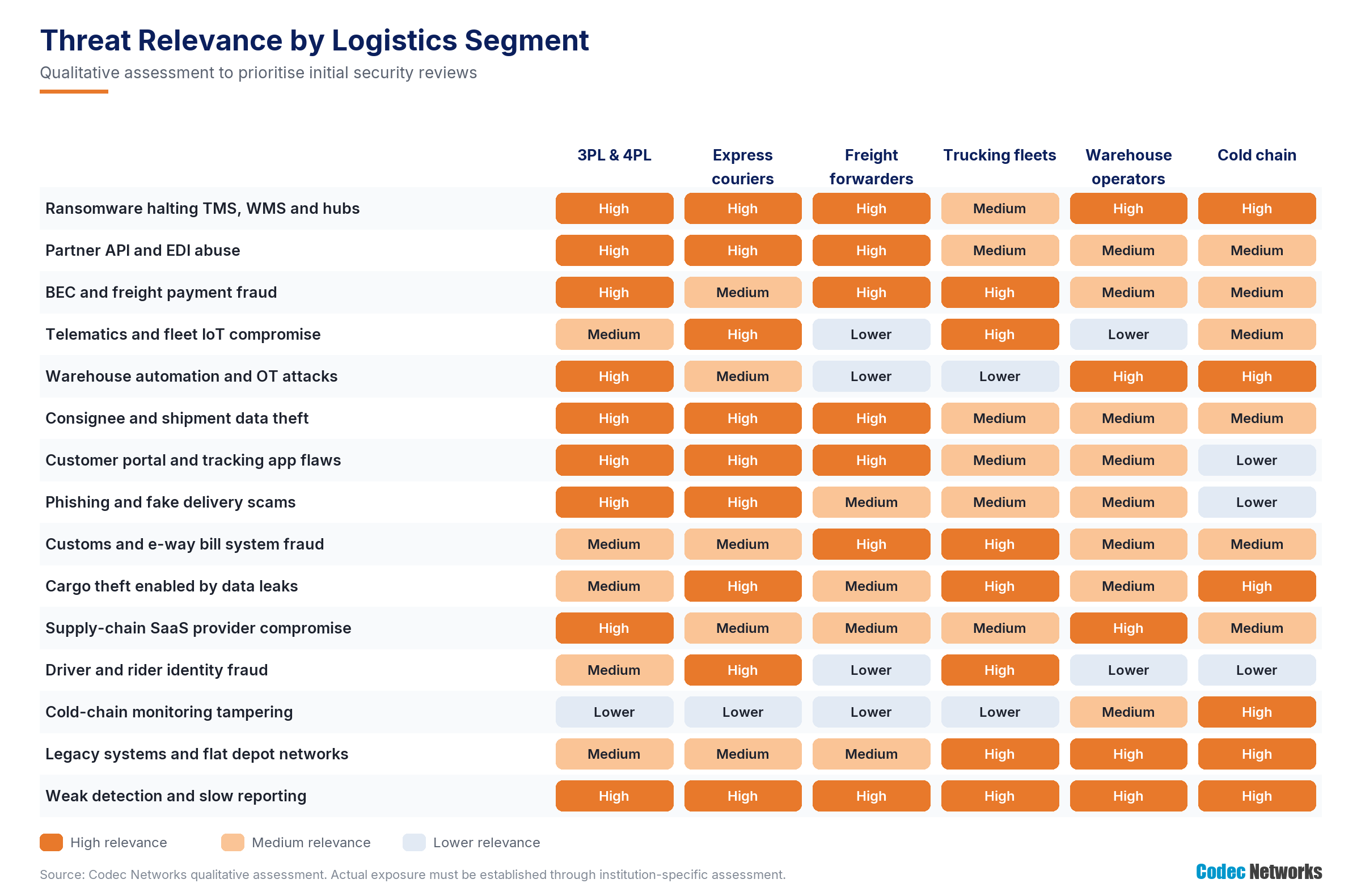
Figure 5: Qualitative threat relevance by logistics segment (Codec Networks assessment).
4. Five priority threats in depth
4.1 Ransomware and the platform dependency
A forwarder, 3PL or courier can lose every hub, filing and delivery at once when TMS, WMS or freight systems are encrypted—as Maersk, Expeditors and Hellmann experienced. Cargo keeps arriving while systems are down, so costs accrue by the hour.
- Questions to test: Which operations depend on which platforms? Can we file, receive, pick and dispatch manually for a week? Are backups immutable and restores tested? Would EDR and the SOC catch privilege escalation before encryption?
- Relevant services: dependency mapping, segmentation, backup and restore testing, EDR validation, crisis exercises.
4.2 Business email compromise in an invoice-driven industry
Freight is paid by invoice between parties who communicate by email. Attackers compromise a mailbox, learn the rhythm of invoicing and insert a changed bank account or a fake invoice; Hellmann warned customers of exactly this after its breach.
- Questions to test: Is MFA enforced on every mailbox? Are forwarding rules and unusual logins monitored? Do finance teams verify bank-detail changes by call-back? Have we tested staff with BEC simulations?
- Relevant services: MFA and conditional access, mailbox monitoring, payment verification procedures, BEC simulation and training, incident investigation.
4.3 Partner APIs, EDI and consignee data
Couriers and platforms issue thousands of API keys to merchants, carriers and integrators. One key embedded in a public website or a sequential tracking number can expose millions of consignees' names, phones and addresses, which then fuel fake delivery-fee and OTP scams.
- Questions to test: Who holds keys to our APIs and with what scope? Are identifiers guessable? Are rate limits and enumeration defences in place? Would we detect bulk retrieval of shipment data?
- Relevant services: partner API and portal testing, key scoping and rotation, rate limiting, API monitoring, DPDP data minimisation.
4.4 Fleet telematics and warehouse automation
Telematics platforms reveal where high-value cargo is and can sometimes immobilise vehicles; warehouse sorters and AS/RS are PLC-controlled systems maintained by vendors with standing access. Both are OT problems arriving in a sector that has treated them as IT conveniences.
- Questions to test: Who can log in to our telematics platform and send commands? Is load and route data minimised? Are WMS and automation segmented from office IT? Is vendor access brokered, time-bound and recorded?
- Relevant services: fleet and IoT security assessment, platform access controls, warehouse OT assessment, zone-and-conduit segmentation, vendor access brokering, OT monitoring.
4.5 Supply-chain SaaS and the 6-hour clock
When a shared TMS, WMS or visibility platform is breached, many operators and their shippers are affected at once—Blue Yonder's 2024 incident reached warehouses and store scheduling on two continents. CERT-In still expects each affected entity to report within six hours and to have logs for investigation.
- Questions to test: Which SaaS providers could stop our operations? Have we assessed them and agreed notification duties? Do we monitor our own tenants and integrations? Is there a playbook covering manual operation, CERT-In reporting and shipper communication?
- Relevant services: supply-chain SaaS and vendor risk programme, contract clauses, tenant and integration monitoring, incident playbooks and reporting support.
5. Impact on logistics companies, their shippers and their partners
|
Player type |
Threats to prioritise |
Main impact |
|
3PLs, express and logistics groups |
Ransomware across networks, API abuse, data theft, disclosure |
Multi-site stoppage, shipper penalties, market disclosure |
|
Forwarders and customs brokers |
BEC, customs credential misuse, freight system outage |
Financial loss, detained cargo, demurrage |
|
Trucking fleets |
Telematics compromise, cargo theft, e-way bill misuse |
Physical loss, insurance and compliance consequences |
|
Warehouse and cold-chain operators |
Automation and OT attacks, monitoring tampering |
Site stoppage, spoilage, tenant claims |
|
Shippers and consignees |
Partner outages, leaked shipment data, scams |
Their own disruptions and financial loss |
6. How regulation turns incidents into business events
- CERT-In: incidents reported within six hours of noticing them; logs available for investigation.
- SEBI LODR: listed logistics companies disclose cyber incidents and data loss in the quarterly corporate governance report.
- NCIIPC: incidents affecting notified transport systems require coordination.
- DPDP: incidents involving consignee, driver or employee personal data trigger breach intimation once provisions commence in May 2027.
- Customs and GST authorities: misuse of ICEGATE or e-way bill credentials attracts penalties and investigation.
- Shippers and insurers: contracts require incident notification and evidence of warranted controls; cargo and cyber insurers scrutinise telematics and backup controls.
|
Insight The most damaging logistics incidents cross organisational boundaries—from a SaaS provider into your hubs, from a merchant's website into your consignee data, from a vendor's laptop into your sorters, from a hijacked mailbox into your customers' payments. Visibility over partners, platforms and identities, tested before every peak, is the best defence. |
7. Questions every leadership team should ask
- If our TMS, WMS and freight systems went dark tonight, could cargo move tomorrow—and for how long?
- Which SaaS provider, merchant or vendor could stop our operations or leak our data, and have we assessed them?
- Would our finance team pay an invoice to a changed bank account without a call-back?
- Who can log in to our telematics platform, and what commands can they send?
- Are our sorters, AS/RS and WMS segmented from office IT and from vendors?
- Could we detect, contain and report an incident within six hours while keeping hubs and deliveries running?
Talk to Codec Networks
|
Contact Codec Networks Pvt. Ltd. New Delhi: 507, 5th Floor, New Delhi House, Barakhamba Road, Connaught Place, New Delhi – 110001 Gurugram: 707, 7th Floor, Silverton Tower, Golf Course Extension Road, Sector 50, Gurugram – 122018, Haryana Landline: 011 430 496 96 | 011 437 522 99 Mobile: +91 99716 76124 | +91 88007 88220 | +91 88003 31124 Email: mktg@codecnetworks.com Web: www.codecnetworks.com |
Note: Threat descriptions and relevance ratings are general guidance, not findings about any specific organisation. Public incident references are summarised from widely reported events and company disclosures.