

Resources Categories

INDUSTRY FACT FILE · MANUFACTURING & INDUSTRIAL PRODUCTION
Market Landscape and the Drivers of Cybersecurity Demand in Manufacturing
The business, technology, regulatory, legal, statutory and customer forces that create cybersecurity, audit and assurance work for engineering, machinery, electronics and industrial equipment companies.
|
In this document 1. Market landscape 2. Business drivers 3. Technology drivers 4. Regulatory drivers: CERT-In, SEBI, DPDP, NCIIPC and export rules 5. Legal and statutory drivers 6. How the drivers differ by manufacturer type 7. What this means for buyers and for Codec Networks |
1. Market landscape
India's manufacturing sector is large, diverse and growing on the back of deliberate policy. Public-sector heavy-engineering undertakings and listed private groups dominate capital goods, electrical equipment and machinery; global and Indian EMS companies are scaling electronics production under PLI; and a long tail of MSME component makers and contract manufacturers supplies OEMs at home and abroad. The National Manufacturing Mission, PLI schemes and Make in India aim to lift manufacturing's share of the economy towards a quarter, which means more plants, more automation and more connectivity.
Cybersecurity demand follows that growth. Manufacturers are the most attacked industry worldwide, their customers now audit supplier security before awarding contracts, listed companies must disclose incidents, CERT-In expects independent audits that include OT, and exporters of connected products face the EU Cyber Resilience Act. Spending is shifting from basic IT security to OT assessments, segmentation, ransomware resilience, supplier risk and monitoring that covers the plant floor.
|
~₹1.97 lakh crore PLI outlay across 14 manufacturing sectors |
6 hours Incident reporting to CERT-In |
Sep 2026 EU CRA reporting duties for connected products began |
May 2027 Most DPDP obligations take effect |
|
Market segment |
Landscape and buying behaviour |
Cybersecurity opportunity |
|
Large listed manufacturers and PSUs |
Multi-plant ERP and OT estates, formal Boards and audit committees, SEBI disclosure, customer and lender scrutiny |
Programme-level OT security, red teaming, SOC, Board reporting |
|
Mid-sized engineering and equipment companies |
Growing automation, OEM customers demanding questionnaires, lean security teams |
IEC 62443 assessments, segmentation, ERP testing, managed SOC |
|
Electronics and EMS companies |
Rapid PLI-driven expansion, global customers, product and firmware obligations |
Customer assurance, product security, OT review of new lines |
|
Component makers and MSMEs |
Single plants, outsourced IT, dependence on one or two OEM customers |
Baseline assessment, backups, remote access review, questionnaire support |
|
Smart-factory and Industry 4.0 programmes |
IIoT, MES and cloud analytics projects across any segment |
IIoT and edge assessment, zone-and-conduit design, OT monitoring |
2. Business drivers
|
Business driver |
Buying trigger |
Relevant services |
|
Production continuity |
A ransomware incident or supplier outage stops lines and shipments |
Ransomware resilience, segmentation, supplier risk |
|
Delivery commitments and penalties |
OEM contracts carry delivery penalties and just-in-time schedules |
Dependency mapping, backup testing, crisis exercises |
|
Protection of designs and know-how |
Competitors and states target CAD, recipes and customer lists |
DLP, PLM access reviews, insider risk, threat hunting |
|
Winning and keeping customers |
OEM, EU and US customers require security evidence before and during contracts |
ISO 27001, IEC 62443, questionnaire readiness, independent audits |
|
Board accountability and disclosure |
Listed companies disclose incidents; Boards own risk management |
Board advisory, incident records, audit programmes |
|
Cyber insurance and lenders |
Insurers and lenders ask for OT controls, backups and MFA evidence |
Control validation, ransomware readiness reviews |
|
Fraud and financial loss |
BEC and payment diversion target supplier-heavy finance teams |
Payment controls, BEC simulation, SOC |
3. Technology drivers
|
Technology driver |
Exposure created |
Codec Networks opportunity |
|
PLCs, SCADA, robots and MES |
Unauthenticated protocols, legacy operating systems, flat networks |
IEC 62443 assessments, segmentation, OT monitoring |
|
ERP, PLM and cloud SaaS |
Business stops when ERP stops; designs concentrated in PLM |
ERP and PLM security, backup validation, cloud posture |
|
OEM remote maintenance |
Permanent vendor tunnels into plant networks |
Remote access brokering, vendor assessments |
|
IIoT, edge and digital twins |
Internet-exposed gateways bridging plant and cloud |
IIoT security assessment, DMZ design |
|
Connected products and remote service |
Product vulnerabilities and service platforms reach customers |
Product and firmware testing, EU CRA readiness |
|
Supplier and customer integrations |
EDI, portals and APIs carrying orders and designs |
Portal and API testing, supplier assessments |
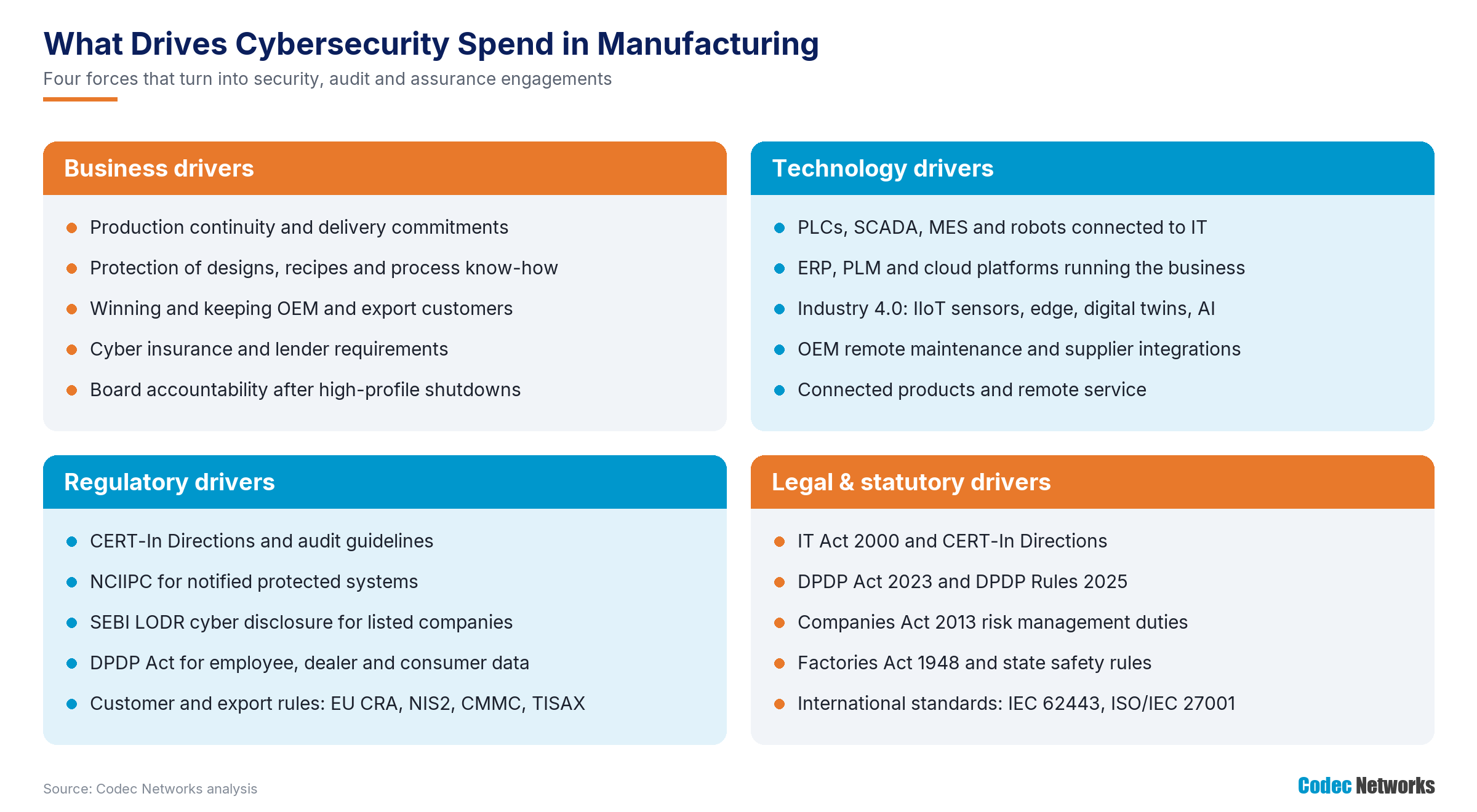
Figure 3: The four groups of drivers behind cybersecurity spending in manufacturing.
4. Regulatory drivers: CERT-In, SEBI, DPDP, NCIIPC and export rules
|
Instrument |
Key requirements |
|
CERT-In Directions (2022) |
Six-hour incident reporting; 180-day ICT logs in India; applies to bodies corporate including manufacturers |
|
CERT-In audit policy guidelines (July 2025) |
Risk-based, independent cyber audits covering IT and OT/ICS, with closure of findings |
|
SEBI LODR Regulations (listed companies) |
Quarterly disclosure of cyber incidents in the corporate governance report; Board oversight of risk |
|
NCIIPC (IT Act Section 70A) |
Protection of notified protected systems—relevant to strategic and public enterprises |
|
DPDP Act 2023 and Rules 2025 |
Employee, dealer, distributor and consumer data safeguards; most obligations from May 2027 |
|
EU Cyber Resilience Act and NIS2 |
Product security and vulnerability reporting for connected products sold in the EU (reporting from September 2026, full application December 2027); supply-chain security clauses from EU customers |
|
Confirm applicability Obligations depend on listing status, products, customers and any NCIIPC notifications. Confirm against the official instruments and your contracts. |
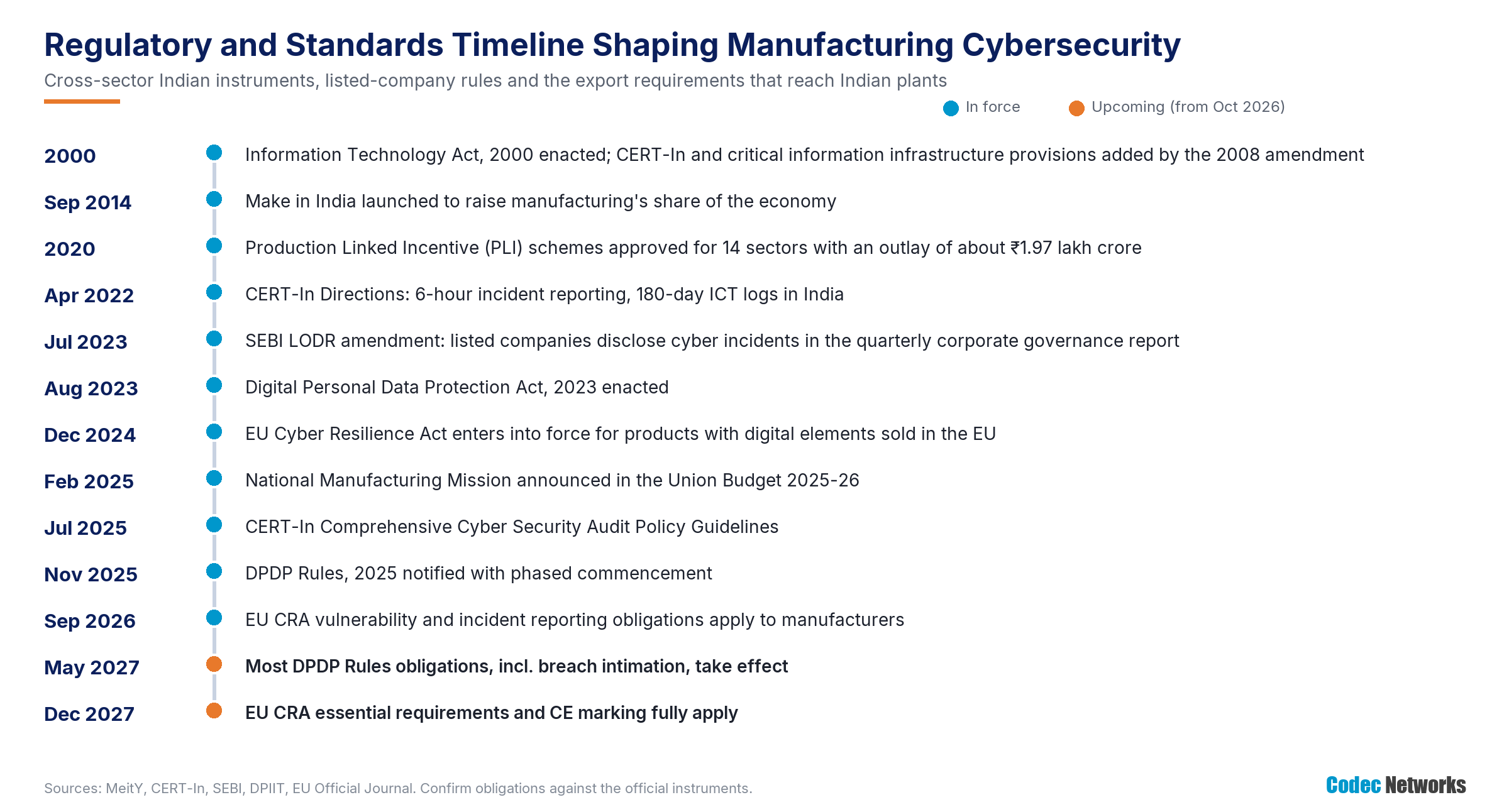
Figure 4: Regulatory and standards timeline shaping manufacturing cybersecurity, as of October 2026.
5. Legal and statutory drivers
|
Law or obligation |
Relevance |
Demand created |
|
IT Act, 2000 and CERT-In Directions |
Incident reporting, logging and protected systems |
SOC, logging, audits and incident response |
|
Companies Act, 2013 |
Board responsibility for risk management and internal controls |
Board risk reporting, audit programmes |
|
SEBI LODR Regulations |
Quarterly cyber incident disclosure for listed entities |
Incident records and disclosure support |
|
DPDP Act, 2023 and Rules, 2025 |
Personal data of employees, dealers and consumers |
Privacy programmes and breach workflows |
|
Factories Act, 1948 and state rules |
Safety of workers and machinery, which cyber incidents can affect |
Machine safety system protection |
|
Customer, OEM and export contracts |
Security clauses, audits, EU CRA, NIS2, CMMC |
Independent testing, certifications, questionnaire evidence |
|
Cyber insurance policies |
Control conditions and warranties |
Control validation and evidence |
6. How the drivers differ by manufacturer type
|
Manufacturer type |
Dominant business drivers |
Dominant technology drivers |
Principal regulatory drivers |
|
Capital goods and PSUs |
Continuity, project delivery, disclosure |
Multi-plant ERP, large OT estates |
CERT-In, SEBI LODR, NCIIPC where notified |
|
Electronics and EMS |
Customer trust, PLI growth |
SMT lines, MES, firmware, customer data |
CERT-In, EU CRA, customer audits, DPDP |
|
Machinery and automation |
Product reputation, service revenue |
Remote service, connected products |
CERT-In, EU CRA, customer requirements |
|
Components and MSMEs |
Keeping the OEM contract |
Single-plant OT, outsourced IT |
CERT-In, OEM questionnaires |
|
Smart factories |
Return on Industry 4.0 investment |
IIoT, edge, cloud analytics |
CERT-In, IEC 62443, cloud obligations |
7. What this means for buyers and for Codec Networks
|
Customer buying need |
Recommended offering |
Natural recurring engagement |
|
“Would ransomware stop our plant and our shipping?” |
Ransomware resilience review: dependency mapping, segmentation, backups, playbooks |
Annual resilience testing and exercises |
|
“Our OEM customer sent a 200-question security questionnaire.” |
Questionnaire readiness and ISO 27001 / IEC 62443 gap assessment |
Annual recertification support |
|
“Who can reach our PLCs from outside?” |
Remote access and segmentation review |
Vendor access recertification |
|
“Which supplier could stop our lines?” |
Supplier cyber risk programme |
Per-supplier assessments and renewals |
|
“We need 24x7 monitoring that includes the plant.” |
IT/OT SOC |
Continuous monitoring |
|
“We need an independent cyber audit.” |
CERT-In-aligned IT/OT audit |
Annual audits |
|
“Our products now connect to the internet.” |
Product and firmware security assessment, EU CRA readiness |
Per-release testing |
Talk to Codec Networks
|
Contact Codec Networks Pvt. Ltd. New Delhi: 507, 5th Floor, New Delhi House, Barakhamba Road, Connaught Place, New Delhi – 110001 Gurugram: 707, 7th Floor, Silverton Tower, Golf Course Extension Road, Sector 50, Gurugram – 122018, Haryana Landline: 011 430 496 96 | 011 437 522 99 Mobile: +91 99716 76124 | +91 88007 88220 | +91 88003 31124 Email: mktg@codecnetworks.com Web: www.codecnetworks.com |
Note: This document is general industry guidance based on public information available as of October 2026. It is not legal, safety or regulatory advice. Obligations differ by company size, listing status, products, customers and export markets; confirm them against the official CERT-In, MeitY, SEBI, NCIIPC and EU instruments and your customer contracts.