

Resources Categories

INDUSTRY FACT FILE · MANUFACTURING & INDUSTRIAL PRODUCTION
Threat Landscape: Top Cyber Threats Facing Manufacturing and Industrial Production
The 18 most relevant cyber threats, attacks and industry challenges for engineering, machinery, electronics, industrial equipment and component manufacturers, and the impact each one has on plants, customers and suppliers.
|
In this document 1. The threat picture in numbers 2. Top 18 threats, attacks and challenges 3. Threat relevance by manufacturing segment 4. Five priority threats in depth 5. Impact on manufacturers, their customers and their suppliers 6. How regulation turns incidents into business events 7. Questions every leadership team should ask |
1. The threat picture in numbers
|
2019 Norsk Hydro ran plants manually after LockerGoga ransomware |
Mar 2022 Toyota halted 14 plants after a supplier's cyber incident |
US$49 m Clorox's direct expenses from its 2023 cyberattack |
6 hours To report incidents to CERT-In |
Manufacturers attract ransomware groups because downtime is measured in lost output and contractual penalties, which makes victims more likely to pay; they attract competitors and state actors because designs, recipes and customer data are valuable; and they attract fraudsters because finance teams pay hundreds of suppliers. The attack surface is unusually wide: legacy PLCs and HMIs, ERP and MES that everything depends on, OEMs with remote access, suppliers with integrations and, increasingly, IIoT devices and connected products.
Landmark incidents show the pattern. Norsk Hydro (2019) ran aluminium plants manually for weeks after ransomware; Honda (2020) paused production at several plants after malware designed to stop industrial processes; Toyota (2022) lost a day of output at all 14 Japanese plants when one supplier was hit; Clorox (2023) spent months processing orders manually. In India, Seqrite's 2026 threat report counts manufacturing among the most targeted sectors, and an engineering-services company in a major industrial group disclosed a ransomware incident in early 2025.
2. Top 18 threats, attacks and challenges
The list below is a practical assessment framework, not a statistical ranking. Priority varies by business model, technology exposure and existing controls.
|
# |
Threat / attack / challenge |
Typical scenario |
Most exposed |
Potential impact |
|
1 |
Ransomware halting production |
ERP, MES or plant systems encrypted; lines stop or run manually |
All manufacturers |
Lost output, missed deliveries, penalties |
|
2 |
Supplier compromise stopping lines |
A tier-2 supplier's outage breaks just-in-time supply |
OEM suppliers, assemblers |
Line stoppage without being attacked directly |
|
3 |
OEM remote maintenance abuse |
Permanent vendor VPNs into PLC networks hijacked |
Automated plants |
Logic changes, scrap, downtime |
|
4 |
Flat IT/OT networks |
No separation between office IT and the plant floor |
Most plants |
Office malware reaching PLCs |
|
5 |
Legacy PLCs, HMIs and Windows |
Unpatched controllers and operator stations |
All plants |
Easy exploitation, no vendor fixes |
|
6 |
ERP and MES compromise |
Attackers alter orders, inventory or routings, or encrypt the system |
All manufacturers |
Shipping stops; financial loss |
|
7 |
Design and IP theft |
CAD, recipes, BOMs and customer data copied out |
Engineering, electronics |
Lost competitive advantage |
|
8 |
Nation-state espionage |
Persistent intrusions into strategic and high-tech manufacturers |
PSUs, defence-adjacent, electronics |
Long-term strategic loss |
|
9 |
Phishing and credential theft |
Staff, engineers and OEM accounts targeted |
All manufacturers |
Initial access |
|
10 |
Business email compromise |
Fraudulent supplier bank-account changes and invoices |
All manufacturers |
Direct financial loss |
|
11 |
IIoT and edge device exposure |
Internet-facing gateways with default credentials |
Smart factories |
Bridge from internet to OT |
|
12 |
Engineering laptops and USB media |
Infected devices moving between office, plant and OEM sites |
All plants |
OT infection |
|
13 |
Product and firmware vulnerabilities |
Connected products shipped with exploitable flaws |
Machinery, electronics |
Customer impact, EU CRA exposure, recalls |
|
14 |
Cloud ERP, PLM and SaaS misconfiguration |
Exposed tenants, excessive permissions, weak identity |
Cloud-first manufacturers |
Data exposure, outage |
|
15 |
Insider misuse |
Employees or contractors abuse access to data or systems |
All manufacturers |
Theft, sabotage, fraud |
|
16 |
Machine and safety system tampering |
Changes to safety PLCs or interlocks |
Heavy engineering, process lines |
Injury risk, damage |
|
17 |
Weak OT detection and response |
No visibility into plant networks or remote sessions |
Most plants |
Long dwell time; missed 6-hour reporting |
|
18 |
Backup and recovery failure |
Backups encrypted, untested or missing PLC programs |
All manufacturers |
Weeks of downtime |
3. Threat relevance by manufacturing segment
The matrix is a qualitative guide for prioritising the first round of security reviews.
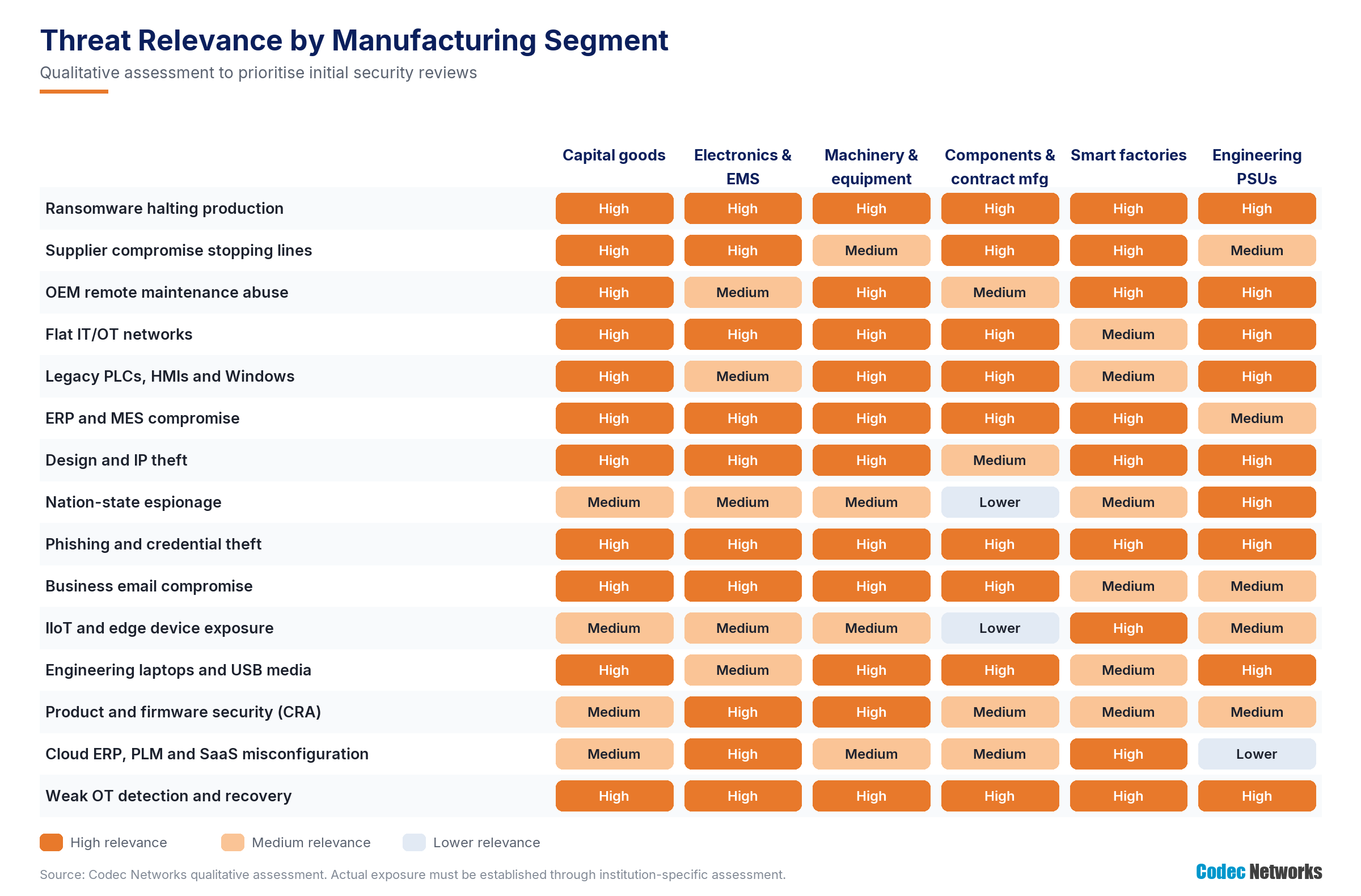
Figure 5: Qualitative threat relevance by manufacturing segment (Codec Networks assessment).
4. Five priority threats in depth
4.1 Ransomware and the ERP dependency
Attackers rarely need to touch a PLC to stop a plant. Encrypting ERP, MES and file servers removes the ability to schedule, pick, label and ship; plants fall back to paper at a fraction of capacity, as Norsk Hydro and Clorox experienced.
- Questions to test: Which plant processes depend on ERP and MES? Can we run and ship without IT for a week? Are backups immutable and restores tested? Would EDR and the SOC catch the intrusion before encryption?
- Relevant services: dependency mapping, segmentation, backup and recovery testing, EDR validation, crisis exercises.
4.2 Suppliers and just-in-time
In a lean supply chain, a supplier's incident is your outage. Toyota's 14-plant stoppage in 2022 came from one parts supplier's systems, not Toyota's own.
- Questions to test: Which single-source or JIT suppliers could stop our lines? Have they been assessed? Do contracts require security and incident notification? Do we hold buffers?
- Relevant services: supplier cyber risk programme, contract clauses, buffer planning, joint exercises.
4.3 OEM remote access and PLC integrity
Automation vendors keep standing remote links to maintain machines and often share credentials across customers. A phished vendor account becomes a path to PLC engineering software.
- Questions to test: Which OEMs can reach our control networks? Is access brokered, time-bound and recorded? Do we verify PLC logic integrity and control changes?
- Relevant services: remote access review and brokering, PLC change control, OT monitoring, vendor assessments.
4.4 Design and intellectual property
A manufacturer's value is in its drawings, recipes and customer relationships. Leavers, contractors and espionage groups all target PLM and CAD repositories, often through cloud sharing.
- Questions to test: Is design data classified and access-controlled? Are uploads to personal cloud monitored? Are leaver procedures enforced on day one?
- Relevant services: data classification, DLP, PLM access reviews, user activity monitoring, forensic readiness.
4.5 Detection, reporting and the 6-hour clock
CERT-In requires reporting within six hours of noticing an incident, and listed companies disclose quarterly. Plant networks are usually unmonitored, so intrusions are found late and reported late.
- Questions to test: Are IT and OT monitored 24x7? Do we see remote sessions and engineering activity? Is there a playbook covering containment, safe plant operation, CERT-In reporting and disclosure?
- Relevant services: IT/OT SOC, playbooks, incident records, joint drills with plant teams.
5. Impact on manufacturers, their customers and their suppliers
|
Player type |
Threats to prioritise |
Main impact |
|
Large manufacturers and PSUs |
Ransomware across plants, espionage, disclosure |
Multi-plant stoppage, strategic loss, market disclosure |
|
Electronics and EMS |
Line stoppage, customer data theft, product vulnerabilities |
Customer penalties, lost contracts, CRA exposure |
|
Machinery and automation makers |
Remote-service platform abuse, product flaws |
Incidents at customers' sites, reputational loss |
|
Component makers and MSMEs |
Ransomware, BEC, being the weak supplier |
Lost OEM contracts, financial loss |
|
OEM customers and end users |
Supplier outages, insecure products |
Their own production stoppages and safety risks |
6. How regulation turns incidents into business events
- CERT-In: incidents reported within six hours of noticing them; logs available for investigation.
- SEBI LODR: listed manufacturers disclose cyber incidents and data loss in the quarterly corporate governance report.
- NCIIPC: incidents affecting notified protected systems require coordination.
- DPDP: incidents involving employee, dealer or consumer personal data trigger breach intimation once provisions commence in May 2027.
- Customers and the EU CRA: contract clauses require incident notification to OEM customers; manufacturers of connected products sold in the EU report actively exploited vulnerabilities and severe incidents.
- Insurers: policies require prompt notification and evidence that warranted controls were in place.
|
Insight The most damaging manufacturing incidents cross boundaries—from a supplier into your plant, from ERP into production, from a vendor's laptop into your PLCs. Strong boundaries, tested recovery and plant-floor visibility are the best defence. |
7. Questions every leadership team should ask
- If ERP went dark tonight, could we ship tomorrow—and for how long?
- Which supplier's outage would stop our lines, and have we assessed them?
- Who can reach our PLCs from outside, and is every session recorded?
- Could a leaver walk out with our drawings without anyone noticing?
- Do we have offline backups of PLC programs and a tested plant restart plan?
- Could we detect, contain and report an incident within six hours while keeping the plant safe?
Talk to Codec Networks
|
Contact Codec Networks Pvt. Ltd. New Delhi: 507, 5th Floor, New Delhi House, Barakhamba Road, Connaught Place, New Delhi – 110001 Gurugram: 707, 7th Floor, Silverton Tower, Golf Course Extension Road, Sector 50, Gurugram – 122018, Haryana Landline: 011 430 496 96 | 011 437 522 99 Mobile: +91 99716 76124 | +91 88007 88220 | +91 88003 31124 Email: mktg@codecnetworks.com Web: www.codecnetworks.com |
Note: Threat descriptions and relevance ratings are general guidance, not findings about any specific organisation. Public incident references are summarised from widely reported events and company disclosures.