

Resources Categories
INDUSTRY FACT FILE · NBFCS & LENDING
Main Products and Services of NBFCs and Lenders
What NBFCs offer, how they originate, service and collect loans, the systems behind each product and where those systems create cybersecurity and compliance exposure.
|
In this document 1. How NBFCs earn their money 2. Products by lender type 3. How loans are originated and serviced 4. Digital lending, co-lending and partnerships 5. The systems behind the products 6. Product trends that change the attack surface 7. Mapping products to Codec Networks engagements |
1. How NBFCs earn their money
NBFCs earn primarily from the spread between their cost of funds—bank borrowings, bonds, commercial paper and, for some, public deposits—and the interest they charge borrowers, plus processing and service fees. Because they borrow from banks and capital markets, their security posture is scrutinised by lenders, rating agencies and investors as well as by RBI.
|
Revenue stream |
How it works |
Security relevance |
|
Interest income |
Interest on home, vehicle, personal, MSME, gold and infrastructure loans |
LOS and LMS integrity and availability protect the core revenue line |
|
Fees and charges |
Processing, documentation, prepayment and late-payment fees |
Fee and charge logic must be tamper-proof and transparent to borrowers |
|
Co-lending and assignment income |
Sharing loans with banks or selling portfolios |
Data exchange with partners must be accurate and secure |
|
Cross-sell income |
Insurance and other products sold with loans |
Borrower data shared with partners must be minimised and protected |
2. Products by lender type
|
Lender type |
Main products |
Main services |
|
Housing finance companies |
Home loans, home improvement and extension loans, loans against property, construction finance |
Branch and digital origination, property document handling, servicing and collections |
|
Vehicle and equipment finance |
New and used car loans, two-wheeler loans, commercial vehicle, tractor and construction equipment finance |
Dealer-point origination, insurance tie-ups, field collections, repossession |
|
NBFC-MFIs |
Joint-liability group loans and individual microloans for income generation |
Field-officer sourcing, centre meetings, cashless collections, financial literacy |
|
Consumer and personal finance |
Personal loans, consumer-durable EMI finance, credit lines, pay-later products |
Point-of-sale and app-based origination, instant approvals, e-mandates |
|
Gold loan companies |
Loans secured by gold jewellery |
Branch valuation and storage, digital top-ups and repayments |
|
Infrastructure finance companies |
Project finance and long-term loans for power, transport and urban infrastructure |
Appraisal, monitoring and syndication with banks and DFIs |
|
MSME and business lenders |
Working-capital loans, term loans, supply-chain and invoice finance |
Data-driven underwriting using GST, bank statements and Account Aggregator data |
3. How loans are originated and serviced
Loans pass through several stages—sourcing, onboarding and KYC, underwriting, disbursement, servicing and collections—each run on different systems and often by different parties.
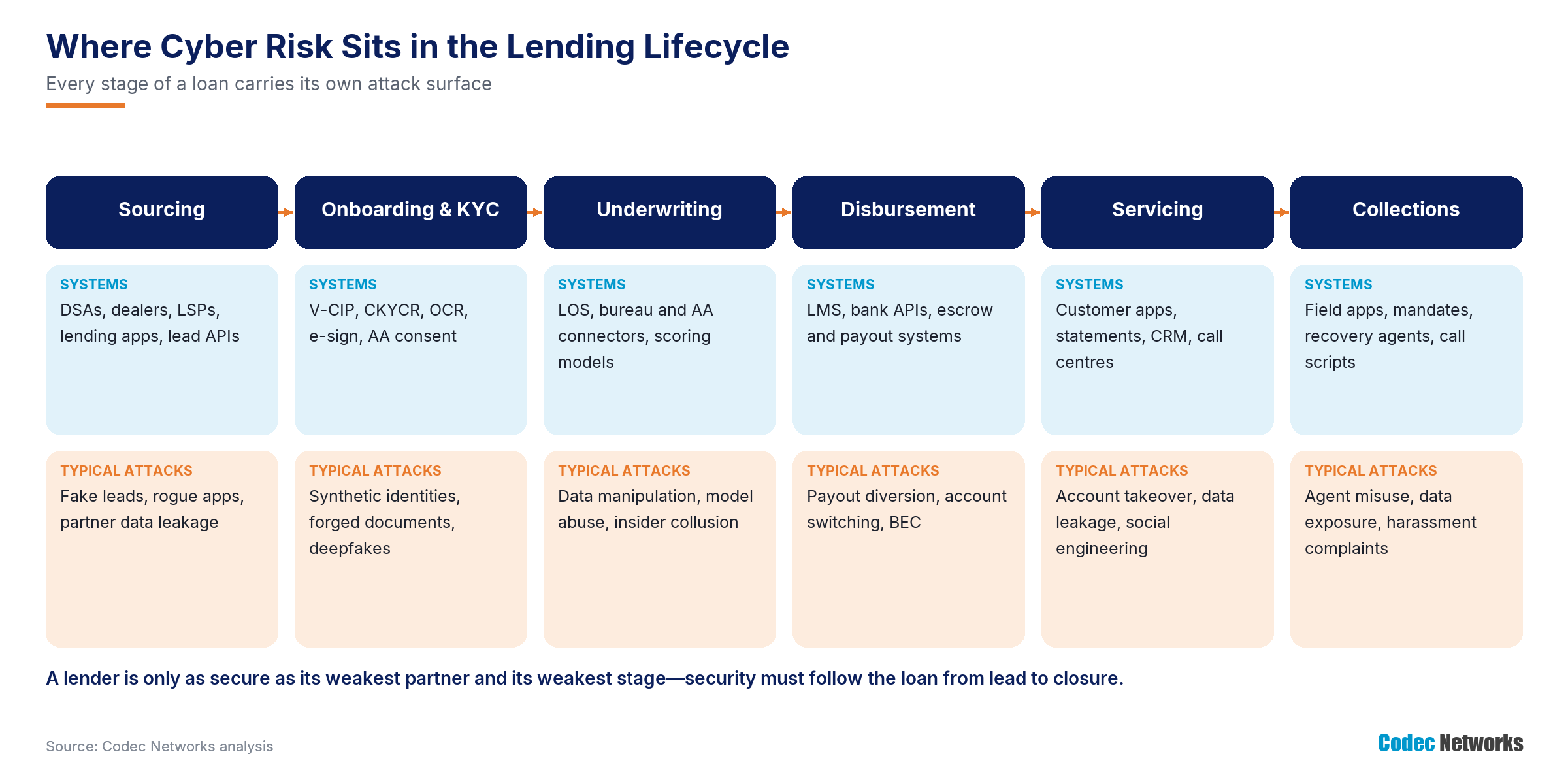
Figure 2: Where cyber risk sits in the lending lifecycle — systems at each stage and the attacks that typically target them.
- Sourcing: branches, field officers, dealers, direct selling agents (DSAs), lending service providers and digital lending apps.
- Onboarding and KYC: CKYCR retrieval, video-based KYC (V-CIP), document capture, e-sign and Account Aggregator consent.
- Underwriting: loan origination systems connected to credit bureaus, bank-statement analysers, AA data and scoring models.
- Disbursement: loan management systems and bank APIs paying borrowers, dealers or sellers.
- Servicing and collections: customer apps, call centres, NACH and UPI AutoPay mandates, field collection apps and recovery agents.
4. Digital lending, co-lending and partnerships
The RBI (Digital Lending) Directions, 2025 govern lending through digital lending apps and lending service providers: regulated lenders remain responsible for their LSPs, must report the digital lending apps they use on RBI's CIMS portal, and must respect restrictions on how borrower data is collected, stored and shared. Multi-lender LSPs must present offers transparently.
The RBI (Co-Lending Arrangements) Directions, 2025—effective 1 January 2026—set the framework for joint lending between banks and NBFCs, including a minimum 10% retention by each partner and a blended interest rate for borrowers. Co-lending requires regular, accurate exchange of borrower and loan data between partners.
|
Why partnerships matter for security In digital and co-lending models, borrower data and loan decisions flow across several organisations. A weakness at an LSP, DSA, dealer or bank-integration point can expose the NBFC's customers and create regulatory consequences for the NBFC itself. |
5. The systems behind the products
|
Product / service |
Systems that deliver it |
Key cyber and compliance touchpoints |
|
Digital personal and consumer loans |
Lending app, LSP platform, LOS, bureau and AA connectors, e-sign |
Digital Lending Directions, API security, borrower-data restrictions |
|
Home loans and LAP |
Branch and DSA portals, document management, LOS, LMS |
Document-fraud controls, data protection, NHB reporting |
|
Vehicle loans |
Dealer portals, field apps, insurance integrations, LMS |
Dealer access control, field-device security, fraud analytics |
|
Microfinance |
Field-officer tablets and apps, offline sync, collection systems |
Device security, offline data protection, agent access monitoring |
|
Gold loans |
Branch systems, valuation and vault records, digital top-up apps |
Branch infrastructure security, insider controls |
|
Co-lending and assignment |
Partner data feeds, APIs, SFTP servers, reconciliation systems |
File integrity, partner authentication, reconciliation controls |
|
Collections |
Mandate systems, payment gateways, call-centre and field apps |
Payment integrity, agent conduct and data-access controls |
6. Product trends that change the attack surface
|
Trend |
What is changing |
Security implication |
|
AI-driven underwriting and collections |
Models and AI assistants make or support decisions |
Model manipulation, data leakage and explainability risks |
|
Account Aggregator-based lending |
Consented financial data replaces paper statements |
Consent integrity and API security become critical |
|
Embedded and point-of-sale credit |
Loans offered inside merchant and consumer apps |
Dependence on partner app security and data handling |
|
Cloud-native LOS and LMS |
Core lending platforms move to cloud and SaaS |
Misconfiguration and shared-responsibility gaps |
|
Field digitisation |
Tablets and apps replace paper in branches and the field |
Device loss, offline data and agent misuse |
|
Deepfake-capable fraud |
Synthetic video and voice used against V-CIP and staff |
Liveness and verification controls must assume impersonation |
7. Mapping products to Codec Networks engagements
|
If the NBFC offers… |
Recommended starting engagement |
|
Digital or app-based loans |
Lending app and API testing, LSP assurance, brand and rogue-app monitoring |
|
Dealer or DSA-sourced loans |
Partner portal testing, dealer and DSA controls review, fraud analytics |
|
Microfinance and field-led lending |
Field app and device security review, agent access monitoring, DLP |
|
Co-lending with banks |
Integration and file-integrity testing, partner security assessment |
|
Branch-based secured lending |
Branch infrastructure assessment, ransomware readiness, privileged-access review |
|
Any NBFC in the Middle Layer or above |
Applicability assessment against Chapter V, six-monthly VA and annual PT programme |
Talk to Codec Networks
|
Contact Codec Networks Pvt. Ltd. New Delhi: 507, 5th Floor, New Delhi House, Barakhamba Road, Connaught Place, New Delhi – 110001 Gurugram: 707, 7th Floor, Silverton Tower, Golf Course Extension Road, Sector 50, Gurugram – 122018, Haryana Landline: 011 430 496 96 | 011 437 522 99 Mobile: +91 99716 76124 | +91 88007 88220 | +91 88003 31124 Email: mktg@codecnetworks.com Web: www.codecnetworks.com |
Note: Product descriptions are general and based on public information available as of October 2026. Lending products are governed by RBI directions, which change frequently; confirm current requirements against official circulars.