

Resources Categories
INDUSTRY FACT FILE · SMART CITIES, WATER & URBAN UTILITIES
Threat Landscape: Top Cyber Threats Facing Smart Cities, Water and Urban Utilities
The 18 most relevant cyber threats, attacks and industry challenges for smart city SPVs, municipal bodies, water and wastewater utilities and urban services operators, and the impact each one has on safety, services and citizens.
|
In this document 1. The threat picture in numbers 2. Top 18 threats, attacks and challenges 3. Threat relevance by smart city and urban utility segment 4. Five priority threats in depth 5. Impact on cities, utilities and the citizens they serve 6. How regulation turns incidents into business events 7. Questions every leadership team should ask |
1. The threat picture in numbers
|
Feb 2021 Oldsmar: lye set-point raised from 100 to 11,100 ppm via remote desktop |
Nov 2023 Aliquippa: booster station PLC seized through a default password |
Dec 2023 MP e-Nagarpalika portal for 413 towns corrupted by a cyber attack |
6 hours To report incidents to CERT-In |
Cities and utilities attract hacktivists and state-linked groups because water, traffic and surveillance are visible, symbolic targets; ransomware groups because municipal portals and command centres cannot stay down without public pressure; fraudsters because tax and billing move citizen payments; and opportunists because plants and field devices are exposed with default settings. The attack surface spans legacy SCADA and HMIs, thousands of IoT gateways, integrator-operated ICCCs, cloud data platforms and internet-facing citizen portals—usually defended by small teams.
Landmark incidents show the pattern. Oldsmar (2021) and Aliquippa (2023) were reached through remote-desktop software and an internet-exposed PLC; the US EPA (2024) found about 70 per cent of inspected systems failing basic standards; Southern Water (2024) spent about £4.5 million responding to a Black Basta ransomware attack and South Staffordshire Water (2022) had corporate IT hit by Clop; American Water (2024) paused billing after an intrusion. In India, Pimpri-Chinchwad's smart city servers (2021), Goa's flood-monitoring system (2022) and Madhya Pradesh's e-Nagarpalika portal (2023) were all hit by ransomware or data-destroying attacks.
2. Top 18 threats, attacks and challenges
The list below is a practical assessment framework, not a statistical ranking. Priority varies by business model, technology exposure and existing controls.
|
# |
Threat / attack / challenge |
Typical scenario |
Most exposed |
Potential impact |
|
1 |
Ransomware on municipal ERP and portals |
E-governance, tax and billing systems encrypted in collection season |
Municipal bodies, SPVs |
Service outage, lost revenue, citizen data exposure |
|
2 |
SCADA and PLC manipulation |
Set-points, pumps or dosing altered at water or sewage plants |
Water and wastewater utilities |
Public health and environmental harm |
|
3 |
Internet-exposed HMIs and remote access |
Remote-desktop tools and PLCs reachable from the internet |
Plants, pumping stations |
Direct path to control systems |
|
4 |
ICCC platform compromise |
Command centre servers, VMS or dashboards taken over or encrypted |
Smart city SPVs, safe-city operators |
City blind; emergency response degraded |
|
5 |
CCTV and surveillance exposure |
Camera feeds, ANPR and recognition data accessed or leaked |
Safe-city, ICCC operators |
Privacy harm, stalking, loss of trust |
|
6 |
Vendor, MSI and O&M remote access abuse |
Standing VPNs and shared integrator accounts hijacked |
All bodies |
Path into ICCC, SCADA and portals |
|
7 |
Flat city and plant networks |
ICCC, SCADA, Wi-Fi, CCTV and office IT on one network |
SPVs, utilities |
Lateral movement from office to plant |
|
8 |
Citizen data theft |
Identity, property and payment records exfiltrated from portals |
Municipal bodies, SPVs |
Fraud against residents, DPDP exposure |
|
9 |
Phishing and credential theft |
Staff, contractor and integrator accounts targeted |
All bodies |
Initial access |
|
10 |
Hacktivism and state-sponsored attacks |
Defacement, disruption and PLC attacks for political effect |
Water utilities, safe-city systems |
Disruption, propaganda, physical risk |
|
11 |
Legacy controllers and telemetry |
Unsupported PLCs, Windows 7 HMIs, unauthenticated radio links |
Water and wastewater plants |
Easy exploitation, spoofed readings |
|
12 |
IoT, smart meters and streetlights |
Field gateways with default credentials enrolled in botnets |
Concessionaires, SPVs |
Service failure, pivot into telemetry |
|
13 |
Payment and collection fraud |
Fake payment links, tampered billing, diverted collections |
Municipal bodies, water boards |
Revenue loss, citizen losses |
|
14 |
Cloud and data platform misconfiguration |
Exposed storage, over-privileged APIs, weak identity |
State platforms, SPVs |
Multi-city data exposure |
|
15 |
Traffic, parking and transit manipulation |
Signal controllers, AFC and parking systems altered |
Traffic and transit units |
Congestion, safety risk, revenue loss |
|
16 |
Insider misuse and contractor churn |
Credentials retained after contracts end; data exported |
All bodies |
Theft, sabotage, leaks |
|
17 |
Weak detection and response |
No monitoring of plants, ICCC or vendor sessions |
Most bodies |
Long dwell time; missed 6-hour reporting |
|
18 |
Backup and recovery failure |
No offline backups of ICCC, SCADA configurations or portals |
All bodies |
Weeks of outage, data loss |
3. Threat relevance by smart city and urban utility segment
The matrix is a qualitative guide for prioritising the first round of security reviews.
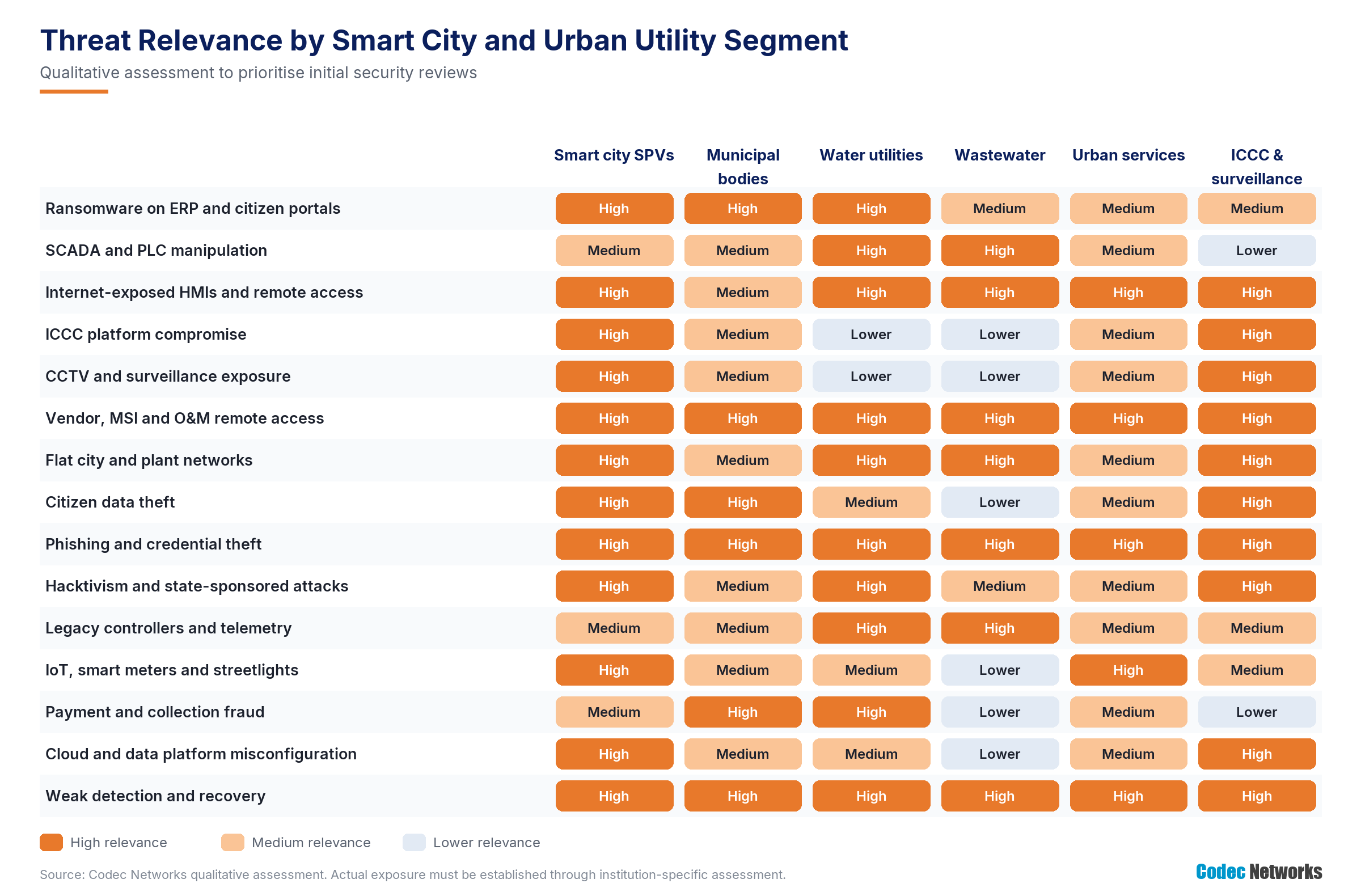
Figure 5: Qualitative threat relevance by smart city and urban utility segment (Codec Networks assessment).
4. Five priority threats in depth
4.1 Plants reachable from outside
Oldsmar was reached through remote-desktop software on an unsupported workstation; Aliquippa through a PLC exposed to the internet with a default password. Indian plants built by contractors often carry the same conveniences.
- Questions to test: Which plants and pumping stations are reachable from the internet or remote-desktop tools? Are default passwords changed? Would set-point limits and alarms catch a malicious change? Are plant and office networks separated?
- Relevant services: SCADA and HMI assessment, remote access removal and brokering, set-point and alarm review, OT monitoring.
4.2 Command centres and their integrators
An ICCC concentrates a city's eyes and controls, and the master system integrator usually holds standing access to all of it. A stolen integrator credential or a ransomware event at the integrator becomes the city's incident.
- Questions to test: Which vendors can reach the ICCC, VMS and SCADA, and is access brokered, named and recorded? Are ICCC platforms segmented from field and office networks? Are backups offline and restores tested?
- Relevant services: MSI access programme, ICCC assessment, segmentation, backup and recovery testing.
4.3 Citizen portals and collection season
Municipal portals and ERP are internet-facing, hold data on millions and peak in tax season. The 2023 attack on Madhya Pradesh's e-Nagarpalika portal corrupted data for 413 towns and forced recovery from tape.
- Questions to test: Are portals and APIs tested and patched? Are backups immutable and restores rehearsed? Is citizen data classified and exports controlled? Is there a manual counter playbook?
- Relevant services: application testing, patch governance, backup review, DPDP programme, continuity playbooks.
4.4 Surveillance data and public trust
City camera networks now carry ANPR and facial recognition. Without governance, contractors and insiders can export footage and recognition logs, and the DPDP Act's protections and exemptions make lawful purpose and access control essential.
- Questions to test: Who can view and export footage and recognition data, and is it logged? What is the purpose, retention and legal basis? Are cameras compliant with MeitY requirements? Are contractor rights removed on exit?
- Relevant services: VMS and analytics assessment, surveillance governance review, DPDP programme, contractor controls.
4.5 Detection, reporting and the 6-hour clock
CERT-In requires reporting within six hours of noticing an incident, and government entities are expected to have a designated CISO and baseline controls. Plants, field networks and vendor sessions are usually unmonitored, so incidents surface through citizens or the media.
- Questions to test: Are plants, ICCC, IoT and IT monitored 24x7? Do we see vendor sessions and configuration changes? Is there a playbook covering safety decisions, containment, CERT-In reporting and public communication?
- Relevant services: city SOC, playbooks, incident records, joint drills with plant, ICCC and civic teams.
5. Impact on cities, utilities and the citizens they serve
|
Player type |
Threats to prioritise |
Main impact |
|
Smart city SPVs and ICCC operators |
Platform takeover, ransomware, surveillance exposure |
City blind, emergency response degraded, public trust lost |
|
Municipal corporations |
Portal ransomware, citizen data theft, payment fraud |
Service outage, revenue loss, DPDP exposure |
|
Water and wastewater utilities |
SCADA manipulation, exposed HMIs, telemetry spoofing |
Public health risk, overflows, supply disruption |
|
Concessionaires and operators |
IoT botnets, contract non-compliance, user data exposure |
Service failure, penalties, lost concessions |
|
Citizens and businesses |
Unsafe water, failed services, misused data |
Health, financial and privacy harm |
6. How regulation turns incidents into business events
- CERT-In: incidents reported within six hours of noticing them; logs available for investigation; government entities expected to have a CISO and baseline controls.
- NCIIPC: incidents affecting notified protected systems require coordination.
- DPDP: incidents involving citizen, commuter or surveillance data trigger breach intimation once provisions commence in May 2027, subject to any exemptions for notified state instrumentalities.
- State governments and auditors: incidents at ULBs and SPVs draw state review, CAG or state audit observations and assembly questions.
- Lenders and concessions: notification and remediation clauses in loan and PPP agreements.
- Police and courts: FIRs, evidence preservation and public-interest litigation, as in past Indian incidents.
|
Insight The most dangerous city incidents cross boundaries—from an integrator into the ICCC, from a remote-desktop tool into a dosing screen, from a portal into citizen data, from a streetlight gateway into pumping telemetry. Strong boundaries, controlled vendor access and plant-floor visibility are the best defence. |
7. Questions every leadership team should ask
- Which plants, pumping stations and controllers can be reached from the internet, and who holds remote access?
- Who can log in to our command centre and VMS, and would we know if an integrator's credential were stolen?
- If our citizen portal and ERP went dark in tax season, could we serve, collect and communicate?
- Who can export camera footage and recognition data, under what authority, and is it logged?
- Do we have offline backups of ICCC platforms, SCADA configurations and portals, and have we restored them?
- Could we detect, contain and report an incident within six hours while keeping water and traffic safe?
Talk to Codec Networks
|
Contact Codec Networks Pvt. Ltd. New Delhi: 507, 5th Floor, New Delhi House, Barakhamba Road, Connaught Place, New Delhi – 110001 Gurugram: 707, 7th Floor, Silverton Tower, Golf Course Extension Road, Sector 50, Gurugram – 122018, Haryana Landline: 011 430 496 96 | 011 437 522 99 Mobile: +91 99716 76124 | +91 88007 88220 | +91 88003 31124 Email: mktg@codecnetworks.com Web: www.codecnetworks.com |
Note: Threat descriptions and relevance ratings are general guidance, not findings about any specific organisation. Public incident references are summarised from widely reported events, regulator statements and official disclosures.