

Resources Categories

INDUSTRY FACT FILE · SPACE, SATELLITE & GEOSPATIAL SERVICES
Industry Overview: Space, Satellite and Geospatial Services in India
Who builds, launches, operates and sells India's space and geospatial services, the rules that apply, who buys cybersecurity in the sector and why each segment needs its own approach.
|
In this document 1. Why space and geospatial security matters now 2. The ecosystem at a glance 3. Categories of space, satellite and geospatial organisations 4. The space, telecom, geospatial, cyber and data framework at a glance 5. Authorities, infrastructure and ecosystem participants 6. Who buys cybersecurity inside a space or geospatial business 7. Why each segment needs a different approach 8. How Codec Networks works with space, satellite and geospatial businesses |
|
Sector scope Sector: satellite makers and operators, launch start-ups, ground stations and teleports, satcom providers, earth observation, geospatial and navigation vendors. Primary service proposition: ground infrastructure security, API/cloud testing, identity controls, supply chain assurance. Defence has a separate fact file. |
1. Why space and geospatial security matters now
India has opened its space sector to private enterprise in a few short years. Reforms announced in 2020 created the Indian National Space Promotion and Authorisation Centre (IN-SPACe) as a single-window body to promote, guide and authorise non-government space activities. The Indian Space Policy 2023, approved by the Cabinet Committee on Security on 6 April 2023, set out the division of labour: ISRO concentrates on research and new technology and steps back from making operational systems, NewSpace India Limited (NSIL) commercialises technologies and platforms built with public money, IN-SPACe authorises activities, and private entities may participate across the value chain, from building and operating satellites and launch vehicles to establishing ground stations and selling satellite-based services. IN-SPACe released its Norms, Guidelines and Procedures for authorising space activities in May 2024, covering the operation of space objects, launch and the establishment of ground systems, and from 1 April 2025 only IN-SPACe-authorised foreign satellites and constellations may provide capacity in India. In February 2024 the Union Cabinet liberalised foreign direct investment: up to 74% through the automatic route for satellite manufacturing and operation, satellite data products and ground and user segments, up to 49% for launch vehicles and spaceports, and up to 100% for satellite components and subsystems, with higher stakes possible through the government route.
|
US$8.4 bn Indian space economy in 2022 (IN-SPACe) |
~440 Space technology start-ups on the DPIIT portal |
113 IN-SPACe authorisations to 52 entities (Aug 2026) |
6 hours To report cyber incidents to CERT-In |
The market is growing on the back of these reforms. IN-SPACe's Decadal Vision targets growth of the Indian space economy from about US$8.4 billion in 2022 to US$44 billion by 2033, including US$11 billion of exports, and in October 2024 the Union Cabinet approved a ₹1,000 crore venture capital fund for the sector under IN-SPACe. In a reply to Parliament in August 2026 the government reported about 440 space technology start-ups registered on the DPIIT Start-up India portal and 113 IN-SPACe authorisations granted to 52 non-government entities, 18 of them start-ups. Satellite communication is changing fastest: the Department of Telecommunications has issued satellite service permits to several operators, including low-earth-orbit broadband providers that also hold IN-SPACe authorisations, and reports in 2025 described additional national security conditions for satcom licensees covering lawful interception, monitoring and in-country data facilities. Earth observation and geospatial services have been liberalised too: the Department of Science and Technology's Geospatial Data Guidelines of 15 February 2021 removed the need for prior approval, security clearance or licences for most acquisition and publication of geospatial data and maps, replacing them with a list of sensitive attributes that may not be shown, and the National Geospatial Policy 2022 builds on them. NavIC, India's regional navigation satellite system, underpins location services alongside other GNSS constellations.
Every space service depends on systems on the ground. Satellites are commanded from mission control centres through telemetry, tracking and command (TT&C) links; ground stations and teleports run antennas, modems, baseband equipment and scheduling software, increasingly shared between operators or offered as ground-station-as-a-service; satcom providers run hubs, gateways, network management systems and fleets of user terminals that receive software updates; and earth observation, geospatial and location businesses deliver their products through cloud platforms and APIs. The most consequential cyber attack on a satellite service to date proved the point. On 24 February 2022, about an hour before Russia's invasion of Ukraine, attackers abused the management network of Viasat's KA-SAT service to push the AcidRain wiper to consumer modems; Viasat said tens of thousands of terminals were rendered inoperable and shipped nearly 30,000 replacements, and in Germany Enercon reported that about 5,800 wind turbines lost remote monitoring and control. The EU, the UK and the US attributed the attack to Russia in May 2022, and CISA and the FBI issued an advisory urging satcom providers and customers to use multi-factor authentication, least privilege, independent link encryption and monitoring. The satellites were never touched: the ground segment was the target.
Indian operators are firmly in the frame. ISRO's then chairman S. Somanath said in October 2023 that the agency faces more than 100 cyber attacks every day. Satellite navigation is under pressure as well: DGCA issued an advisory circular on GNSS interference in November 2023, and in December 2025 the government confirmed GPS spoofing reports near Delhi's airport and interference reports from several other major airports, a reminder that location services must be designed to cope with degraded or false signals. Cyber obligations apply across the sector. CERT-In's Directions require incidents to be reported within six hours and ICT logs to be kept for 180 days, and its July 2025 audit guidelines cover risk-based audits including OT; telecom entities, including satcom licensees, fall under the Telecommunications (Telecom Cyber Security) Rules 2024; the DPDP Act applies to personal and location data; and operators serving telecom, power, transport, BFSI or government customers may find that parts of their service touch systems notified as protected under Section 70 of the IT Act. Abroad, the European Commission proposed an EU Space Act in June 2025 with cybersecurity rules that reach ground as well as in-orbit infrastructure, which Indian firms serving European customers should track as it moves through the legislative process.
|
Key takeaway In space and geospatial services, the ground is where most attacks land. Securing ground stations, mission control and command keys, satcom management networks and terminal updates, testing every API and cloud platform that sells imagery or location data, controlling privileged and vendor access, assuring suppliers and reporting incidents within six hours are now authorisation, licence, customer and investor expectations, not optional extras. |
2. The ecosystem at a glance
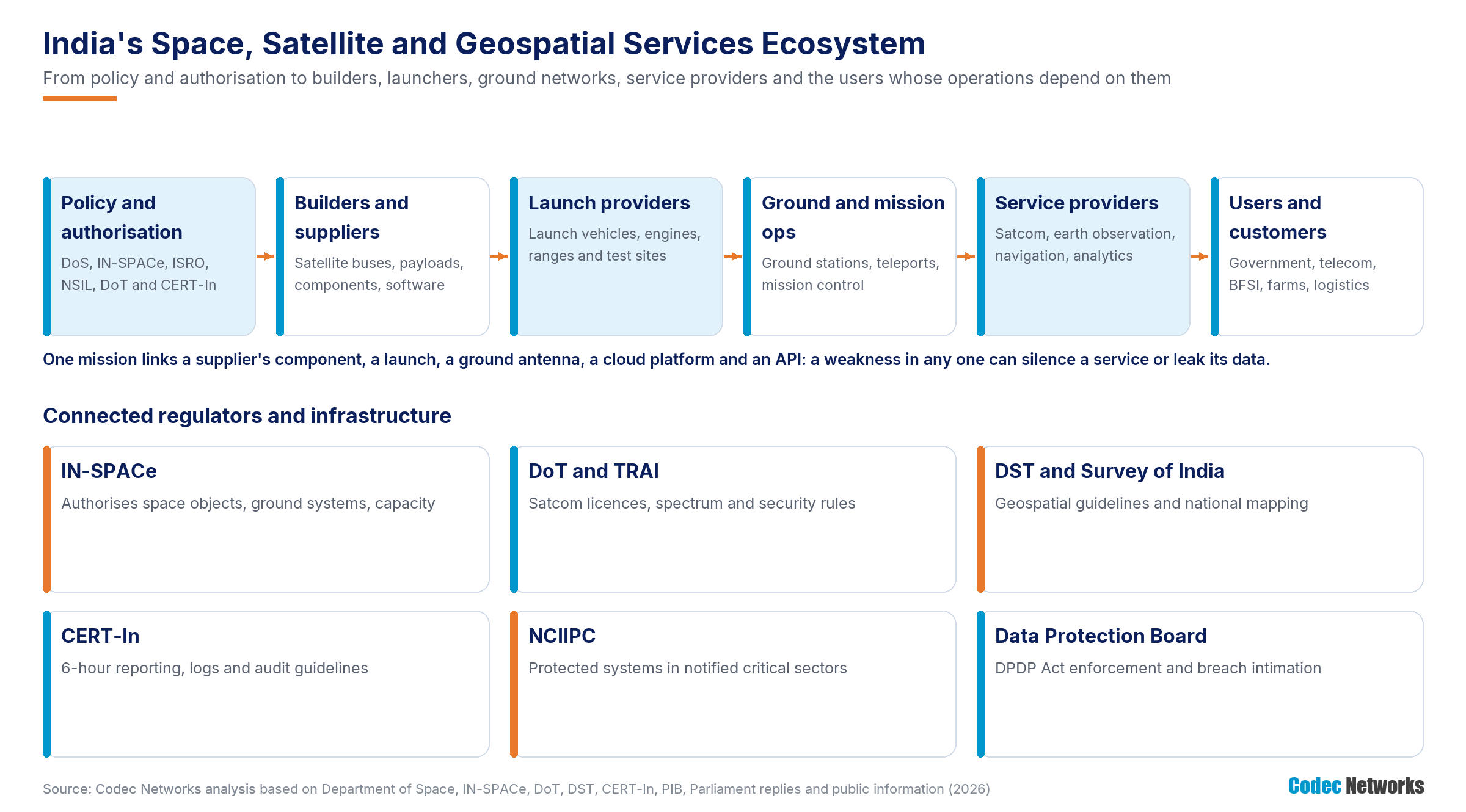
Figure 1: India's space, satellite and geospatial services ecosystem.
3. Categories of space, satellite and geospatial organisations
|
Category |
Who they are |
Typical ownership |
Key regulatory basis |
|
Satellite manufacturers |
Makers of small satellites, buses, payloads and subsystems for government, commercial and export customers |
Private; start-ups, listed firms and joint ventures |
Space Policy 2023; IN-SPACe NGP; FDI policy; export controls; CERT-In |
|
Component and subsystem suppliers |
Solar arrays, propulsion, star trackers, radios, onboard computers and flight software |
Private, often MSMEs |
FDI up to 100% automatic; buyer and tender terms; CERT-In |
|
Satellite operators |
Communication, earth observation and constellation operators, including NSIL-owned capacity |
Private, PSU and joint ventures |
IN-SPACe authorisation; telecom licences where services are sold; CERT-In |
|
Launch service start-ups |
Developers of small launch vehicles, engines, launch pads and test facilities |
Private, venture-funded |
IN-SPACe authorisation; FDI up to 49% automatic; range and safety terms |
|
Ground station and teleport operators |
Antenna networks, TT&C, teleports and ground-station-as-a-service |
Private and PSU |
IN-SPACe NGP for ground systems; DoT licences for teleports; CERT-In |
|
Satellite communications providers |
VSAT, satellite broadband, maritime, aero and mobile satellite services |
Private licensees and global operators |
Telecom Act 2023; DoT licence conditions; Telecom Cyber Security Rules; IN-SPACe |
|
Earth observation and geospatial platforms |
Imagery, analytics, mapping, GIS, surveying and digital twin providers |
Private, often SaaS |
Geospatial Guidelines 2021; National Geospatial Policy 2022; DPDP; CERT-In |
|
Navigation and location-solution vendors |
GNSS and NavIC receivers, fleet telematics, location SDKs and APIs |
Private |
IT Act; DPDP for location data; client contracts; CERT-In |
4. The space, telecom, geospatial, cyber and data framework at a glance
|
Instrument or expectation |
What it means for space, satellite and geospatial businesses |
|
Indian Space Policy 2023 |
Roles of ISRO, NSIL, IN-SPACe and private entities; non-government entities may build and operate satellites, launch vehicles and ground facilities, subject to IN-SPACe authorisation |
|
IN-SPACe Norms, Guidelines and Procedures (May 2024) |
Authorisation of space objects, launch and ground systems, eligibility of Indian entities, registration of space objects; foreign satellites need IN-SPACe authorisation to provide capacity in India from 1 April 2025 |
|
FDI policy amendment for space (February 2024) |
Automatic route up to 74% for satellites, data products and ground and user segments, 49% for launch vehicles and spaceports, 100% for components; investor and ownership due diligence follows |
|
Telecommunications Act 2023 and DoT licences |
Authorisation of satellite communication services; the First Schedule lists satellite services for administrative assignment of spectrum; licence conditions include security, interception and monitoring requirements |
|
Telecommunications (Telecom Cyber Security) Rules 2024 |
Notified on 21 November 2024; telecom entities report security incidents within six hours with details within 24 hours, appoint a Chief Telecommunication Security Officer and maintain security operations |
|
CERT-In Directions (28 April 2022) and audit guidelines (25 July 2025) |
Incidents reported within six hours; ICT logs kept for 180 days in India; clocks synchronised; risk-based independent audits, including OT and ICS environments |
|
Geospatial Data Guidelines 2021 and National Geospatial Policy 2022 |
No prior approval for most acquisition and publication of geospatial data and maps; a negative list of sensitive attributes; self-certification of compliance |
|
IT Act 2000 and NCIIPC |
Offences such as unauthorised access; protected systems under Section 70 in notified critical sectors, which satellite services may support |
|
DPDP Act 2023 and Rules 2025 |
Personal and location data of customers, drivers, field staff and app users; reasonable security safeguards and breach intimation; most obligations from May 2027 |
|
Export markets: EU Space Act proposal and NIS2 |
Proposed in June 2025 with cyber risk management, testing and incident reporting for space operators and ground infrastructure; still in the legislative process; NIS2 lists space as a sector of high criticality |
|
How these apply Space duties follow the activity and the IN-SPACe authorisation; telecom duties follow the licence; CERT-In's Directions apply to service providers, intermediaries, data centres and body corporates; geospatial rules follow the data; DPDP applies to personal data; export rules follow the market. Confirm against the official instruments and your agreements. |
5. Authorities, infrastructure and ecosystem participants
- The Department of Space frames space policy and IN-SPACe promotes, guides and authorises non-government space activities, while ISRO focuses on research and missions and NSIL commercialises space technologies and capacity.
- The Department of Telecommunications licenses satellite communication services and sets their security conditions, TRAI recommends terms such as spectrum pricing, and the Wireless Planning and Coordination Wing manages frequency matters.
- The Department of Science and Technology issues the geospatial guidelines and policy, and the Survey of India maintains national mapping and reference frameworks.
- CERT-In receives incident reports and issues advisories and audit guidelines; NCIIPC protects notified critical information infrastructure; MeitY frames IT and data policy, and the Data Protection Board enforces the DPDP Act.
- Satellite makers, component suppliers, launch start-ups, satellite operators, ground station and teleport operators, satcom providers and geospatial and location firms design, launch and run the services; government, telecom, BFSI, energy, agriculture, logistics and maritime users depend on them.
- Cloud providers, antenna and modem vendors, integrators, analytics and mapping vendors and international partners sit inside almost every service, and their weaknesses become the operator's incidents.
6. Who buys cybersecurity inside a space or geospatial business
|
Stakeholder |
What they care about |
What they buy |
|
Board, founders and CEO |
Authorisations, contracts, investor and FDI diligence, reputation, export growth |
Board briefings, maturity assessments, crisis exercises |
|
CTO and head of mission systems |
Secure flight software, mission control, ground systems and command keys |
Ground segment testing, secure SDLC, key custody reviews |
|
CISO or head of information security |
Ground network exposure, cloud and API security, CERT-In and customer audits |
CERT-In empanelled audits, VAPT, SOC, incident response retainers |
|
Head of ground operations or network operations |
Antennas, teleports, NMS, terminal updates and vendor access |
Ground station and satcom network assessments, access reviews |
|
Product and platform heads (EO, geospatial, location) |
API security, tenant isolation, data delivery and uptime |
API and cloud VAPT, DevSecOps reviews, abuse monitoring |
|
Supply chain and procurement |
Component and software provenance, supplier evidence, contract clauses |
Supplier assessments, SBOM and software integrity reviews |
|
Data protection officer, legal and regulatory affairs |
Location and personal data, sensitive geospatial attributes, licence conditions |
Privacy programmes, data mapping, licence condition reviews |
7. Why each segment needs a different approach
|
Organisation type |
Highest-consequence risk |
Starting point for assurance |
|
Satellite makers and component suppliers |
Tampered components or flight software and theft of designs |
Supplier assessments, software integrity and SBOM reviews, engineering IT security |
|
Satellite operators and mission control |
Misuse of command access and keys, or loss of control of a satellite |
Mission control and TT&C reviews, privileged access and key custody |
|
Launch start-ups |
Ransomware or OT intrusion at test sites and launch preparation |
Range and test facility OT assessment, engineering IT, recovery testing |
|
Ground stations and teleports |
Vendor tunnels and flat networks exposing antennas and scheduling |
Ground network VAPT, segmentation and vendor access review |
|
Satcom providers |
Management network compromise pushing malicious terminal updates |
Hub, NMS and update server assessment, MFA, managed SOC |
|
EO, geospatial and location platforms |
Broken API authorisation exposing imagery or location histories |
API and multi-tenant testing, cloud review, DPDP programme |
8. How Codec Networks works with space, satellite and geospatial businesses
Codec Networks is a CERT-In empanelled information security auditing organisation, empanelled with NICSI for application audit and compliance services (start-up category), and certified to ISO 9001:2015, ISO/IEC 27001:2022 and ISO/IEC 20000-1:2018. For space, satellite and geospatial businesses we deliver ground station and teleport security assessments covering antenna control, baseband and modem networks, scheduling systems and segmentation; mission control and TT&C reviews focused on who can command a satellite and how command keys are held; satcom network assessments of hubs, gateways, network management systems, management VPNs and terminal update processes; VAPT of earth observation tasking and delivery APIs, geospatial and location platforms and cloud ground segment deployments, including tenant isolation testing; identity and privileged access reviews for operators, engineers and vendors; supply chain assurance for component and software suppliers, integrators and support vendors, including SBOM and software integrity reviews; OT assessments of launch ranges and test facilities; CERT-In empanelled audits; ISO 27001 readiness and support for telecom security obligations; DPDP programmes for location and customer data; 24x7 managed SOC for ground networks, NMS, cloud and APIs; and incident response and forensics for ground segment, terminal and data incidents. Radio frequency and link testing is performed only with authorisation, in controlled environments, coordinated with the customer and any required licences and permissions. Each proposal confirms auditor eligibility and independence against CERT-In's and the client's requirements. Codec Networks does not provide space authorisation, spectrum, licensing or export control advice.
Talk to Codec Networks
|
Contact Codec Networks Pvt. Ltd. New Delhi: 507, 5th Floor, New Delhi House, Barakhamba Road, Connaught Place, New Delhi – 110001 Gurugram: 707, 7th Floor, Silverton Tower, Golf Course Extension Road, Sector 50, Gurugram – 122018, Haryana Landline: 011 430 496 96 | 011 437 522 99 Mobile: +91 99716 76124 | +91 88007 88220 | +91 88003 31124 Email: mktg@codecnetworks.com Web: www.codecnetworks.com |
Note: This document is general industry guidance based on public information available as of October 2026. It is not legal, regulatory, licensing, export control or national security advice. Obligations differ by activity (manufacturing, launch, satellite operation, ground systems, satellite communication services, earth observation, geospatial data or navigation and location services), by the IN-SPACe authorisations, telecom licences and permissions held, by the customers and countries served, listing status, contracts and the data each organisation handles; confirm them against the official Department of Space, IN-SPACe, Department of Telecommunications, TRAI, Department of Science and Technology, CERT-In, NCIIPC, MeitY and Data Protection Board instruments, any space activities law if enacted, and your agreements. Radio frequency and link testing is described only as authorised testing in controlled environments, coordinated with the customer and any required licences and permissions. Incident references are summarised from official statements and widely reported events.