

Resources Categories

INDUSTRY FACT FILE · TEXTILES, APPAREL & CONSUMER MANUFACTURING
Main Products and Services in Textiles, Apparel and Consumer Manufacturing
What India's mills, exporters, footwear and consumer goods makers and brands produce and deliver, the plant, enterprise, buyer and consumer systems behind each activity, and where those systems create cybersecurity and compliance exposure.
|
In this document 1. How textile, apparel and consumer manufacturers earn their money 2. Products and services by company type 3. The factory layer: machines, lines and plant systems 4. The enterprise and channel layer: ERP, PLM, buyers and D2C 5. The systems behind the products and services 6. Trends that change the attack surface 7. Mapping operations to Codec Networks engagements |
1. How textile, apparel and consumer manufacturers earn their money
|
Revenue stream |
How it works |
Security relevance |
|
Export orders from global brands |
Garments, home textiles, footwear and goods made to buyers' designs, prices and ship dates |
Buyer data and designs; document integrity; on-time shipment; vendor compliance |
|
Yarn, fabric and intermediate sales |
Spinning and weaving output sold to converters, exporters and traders |
ERP order-to-cash; e-invoicing; plant uptime |
|
Job-work and contract manufacturing |
Processing, embroidery, assembly and packaging for others |
Customer data; delivery performance; small IT teams |
|
Own brands through retail and wholesale |
Branded apparel, footwear and consumer goods through stores, distributors and marketplaces |
Pricing and scheme data; distributor portals; brand reputation |
|
Direct-to-consumer sales |
Brand websites, apps, marketplace stores, subscriptions and loyalty |
Consumer and payment data; account security; availability in sale events |
2. Products and services by company type
|
Company type |
Main products and services |
Key systems |
|
Spinning and weaving mills |
Yarn, woven and knitted fabric, denim, technical textiles |
Mill ERP, machine monitoring, lab and quality systems, power and utilities |
|
Processing and job-work units |
Dyeing, printing, finishing, embroidery, washing |
Recipe and colour systems, job-work order tracking, small ERP |
|
Garment and home textile exporters |
Apparel, made-ups, home textiles to buyer specifications |
ERP, PLM, cutting-room software, line monitoring, buyer portals, export documentation |
|
Footwear manufacturers |
Leather and non-leather footwear, components |
CAD for lasts and patterns, cutting and injection machines, ERP, buyer portals |
|
Consumer products manufacturers |
Home, personal care, lifestyle and household goods |
ERP, MES, packaging lines, brand and distributor portals, product firmware where connected |
|
Brand owners and D2C arms |
Design, sourcing, marketing, retail and online sales |
PLM, e-commerce platforms, apps, OMS, CRM, loyalty, payment gateways, marketplaces |
3. The factory layer: machines, lines and plant systems
A modern mill or garment factory is more automated than it looks. Spinning and weaving machines report to monitoring systems; cutting rooms run on CAD and automated cutters; knitting, embroidery and sewing automation carry programmable controllers; line monitoring and manufacturing execution systems track output and quality; and laboratories and colour-matching systems hold recipes. Footwear and consumer goods plants add injection moulding, assembly and packaging lines with PLCs and HMIs, and sometimes product firmware for connected goods.
Much of this estate is vendor-maintained and loosely networked. Machine controllers run for many years on unsupported operating systems, OEMs connect remotely to service knitting, embroidery and cutting equipment, and the plant network is frequently the same flat network as the office. The result is that an office infection or a vendor laptop can reach the lines, and that a ransomware event in IT stops cutting plans, labels and packing even when machines could run.
4. The enterprise and channel layer: ERP, PLM, buyers and D2C
Above the factory sits the enterprise layer that actually ships goods. ERP manages orders, materials, production, GST e-invoicing and dispatch; export documentation flows through customs and bank systems; PLM and shared cloud folders hold designs, tech packs, lasts and costings; buyer portals and EDI carry purchase orders, approvals and compliance records; and HR and contractor systems hold data on large workforces. If ERP or the document systems stop, lines may keep sewing but nothing can be packed, invoiced or cleared.
Brand owners and D2C arms add a consumer-facing layer: e-commerce platforms, apps, order management, CRM and loyalty systems, payment gateways and marketplace integrations, usually built from SaaS and third-party scripts and run by marketing as much as IT. These systems hold consumer personal data covered by DPDP, process card payments covered by PCI DSS, and are exposed to credential stuffing, web skimming and fraud every sale season.
|
Highest-risk moments Peak-season shipments that depend entirely on ERP and document systems, buyer remittances and supplier payments that can be redirected by a convincing email, design files shared with contractors and buyers in cloud folders, D2C sale events that attract credential stuffing and skimming, vendor laptops and remote sessions into plant machines, and job-workers whose outage starves your lines are where incidents in this sector typically begin or escalate. |
5. The systems behind the products and services
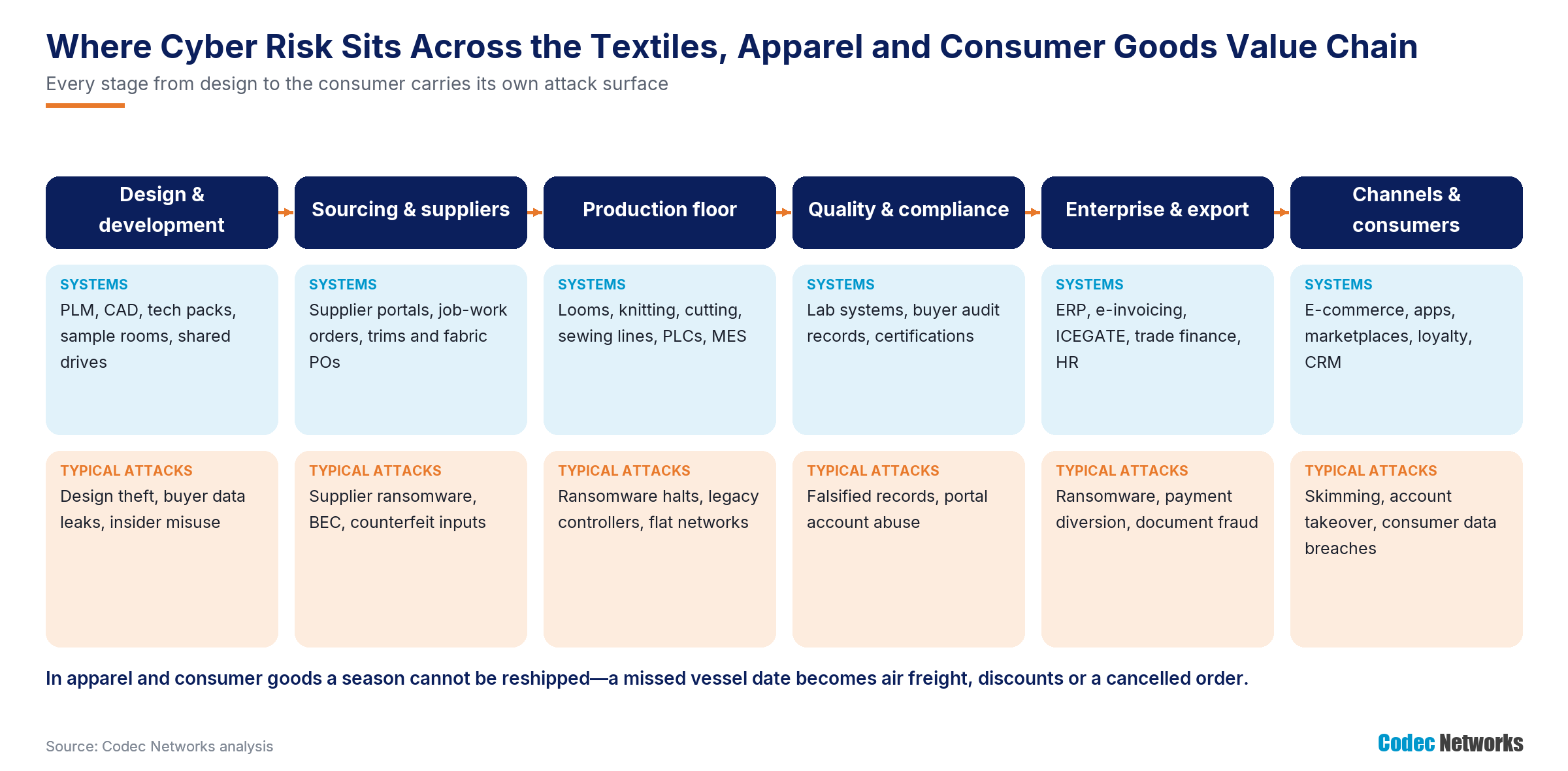
Figure 2: Where cyber risk sits across the textiles, apparel and consumer goods value chain.
|
Product / service |
Systems that deliver it |
Key cyber and compliance touchpoints |
|
Design and development |
PLM, CAD, tech packs, sample rooms, shared drives |
Data classification, access reviews, DLP, contractor controls |
|
Sourcing and suppliers |
Supplier portals, job-work orders, fabric and trim POs |
Supplier assessments, portal testing, payment controls |
|
Production floor |
Cutting, knitting, sewing and packaging automation, MES, line monitoring |
Segmentation, OEM remote access controls, legacy compensating controls |
|
Quality and compliance |
Lab systems, buyer audit records, certification evidence |
Integrity of records, portal account security |
|
Enterprise and export |
ERP, e-invoicing, customs and bank systems, HR, email |
EDR, backups, identity, BEC controls, SOC |
|
Channels and consumers |
E-commerce, apps, OMS, CRM, loyalty, payment gateways |
Web, API and app testing, bot controls, PCI DSS, DPDP |
6. Trends that change the attack surface
|
Trend |
What is changing |
Security implication |
|
PLI, PM MITRA and new capacity |
Large integrated MMF and technical textile plants |
Security must be designed into new plants and systems |
|
Buyer security and traceability demands |
Brands extending security questionnaires and data requirements to suppliers |
Evidence-based assurance becomes a condition of business |
|
D2C and marketplace growth |
Manufacturers and brands selling direct through sites, apps and marketplaces |
Consumer data, payments and account security become core risks |
|
Cloud ERP, PLM and SaaS |
Core systems moving to multi-tenant platforms |
Identity, configuration and third-party script security |
|
Digital tax and trade compliance |
E-invoicing, e-way bills and electronic customs filings |
Availability and integrity of compliance flows |
|
Regulatory formalisation |
CERT-In audit guidelines, SEBI disclosure, DPDP, BIS QCOs |
Audit-ready controls replace informal practice |
7. Mapping operations to Codec Networks engagements
|
If the company operates… |
Recommended starting engagement |
|
ERP, PLM and export documentation that ship the goods |
ERP and document security testing, backup and recovery validation, dependency mapping |
|
Design, sampling and buyer collaboration in cloud folders |
IP protection programme: classification, DLP, access and contractor reviews |
|
Buyer remittances and supplier payments by email instruction |
BEC and payment diversion controls, mailbox hardening, simulation |
|
D2C sites, apps, loyalty or marketplace stores |
Web, API and mobile testing, bot and skimming controls, PCI DSS and DPDP |
|
Automated lines with OEM remote access |
Plant assessment, segmentation, remote access brokering |
|
Job-workers and tier-2 suppliers critical to delivery |
Supplier assurance programme with contract clauses and exercises |
Talk to Codec Networks
|
Contact Codec Networks Pvt. Ltd. New Delhi: 507, 5th Floor, New Delhi House, Barakhamba Road, Connaught Place, New Delhi – 110001 Gurugram: 707, 7th Floor, Silverton Tower, Golf Course Extension Road, Sector 50, Gurugram – 122018, Haryana Landline: 011 430 496 96 | 011 437 522 99 Mobile: +91 99716 76124 | +91 88007 88220 | +91 88003 31124 Email: mktg@codecnetworks.com Web: www.codecnetworks.com |
Note: Descriptions are general and based on public information available as of October 2026. Systems and exposures differ by unit and company.